
$27.5 million leadership gift from Arthur Blank results in launching Atlanta Opera’s Molly Blank Center a new headquarters and creative campus
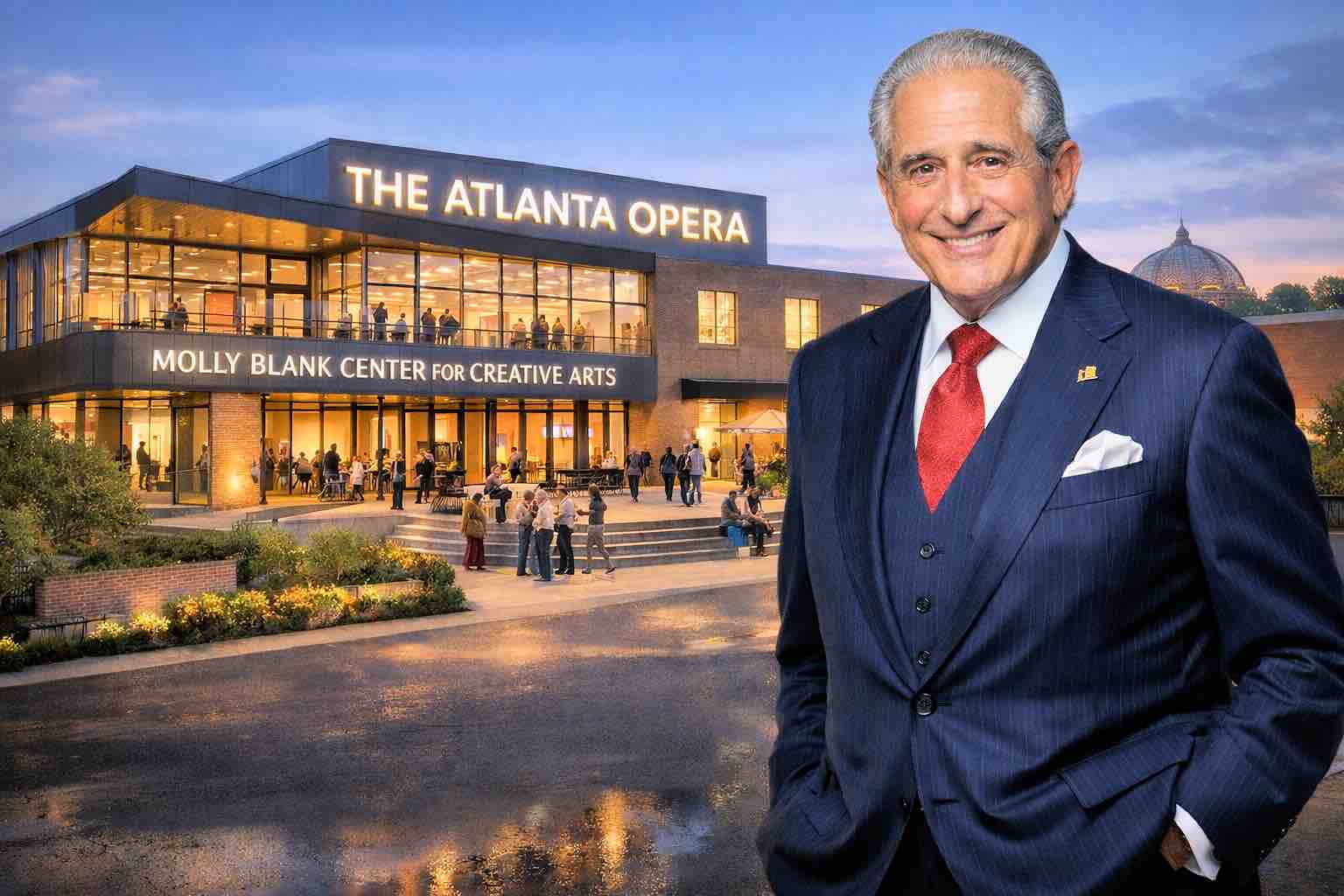
The Atlanta Opera has broken ground in Buckhead on the $64 million Molly Blank Center for Opera and the Arts, a new headquarters and creative campus that will be built around the historic 1941 Bobby Jones Golf Course clubhouse overlooking the fairways and the Atlanta BeltLine’s Northwest Connector Trail.
The project is being driven by a $110 million campaign anchored by a $27.5 million leadership gift from the Arthur M. Blank Family Foundation, which secured naming rights in honor of Blank’s mother, Molly, an artist whose passion for culture and social justice helped shape her son’s approach to business and giving. The gift, first announced in late 2024, allocates $25 million toward the capital development of the center and an additional $2.5 million to expand the opera’s Molly Blank Discoveries Series, which introduces opera to new and more diverse audiences.
For the company, which will continue mounting major productions at Cobb Energy Performing Arts Center, the new campus is designed as a working home—housing administrative offices, rehearsal studios, a theater, a 200‑seat recital hall, and education spaces—while preserving the clubhouse as a signature entry point that keeps Atlanta’s architectural history at the heart of its artistic future.
The Molly Blank Center is expected to open in 2027, positioning the Atlanta Opera as the first arts organization with a permanent headquarters directly on the BeltLine’s 22‑mile loop.
Within Atlanta’s arts ecosystem, the Blank Foundation’s role has been building steadily for years. The foundation’s “Art of Change” initiative has supported major cultural institutions, including the Woodruff Arts Center and the campaign to build a new hall for the Atlanta Symphony Orchestra, as part of a broader focus on enhancing quality of life through inspiring public spaces and the arts.
Through the dedicated Molly Blank Fund—created to carry forward Molly’s own philanthropic interests—the family has backed programs that blend culture, education, and community, from the Breman Museum’s Molly Blank Cultural Series to significant support for the Atlanta Opera’s earlier Discoveries Series, as well as arts education at the Musical Instrument Museum in Phoenix.
In that context, the $27.5 million investment in the new opera campus is both a capstone and an expansion: a bet that a permanent, multidisciplinary home can convert episodic arts engagement into a daily, neighborhood-defining presence on the BeltLine.
Blank’s philanthropy, however, has never been confined to culture.
Since founding the Arthur M. Blank Family Foundation in 1995, the Home Depot co‑founder and Atlanta Falcons owner has used it as a family platform to support youth development, education, health, the environment, and community revitalization, concentrating particularly on Georgia and, more recently, Montana.
Early grantmaking emphasized better beginnings for children, postsecondary access, green spaces, and sports and fitness, a portfolio that evolved into thematic pillars such as Fostering Opportunity and Enhancing Quality of Life.
More recently, the foundation has organized its work around priority areas including Atlanta’s Westside, democracy, the environment, mental health and well‑being, youth development, and founder initiatives like the Molly Blank Fund. Across these areas, the Blank family and their foundation have now granted more than $1 billion to charitable causes, a scale that reflects the transformation of a retail fortune into a long‑term civic engine.
Education—especially equity‑driven higher education—has emerged as a defining theme. In 2025, the foundation announced a $50 million, ten‑year commitment to fund scholarships for students at Atlanta’s four HBCUs: Clark Atlanta University, Morehouse College, Morris Brown College, and Spelman College.
Structured as “gap scholarships” to help students overcome financial hurdles that can derail degree completion, the program aims to support roughly 10,000 students and improve graduation rates, building on earlier gifts such as $10 million for Spelman’s innovation lab and $6 million to upgrade athletic fields at Clark Atlanta, Albany State, Miles College, and Savannah State.
The foundation’s higher‑education giving also extends beyond Georgia, with grants to institutions like Montana State University and programs like Reach Higher Montana, which links students to work‑based learning and postsecondary pathways, underscoring Blank’s focus on education as both individual opportunity and regional economic strategy.
The Molly Blank Center for Opera and the Arts draws a direct line back to the woman whose name it bears. Molly Blank was a philanthropist, artist, dancer, and advocate for social justice, and the Molly Blank Fund has intentionally followed her interests in at‑risk youth, arts and culture, Jewish causes, and interfaith coalitions, with a geographic emphasis on Arizona and Georgia.
Grants under her banner have ranged from pediatric care at National Jewish Health to early childhood literacy through PJ Library and support for vulnerable populations, particularly seniors and women and girls—always with an insistence, in her words, on “making it count” because “you only pass through life once.
” By placing her name on a new BeltLine‑side opera campus that fuses preserved architecture, green surroundings, rehearsal and performance space, and community‑facing education, Arthur Blank is effectively turning that credo into built form, ensuring that his mother’s love of the arts becomes a daily encounter for audiences who may never set foot in a traditional opera house.
In philanthropic terms, the Atlanta Opera gift is notable not just for its size but for its structure and symbolism.
As the lead commitment in a $110 million campaign, the $27.5 million grant de‑risks the capital project, signals confidence to other donors, and underwrites programmatic outreach through the Discoveries Series, linking bricks‑and‑mortar investment with audience development.
It also complements other Blank‑backed “inspiring spaces” initiatives—from park and trail projects like the Atlanta BeltLine to stadium and neighborhood work—that seek to make physical environments catalysts for health, creativity, and civic connection.
For Atlanta, the groundbreaking marks the moment when an NFL owner and retail entrepreneur cements his role as a long‑horizon arts patron; for the opera, it marks the start of a new era in which a mid‑sized American company claims both a prominent BeltLine address and a patron’s family story as part of its institutional identity.