
$20 million gift from Bob McCreary to university is the latest chapter in one man’s lifelong love story with his alma mater
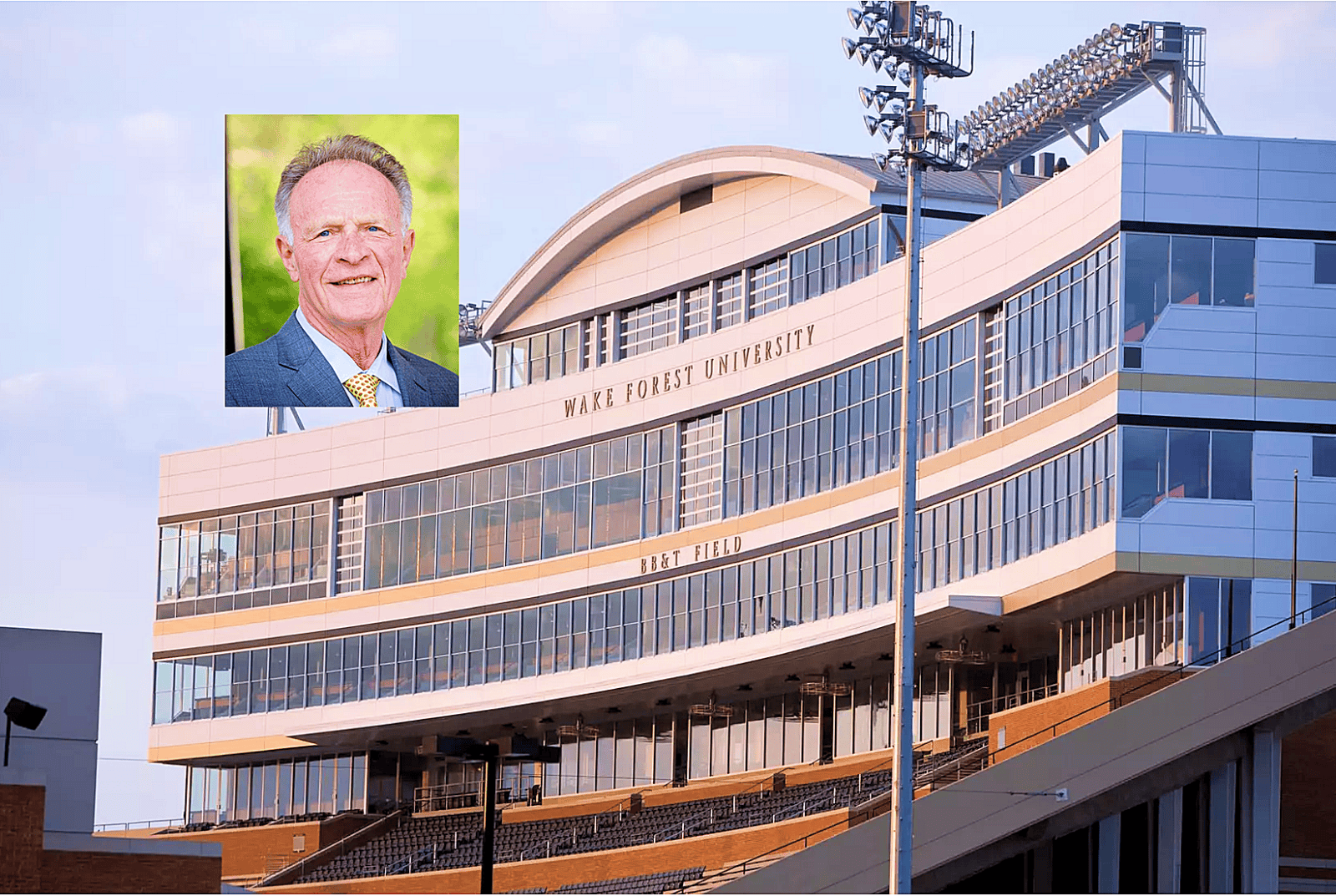
Wake Forest University’s latest landmark gift is also the latest chapter in one man’s lifelong love story with his alma mater.
On a December morning more than six decades after he first arrived on campus as a skinny football recruit from a factory town in western North Carolina, Bob McCreary – Class of 1961, furniture entrepreneur, and one of the most influential benefactors in Demon Deacon history – committed an additional $20 million to Wake Forest Football, a decision he describes not as generosity, but as gratitude.
The new pledge, directed toward 10 current-use football scholarships and a suite of football excellence initiatives, brings his total support for Wake Forest to more than $75 million and cements his role as the central philanthropic architect of the university’s modern athletics era.
McCreary’s journey to this moment traces back to those early days when an athletics scholarship opened doors that family finances alone never could have unlocked. He grew up in a blue-collar community where steady work, not college degrees, was the default, and it was football that carried him to Winston-Salem and into the classrooms and locker rooms that changed the trajectory of his life.
That personal history shapes every decision he makes as a donor: he is perpetually conscious that each scholarship awarded in his name could be the margin of difference for another young man trying to leap from small-town limits into a larger world.
His latest investment continues that theme with precision, underwriting 10 new current-use football scholarships that will immediately expand opportunities for student-athletes to earn a Wake Forest degree while competing at the highest level.
For McCreary, however, scholarships are only one part of a larger philosophy about what it takes to sustain excellence in contemporary college athletics.
His $20 million commitment is tightly integrated into the launch of the McCreary Triple Double Challenge: A $100 Million Initiative, a fundraising campaign that bears his name and reflects his conviction that Wake Forest must think and act at national scale.
By anchoring the effort with his own gift, he is effectively issuing a public challenge to the entire Demon Deacon community—alumni, parents, and fans—to match his belief in the program.
The Triple Double Challenge’s structure mirrors his worldview: $50 million for current-use scholarships across all sports to secure access and opportunity, and $50 million for sport excellence funds to power the less visible, but decisive, engines of competitive success such as coaching, recruiting, sports performance, mental health, nutrition, technology, and leadership development.
McCreary understands that in the new revenue-sharing era of college athletics, sentiment alone will not keep Wake Forest competitive; serious financial commitments will.
That pragmatic realism does not dim his loyalty; it sharpens it. Wake Forest had already made a significant up-front investment to prepare for the changing economics of college sports, a move that helped catalyze $45 million in new gifts for scholarships and excellence funds since mid-2024. McCreary’s new $20 million gift lifts total support for the Triple Double Challenge to $65 million and resets the horizon: he is now personally calling on Deacon Nation to help close the remaining $35 million gap by December 31, 2026.
In his public remarks, he framed the moment as a test of collective will, stressing that under head coach Jake Dickert the football program has “rediscovered its edge, its belief, and its identity,” and that it is now incumbent on those who love Wake Forest to ensure the team has the resources to compete for championships.
That sentiment is as much a rallying cry as it is a donor statement, reflecting the way McCreary blends personal conviction with public leadership.
This latest gift is also carefully timed to align with the program’s on-field momentum, a synergy McCreary appreciates as both a former player and a seasoned businessman.
Under Dickert’s leadership in 2025, Wake Forest reclaimed the national spotlight with an eight-win season, the fifth time in nine years the Deacons have reached that benchmark, placing them in select company within the ACC. Signature wins—a road upset of No. 12 Virginia, the Cavaliers’ lone home loss of the year, and a victory that snapped SMU’s 20-game regular-season conference winning streak—have revived belief among players and fans alike.
Add in the largest and highest-rated signing class in program history, secured on National Signing Day with 30 future Deacs, and the picture is one of a program on the rise. McCreary has watched that ascent up close, attending sellout games at Allegacy Federal Credit Union Stadium where student attendance routinely approaches 80 percent of the undergraduate population; for him, these scenes confirm that the emotional and competitive foundation is in place and ready to be matched by long-term financial backing.
The architecture of modern Wake Forest Athletics, in fact, is already inseparable from McCreary’s name. Over the past decade, as the university executed a fully fundraised $180 million facilities transformation from 2013 to 2023, his leadership and resources played an outsized role at nearly every turn.
The McCreary Football Field House, the McCreary Football Complex, and the McCreary Tower at Allegacy Federal Credit Union Stadium anchor the physical footprint of Demon Deacon Football. Adjacent world-class facilities such as the Sutton Sports Performance Center and Shah Basketball Complex, while bearing other names, are part of the same era of expansion that his philanthropy helped ignite.
Even details like McCreary Plaza and the Bob McCreary Videoboard Honoring the Class of 1961 reinforce how deeply his presence is woven into the game-day and everyday experience of Wake Forest athletes and fans.
With the infrastructure phase largely complete, McCreary has turned his focus to what he calls the “lifeblood” of Athletics: the student-athletes, coaches, and staff whose daily work defines the school’s competitive spirit and its Pro Humanitate mission.
Those who work alongside him emphasize that the dollars are only one aspect of his influence. Wake Forest President Susan R. Wente describes McCreary as a figure whose life story—arriving as a scholarship student-athlete and evolving into one of the university’s most consequential benefactors—embodies the promise of the institution itself.
In her view, this new gift does more than fund scholarships or staff positions; it “fortifies” the university’s broader commitment to excellence by reinforcing the foundation on which student-athletes, coaches, and the wider campus community depend.
Head Football Coach Jake Dickert echoes that sentiment from within the locker room, noting that McCreary’s investment is “personal” and rooted in a deep belief in the young men who wear the Wake Forest uniform.
For Dickert and his staff, the McCreary gift is as much about validation as it is about budgets: it signals that one of the university’s most trusted voices believes fully in their vision and is willing to stake his name and resources on its success.
John Currie, Vice President and Director of Athletics, places McCreary’s impact in a generational frame. He credits McCreary’s “sacrificial financial support” with resetting expectations for what is possible at Wake Forest in the 21st century and with inspiring thousands of other donors to step forward, both with their own contributions and their visible presence in the stands.
Currie points to moments such as McCreary’s appearance in the locker room after the Deacons’ dominant win over North Carolina before a sellout crowd—images that circulated widely on social media—as emblematic of how he functions as both benefactor and emotional touchstone. In Currie’s telling, this newest gift will accelerate the momentum Dickert and his staff have already created, deepen the program’s recruiting and development capacity, and position Wake Forest for sustained excellence in an increasingly competitive landscape.
For a department celebrating the 75th anniversary of the Deacon Club, the official fundraising arm of Wake Forest Athletics, there is symbolism in having its most visible modern champion leading the charge.
Behind the public announcements and stadium signage, there is also a deeply personal dimension to McCreary’s philanthropy, particularly in the wake of the loss of his wife and business partner, Michele Acosta McCreary.
Together, the couple built McCreary Modern, the furniture company whose success underwrote their giving and allowed Michele to pursue what friends say she loved most: caring for others and quietly supporting the communities that mattered to her, especially Wake Forest Athletics.
Her unexpected passing in August 2024 left a profound void. In response, Bob created the Michele Acosta McCreary Baseball Scholarship, a $1 million fund providing two scholarships per year for Demon Deacon baseball players over five years—a tribute that blends Michele’s lifelong affection for baseball with her instinct to lift people up.
That act of remembrance sits alongside his new football commitment as part of a coherent legacy: a family story in which business success is converted, almost reflexively, into opportunity for young people wearing black and gold.
In the end, what distinguishes Bob McCreary’s latest $20 million gift is not only its scale but its clarity of intent. It is a pledge from a man who once needed an athletics scholarship to change his own prospects, now determined to ensure that future generations of student-athletes inherit a Wake Forest that is stronger, more competitive, and more faithful to its Pro Humanitate ideals than the one he joined in 1957.
He has already helped build the buildings, name the towers, and transform the skyline of Wake Forest Athletics. With the McCreary Triple Double Challenge, he is turning his attention to something less visible but more enduring: the people and programs that will define what Demon Deacon Football—and Wake Forest University—become in the next era.
His message to Deacon Nation is simple and urgent: the university gave him a chance that changed everything, and now is the time for everyone who shares that story to step forward and do the same.