
$20 million donation from Susan and Tandean Rustandy helps carry UChicago Medicine’s cancer pavilion to the finish line
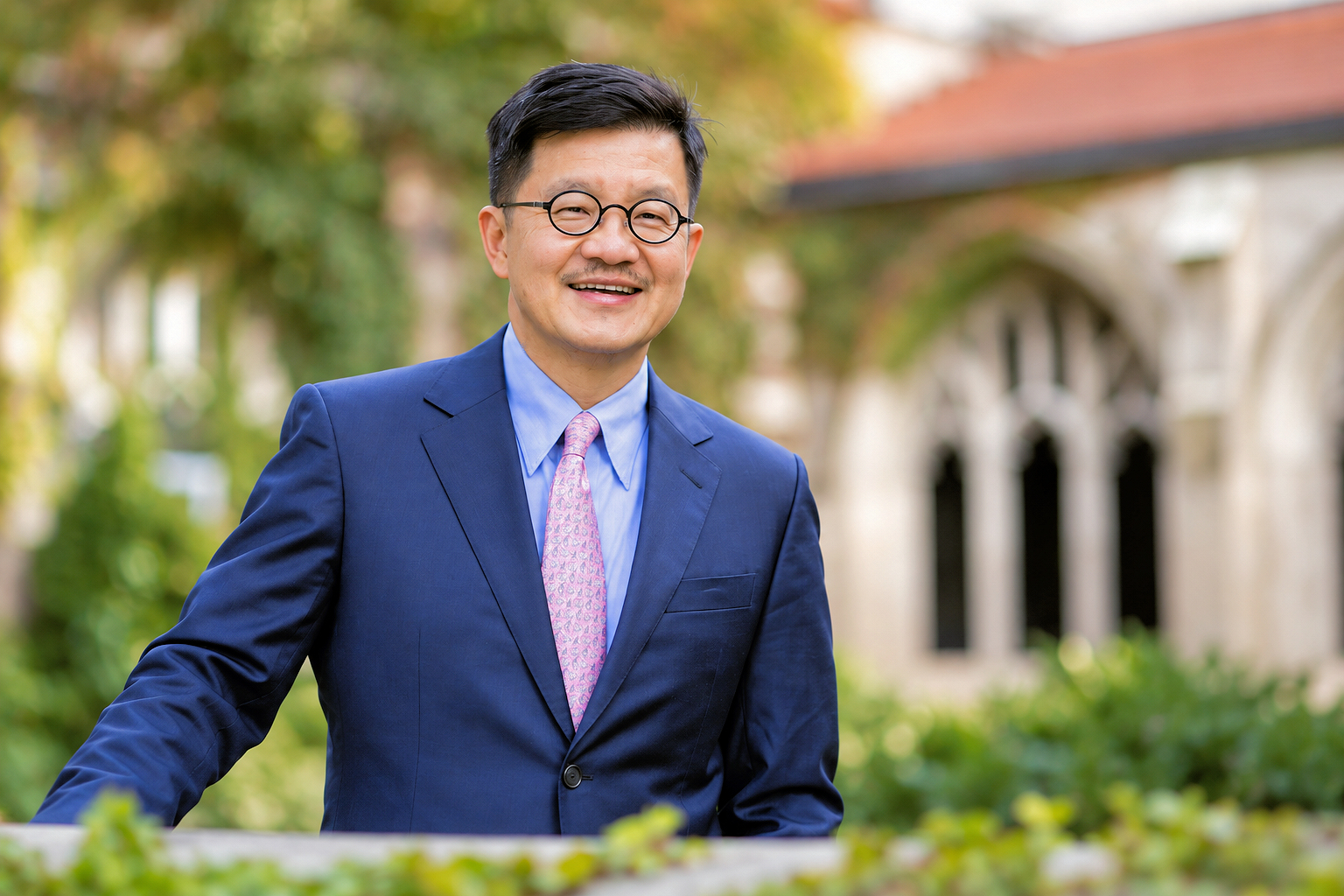
When Tandean Rustandy talks about cancer, he starts with the numbers and then with the people behind them.
“These statistics are a stark reminder of the importance of advancing research and treatment options to make a tangible difference in the lives of patients and their families,” he said when he and his wife, Susan, gave $20 million toward a new cancer hospital on Chicago’s South Side. The building they helped fund now stands finished.
On September 24, the University of Chicago Medicine finished construction on the AbbVie Foundation Cancer Pavilion.
It is a seven-story, 575,000-square-foot building on the Hyde Park campus and the first freestanding hospital in Illinois devoted only to cancer care and research. Community advisers, construction partners and health-system leaders gathered as Turner Construction formally handed over the building and the monument bearing its name was unveiled. The $815 million project now moves into its last stretch: months of outfitting clinical spaces, testing systems and training staff before patients arrive in April 2027.
The building takes its name from the AbbVie Foundation, the philanthropic arm of the drugmaker, whose $75 million donation in 2024 is the project’s largest gift.
The largest gift from individuals came earlier.
Just three months after the groundbreaking, the Rustandys committed $20 million. It was the first major philanthropic signal that the pavilion would be built with community support as well as institutional will.
For the couple, the gift continued a long relationship with the university. Tandean Rustandy is the founder and chief executive of PT Arwana Citramulia Tbk, a publicly traded maker of ceramic floor and wall tiles based in Indonesia. He earned his MBA at Chicago Booth in 2007 and now serves as a trustee of both the University of Chicago and the University of Chicago Medical Center.
The Rustandys have supported the college, the Divinity School, and Booth, where the Rustandy Center for Social Sector Innovation opened in 2013 as a permanent home for social-impact work.
In 2014, they created the Tandean Rustandy Fund for Fundamental Cancer Research in the university’s Biological Sciences Division. That made the pavilion gift a natural next step, from funding discovery to building the place where discovery reaches patients.
“Susan and I are honored to contribute to the University of Chicago’s mission and initiatives to pursue globally impactful solutions to seemingly unsolvable challenges,” he said at the time.
“We believe in the power of collaborative efforts to effect transformative change, and the new cancer pavilion holds immense potential to impact not only the local community but also the broader landscape of patient care globally.”
Both parts of that hope, local and global, are built into the pavilion. On Chicago’s South Side, cancer death rates are nearly twice the national average, and new cases are projected to rise 19 percent by 2035, more than twice the expected rate for the rest of the Chicago area.
The building will bring specialists, advanced diagnostics, treatment, clinical trials, patient navigation, supportive services and survivorship care together under one roof. It will have 80 private inpatient beds. At full capacity, it is expected to handle about 200,000 outpatient visits and 5,000 admissions a year.
The Rustandys’ gift was also meant to speed up the science. It supports more than 200 clinicians, physician-scientists, and researchers who will work side by side on new cellular therapies and radiotheranostics, which target cancer cells while sparing healthy tissue.
The building is also meant to anchor newer fields such as cancer metabolomics and AI-assisted diagnosis. “We are building a cancer program of the future,” said Kunle Odunsi, director of the UChicago Medicine Comprehensive Cancer Center, which has held the National Cancer Institute’s top “comprehensive” designation since 2008. It is one of only two such centers in Illinois.
The pavilion has also attracted other support.
More than $133 million has been raised for it, and in January the Ralph Lauren Corporate Foundation granted funds to create the UChicago Medicine Ralph Lauren Center.
But the earliest large commitment came from a couple who had already spent years backing the university’s cancer research.
As the scaffolding comes down and the building prepares its first patients, their gift reads less like a single donation and more like a promise kept.