
$155 million gift from Mike Bloomberg creates the William and Charlotte Bloomberg Public Science Commons at Museum of Science- raises his philanthropic giving to more than $26 billion
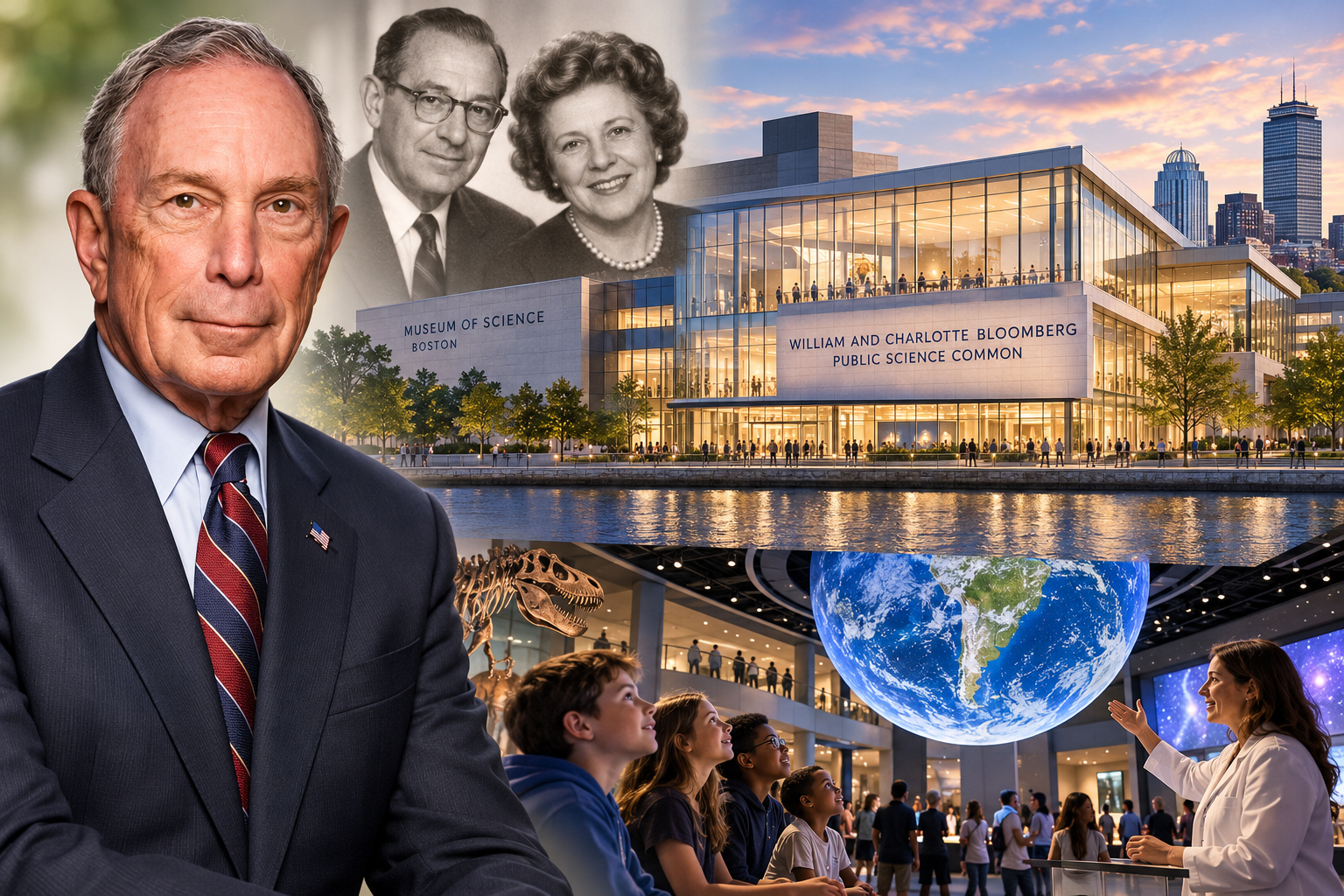
Michael Bloomberg’s gift to Boston’s Museum of Science began, as such things often do, with a memory from childhood.
He has said he can still picture standing in front of a 2,000-year-old giant sequoia there, running his finger along its rings, and feeling the shape of his own curiosity start to form.
His parents, William and Charlotte Bloomberg, raised their children in nearby Medford and made a habit of ferrying Michael and his sister Marjorie Tiven across the Charles River whenever they could to visit the museum.
It became, in Bloomberg’s own telling, one of the formative places of his childhood.
Six decades later, that memory has become the largest gift in the museum’s history.
Recently, the Museum of Science, Boston, announced that Bloomberg Philanthropies had committed $155 million to build the William and Charlotte Bloomberg Public Science Common, a 10,000-square-foot civic gathering space named for the two people who first walked him through those halls.
The new wing is slated to open to the public on October 10, 2026, with a celebratory event to follow on October 28—one that Bloomberg himself is expected to attend.
The scale of the gift had been an open secret for years before the number became public.
In May 2024, the Boston Globe reported that the museum was undertaking an ambitious renovation of its aging Cahners Theater, funded by what the museum’s president, Tim Ritchie, would only describe as “a large, undisclosed donation” from Bloomberg Philanthropies—one he confirmed, without citing figures, had already surpassed the foundation’s previous record gift to the institution.
It took more than two years of construction, and a fair amount of Boston curiosity, before the full $155 million figure and the tribute to his parents were finally confirmed.
What’s rising along the Charles River is not simply a bigger room.
Designed by William Rawn Associates—the firm behind Tanglewood’s Seiji Ozawa Hall and the transformation of the Boston Public Library’s Central Library—and built by Consigli Construction, the space tears out the theater’s old windowless brick walls in favor of floor-to-ceiling glass, opening onto 270-degree views of the Boston and Cambridge skylines.
Inside, movable walls, retractable seating, and an immersive media system capable of 3D projection mapping let the room morph in minutes: an intimate roundtable for a dozen researchers by morning, a school program by afternoon, and a full-scale public event with a live stage by night.
The museum has described it, without much modesty, as “the world’s stage for science.”
Its opening programming will lean into the questions people are actually anxious and curious about right now—artificial intelligence, climate change, public health, space exploration—staged as live conversations between scientists and the public rather than static exhibits behind glass.
This is, notably, the second time Bloomberg has put his parents’ names on a piece of this museum.
In October 2016, Bloomberg Philanthropies gave $50 million—then the largest gift in the institution’s 186-year history—to endow the museum’s education division as the William and Charlotte Bloomberg Science Education Center.
That earlier gift helped fund computational-thinking and food-science curricula and secured the long-term stability of the museum’s education programs.
The foundation has also previously funded the renovation of the museum’s Charles Hayden Planetarium and various access and internship programs, making the Public Science Common at least the fourth distinct Bloomberg investment in this one institution over roughly fifteen years.
Set against Bloomberg’s broader giving, though, even $155 million is a comparatively modest line item.
Bloomberg has now given away roughly $26 billion to charitable causes over his lifetime.
In 2025 alone, he gave away $4.3 billion, making him, for a third consecutive year, America’s most generous individual donor, according to the Philanthropy 50 ranking.
His single largest beneficiary remains his alma mater, Johns Hopkins University, which has now received more than $4.55 billion from him over the years, reportedly making him the most generous living donor to any educational institution in the United States.
He has said publicly that he has never understood the impulse to wait until death to give money away, preferring to see the impact of his gifts while he’s still alive to watch it unfold.
Measured against that river of billions, the Public Science Common reads less like a headline gift and more like something closer to the heart—a museum he loved as a boy, a wing built in glass and light, carrying his parents’ names into a room where strangers will gather to argue about the future.
It is the kind of giving that doesn’t move markets, but, by Bloomberg’s own account, it’s the kind that started everything else.