
$105 million for Yellowstone: Sean Klimczak, Crystal Heter and Lisa Diekmann build a permanent fund for America’s first national park
It started with a visit.
Sean Klimczak came to Yellowstone National Park last summer, and he didn’t leave as just another traveler who’d seen Old Faithful.
Klimczak runs Blackstone’s global infrastructure business, which owns Tallgrass, an energy company with deep roots in Wyoming.
He left the park with a question: what could a company with a stake in the state do for it?
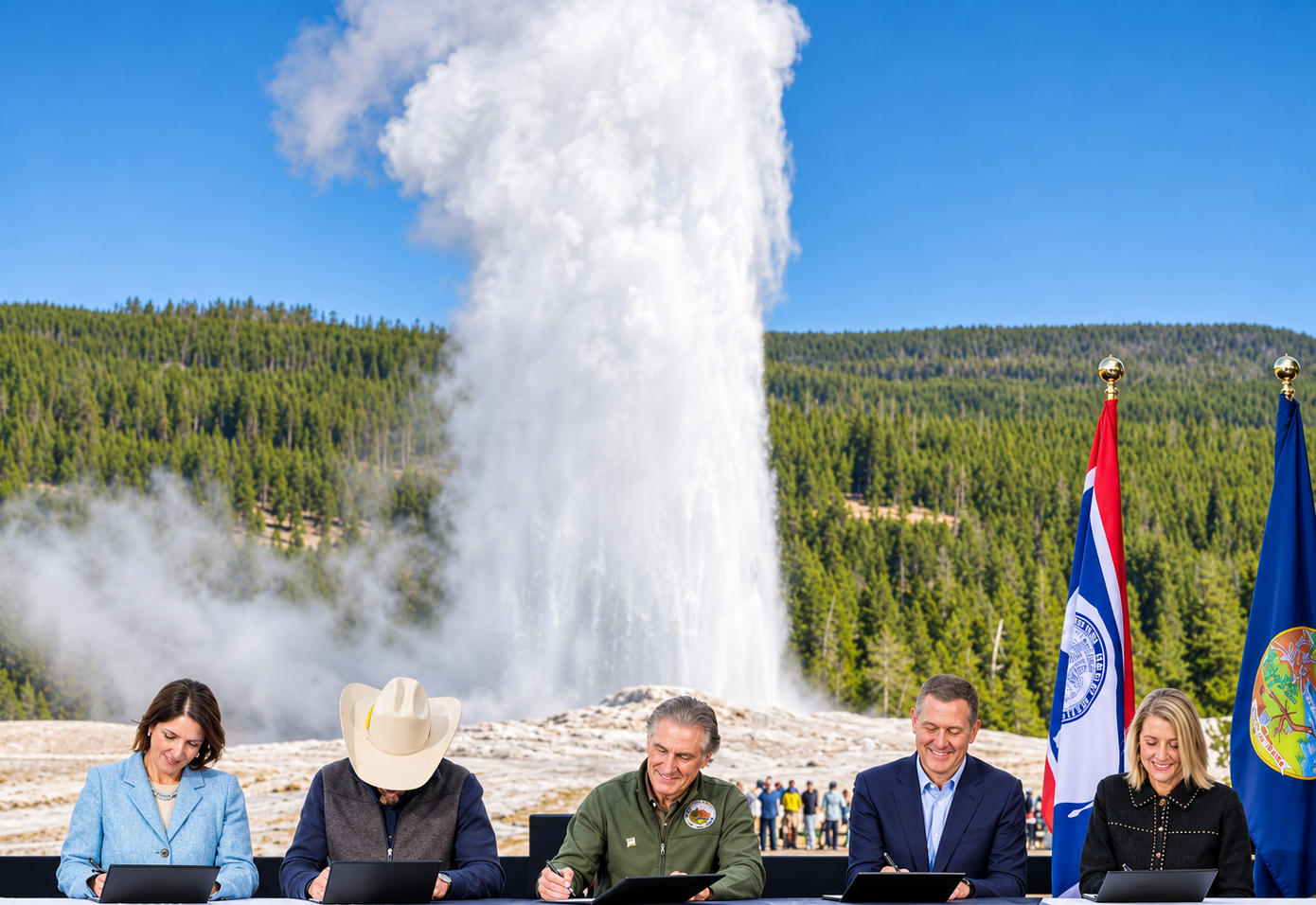
More than a year later, he joined a small group inside the Old Faithful Inn, beneath its timbered balconies and towering stone chimney, to sign an agreement creating the largest single private gift in the history of the National Park Service.
The gift is a $105 million Conservation and Stewardship Fund, a permanent source of support for the world’s first national park. It is funded by Tallgrass, the Blackstone Infrastructure portfolio company, and administered by Yellowstone Forever, the park’s official nonprofit partner.
The National Park Service keeps full authority over how the park is managed. Around that table sat the people whose work made it happen: Klimczak; Crystal Heter, Tallgrass’s president and chief executive; Lisa Diekmann, president and CEO of Yellowstone Forever; Wyoming Governor Mark Gordon; and Interior Secretary Doug Burgum.
The fund’s shape tells you who it is for. Roughly $50 million is set aside for conservation and research, extending the reach of the park’s scientific work.
About $35 million is planned for a new visitor-education center at Norris Geyser Basin, Yellowstone’s hottest, oldest, and most restless thermal area. The remaining $20 million will build a long-term endowment, the Tallgrass Yellowstone Initiative, to bring Wyoming students, families, and community members into a park that sits, quite literally, in their own state’s backyard.
Few people have a longer history with Yellowstone’s philanthropy than Diekmann. A Yale graduate who also earned a master’s degree from the Yale School of Forestry and Environmental Studies, she started out at Goldman Sachs and later worked for the United Nations Environment Program.
In 1996 she moved to Bozeman, Montana, to become the founding executive director of the Yellowstone Park Foundation, the small philanthropic organization that would later become part of Yellowstone Forever.
She left in 2007 to raise money for The Wilderness Society, then led development for the Bridger Ski Foundation.
She came back to lead Yellowstone Forever in the summer of 2020, returning to the park she had helped give a philanthropic voice decades earlier.
She has called the new fund “a transformational investment in Yellowstone National Park,” and she speaks about it with the steadiness of someone who has spent thirty years asking people to love a place enough to give to it.
“It gives us the ability to meet urgent needs today while building enduring support for the research, education, stewardship, and visitor infrastructure that will protect this park for generations to come,” she said.
She says the conversation with Tallgrass began after Klimczak’s visit and took more than a year to come together. She also makes clear that size doesn’t change the principle.
“Being consistent with our mission is absolutely paramount,” she said, “whether it’s thirty-five dollars, thirty-five million dollars, or one-hundred-and-five million dollars.”
Klimczak’s own story starts far from the geysers. According to his résumé, he paid his own way through the University of Notre Dame and graduated summa cum laude in finance and business economics.
He went on to Harvard Business School, finishing with the highest academic standing in his class as a Baker Scholar.
He worked in mergers and acquisitions at Morgan Stanley and at the private equity firm Madison Dearborn Partners before joining Blackstone in 2005.
There he helped launch the firm’s energy-transition business and, in 2017, founded Blackstone Infrastructure, which he still leads. He also serves as president of The Blackstone Charitable Foundation.
His reflection on Yellowstone was notably modest for a man who oversees some of the largest infrastructure investments in the world.
“Yellowstone is one of America’s great natural treasures, and we feel a profound sense of responsibility to protect it for future generations,” he said.
“This historic gift reflects our belief that infrastructure investment can and should be a force for good, helping us invest in Yellowstone’s future and the growth of the communities that surround it.”
If Klimczak supplied the spark, Heter supplied the connection to Wyoming. She has been with Tallgrass since its founding in 2012 and became chief executive this spring, taking the helm of a company with more than 10,000 miles of pipelines across 14 states, about 3,000 of them in Wyoming.
A chemical engineering graduate of the Colorado School of Mines, she began her career doing mapping and drafting at KN Energy, a predecessor of Kinder Morgan.
From there she moved through risk and project management into the commercial side of the business, eventually running the Rockies Express Pipeline and then serving as Tallgrass’s chief operating officer.
Looking back on that path, she once said with real candor that while she could build pipelines and design compressor stations, she hadn’t yet understood how the company made money doing it, so she asked to learn. That curiosity carried her to the top.
“Wyoming has been part of the Tallgrass story from the beginning, and Yellowstone captures something timeless about the spirit of this state,” Heter said.
“We’re proud to do our part to preserve what makes Yellowstone so extraordinary and to strengthen its connection with the next generation.”
That next generation is the heart of the WYld initiative, and it’s the part of the gift Governor Gordon talks about most warmly.
Ninety-three percent of Yellowstone lies within Wyoming, yet, as he noted, surprisingly few of the state’s schoolchildren really know the place.
Wyoming families who love the outdoors already have favorite mountains, the Wind Rivers or the Absarokas, and Yellowstone can feel like somewhere tourists go.
The governor sees the gift as a way to change that, teaching young people about wildlife migration and how the park connects to the rest of the state.
“Programmed money for kids all through Wyoming to learn more about Yellowstone,” he said, “which means learning a lot more about wildlife migration, looking a lot more about how precious Wyoming is. And all of that is good.”
Steven Davidson, Tallgrass’s senior vice president of government and public affairs, put it more bluntly.
“If you are a Wyoming kid, family, we are going to target these programs for you,” he said. “Let’s be proud and selfish for Wyoming kids.”
He described the gift as an effort to be “a force for good outside of the city and county lines,” following the company’s earlier support for the University of Wyoming. Its reach goes beyond one state, too.
“Very few places offer what Yellowstone does,” he said. “It also has this really outsized impact on three different states’ economies.”
The first big project will be at Norris, where visitors walk boardwalks above steaming vents and acidic pools as the ground hisses and shifts around them.
The basin draws millions of people a year, but its main interpretive space is still a small, historic log cabin. “There’s no place for you to sit and engage with a ranger directly,” Davidson said. Diekmann was direct about it: “The existing infrastructure at Norris is inadequate for current demand. This investment will transform Norris into a safer, more functional, educational, and visitor-friendly destination.”
Yellowstone has not opened a new visitor center since the Old Faithful Visitor Education Center in 2010. Like any construction in a national park, the Norris project will go through full federal environmental review.
Beyond Norris, Diekmann has described the kinds of work the research and conservation dollars might support: protecting wildlife and fisheries, watersheds and the park’s fragile geothermal systems; buying scientific equipment; building research partnerships; and funding internships and fellowships for the next generation of park scientists.
The need is real. The Park Service estimates Yellowstone’s deferred maintenance and repair needs at about $1.2 billion, across buildings, trails, campgrounds, roads and water systems.
The park is also in a leadership transition, with Barclay Trimble serving as acting superintendent after Cam Sholly’s eight-year tenure.
A corporate gift this large naturally raises questions about what the donor expects in return, and the agreement answers them through its structure.
Yellowstone Forever administers the fund. The Park Service keeps final say over park decisions, and every project must follow federal law, policy and park priorities. Davidson has said Tallgrass will have “no involvement” in how the money is spent.
“They know what we’ve given the dollars for,” he said. “They have a very capable board and leadership team, and it’s their responsibility to go out and put the funds to use.” Dan Wenk, who served as Yellowstone’s superintendent from 2011 to 2019, said the Park Service’s vetting process exists for exactly this reason and that the agency does not accept gifts tied to a quid pro quo.
“It’s a very generous donation,” he said. “It certainly exceeds, by many times, the largest previous donations to Yellowstone National Park.”
Gordon, who has spent his life in a state where ranching, energy and wild country exist side by side, framed the partnership in Theodore Roosevelt’s terms.
He noted that private enterprise “has always been involved in our parks.” Secretary Burgum also reached back to Roosevelt, who laid the cornerstone of the stone arch at the park’s northern gateway more than 120 years ago, with the promise carved into it that the park exists “for the benefit and enjoyment of the people.”
Burgum called the gift a chance to “inspire the next generation to experience America’s great outdoors.”
Details on how the money will be distributed are expected in the coming weeks, but the core of it is already clear.
A Wall Street dealmaker visited Yellowstone and came away feeling responsible for it. A pipeline engineer who rose from drafting maps to running the company decided the park was worth a permanent commitment.
And a fundraiser who came to Bozeman three decades ago to build Yellowstone’s first philanthropic foundation now holds the largest gift the National Park Service has ever received.
Somewhere in Wyoming, a fourth-grader who has never seen Grand Prismatic Spring or heard the ground breathe at Norris will get that chance, and the fund is built to keep giving it to kids who aren’t born yet.