$100 million in latest gifts for cancer research follows her hundreds of millions given to causes and a pledge to give it all away- Philanthropist Lyda Hill receives 2026 Pride of Texas Award
Lyda Hill’s favorite color is orange. It’s on her business cards, and on the back of each card is the phrase she has lived by for almost 50 years: “Science is the answer.”
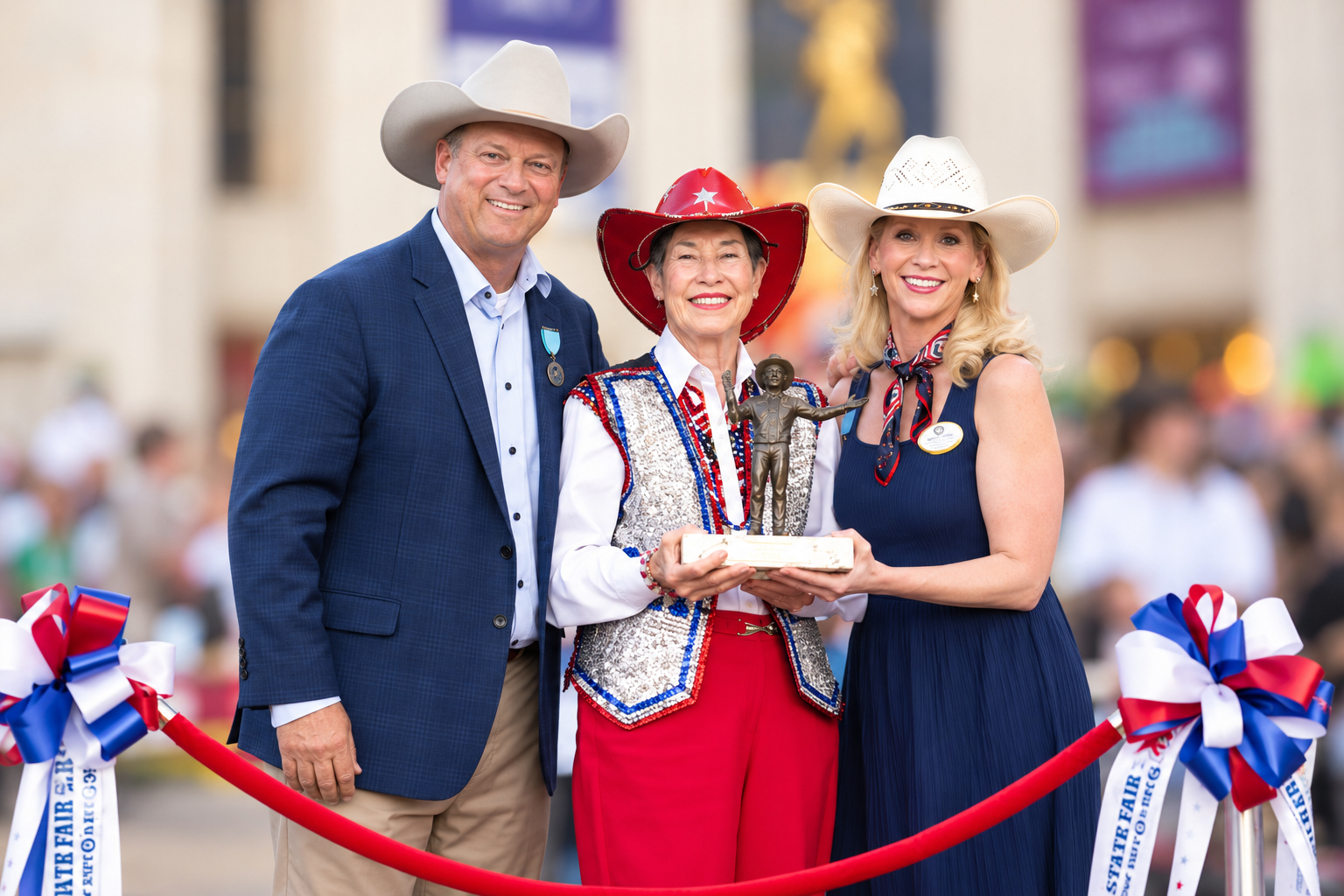
So it fit that the State Fair of Texas, known for its bright colors and Texas pride, opened its 2026 season by honoring her. On the steps of the Hall of State at Fair Park, the Dallas-born entrepreneur and philanthropist received the 2026 Pride of Texas Award.
The fair created the honor in 2014 for Texans who show resilience, loyalty, generosity, and selflessness.
“Lyda has shown us that being a great Texan is about more than success. It is about leaving Texas better than you found it,” said Karissa Condoianis, the fair’s senior vice president of public relations, as she announced the award.
State Fair President Mitchell Glieber, who presented it, called Hill’s life’s work “an enduring inspiration, proving that through commitment and generosity we can build a brighter future for all Texans.”
Hill was born in 1942, weighing six pounds, and was named for her grandmother, the wife of oilman H.L. Hunt. Her mother, Margaret Hunt Hill, was H.L. Hunt’s eldest daughter and a devoted philanthropist. She had Lyda volunteering so early that Lyda jokes she was “volun-told,” and she didn’t learn until later that volunteering was optional.
Her father, Al Hill, built Seven Falls in Colorado Springs into a tourist attraction. When he found that the stairway there had no viewing platform, he built one from leftover oil-field pipe, placed exactly where visitors could see all seven waterfalls at once.
Lyda worked summers in the lunchroom there and later in the gift shop. She has called her father the biggest influence on her life and says she got her “vision” gene from him.
She put that vision to work in 1967. In her mid-20s, she watched Braniff Airways turn Dallas into a travel hub, saw business travelers pouring through the city, and founded Hill World Travel. It became the largest travel agency in Dallas, and she became one of the first women in the Young Presidents’ Organization.
After selling the company in 1982, she created the Volunteer Connection. The program spread across the country, and President Ronald Reagan appointed her to a national advisory council on private-sector initiatives. With developer Holt Hickman, she also helped revive the Fort Worth Stockyards, which she called “real Texas, not Southfork.”
She calls herself a serial entrepreneur and describes this chapter of her life with a word of her own: “philentrepreneur.”
In 1979, in her mid-30s, Hill was diagnosed with breast cancer.
She recovered, but cancer has taken many members of her family, and the fight became central to her life. She founded the Oklahoma Breast Care Center in an area with few medical resources.
Since then she has given more than $100 million to cancer causes, including more than $60 million to MD Anderson Cancer Center in Houston.
Her $50 million gift to its Moon Shots Program in 2013 was the largest private gift to the program at the time, and the Lyda Hill Cancer Prevention Center now carries her name. “We have many, many supporters,” MD Anderson President Peter Pisters has said, “but I don’t think that we have anyone who’s been so committed to our mission over such a long period of time.”
Beyond her grants, she has invested more than $400 million in cancer-focused companies and funds.
One of those was an early bet on Reata Pharmaceuticals, which started at UT Southwestern and Biogen bought for $7.3 billion.
Her mark is all over Dallas medicine. She has given more than $60 million to UT Southwestern, where her name is on the Department of Bioinformatics and on the deanship of the new School of Public Health. She was a cofounding donor of the Meadows Mental Health Policy Institute, with more than $35 million in support.
She has also backed brain-health training for Dallas police officers, launched after five officers were killed in the line of duty on July 7, 2016. And with a nephew serving as an Air Force pilot, she gave $2 million to help veterans recover from brain injuries suffered in war.
In 2010, Hill signed the Giving Pledge and promised to give away her entire estate. “I want the last check to bounce,” she says. Her nieces and nephews know not to expect an inheritance, because she believes the better gift is a better world.
She took to heart Warren Buffett’s advice: don’t do what other donors can and will do, do what they can’t and won’t. She describes her own approach as a mix of “big bets” and “sure bets.”
Her philanthropy has now supported more than 1,180 grantees through more than 5,500 gifts, including more than 600 gifts to 384 organizations in 2025 alone. One December, she mailed $110,000 checks to 20 Dallas nonprofits.
Her curiosity has also shaped science. After hearing paleoanthropologist Lee Berger speak about his work in South Africa’s Rising Star caves, she asked him what he needed.
Her $5 million gift to the National Geographic Society helped him find Homo naledi, a newly identified human relative. Casts of four small skulls now sit in her office next to the 2015 National Geographic cover that announced the discovery: “Almost Human.” In 2024, scientists near Colorado Springs named an ancient ancestor of hoofed mammals, Militocodon lydae, in her honor.
She has given $50 million to The Pew Charitable Trusts for national parks and ocean conservation. She also gave more than $50 million to the Perot Museum of Nature and Science, lent it much of her own gem and mineral collection, and persuaded other Dallas collectors to do the same. “She wants to be at that front edge,” says museum CEO Linda Silver, “and she hopes that people will then come in behind her.”
That same front-edge thinking led to IF/THEN, the initiative she cofounded in 2019 with Nicole Small, who now leads her philanthropy and investment office.
More than $75 million in funding has produced 120 life-size orange statues of real women scientists and engineers, the largest group of statues of real women ever assembled. About 4 million people have seen them. This summer, a new series of green statues of women whose innovations are changing sports debuted at the FIFA Fan Festival in Dallas.
Her giving also reaches everyday life across Texas. A study she funded found that Texas produces more than 350 million pounds of surplus produce each year, and that food banks were collecting less than a fifth of it. She then helped build a system that gets more fresh fruits and vegetables to families who need them.
She has given more than $45 million to Dallas parks, including Klyde Warren Park, and helped turn hot, treeless schoolyards into shaded community parks that neighbors can use after the school day ends. She gave $1.7 million for a Girl Scouts Dream Lab in South Dallas and $20 million to her alma mater, Hockaday. “She is investing in her own city,” says Molly Morgan of the Trust for Public Land, “not from a distance but from the ground up.” In Hill’s own folksy words: “Do your givin’ while you’re livin’.”
When she noticed young Dallas talent leaving for Boston and San Francisco, she helped turn the old Zale Corporation headquarters into Pegasus Park. The 26-acre campus now houses dozens of life sciences companies, 35 nonprofits and a national hub of the federal health research agency ARPA-H. Its shared lab space was expected to take five years to fill and filled in 15 months. “She doesn’t just write checks,” says Julie Diaz of The Dallas Foundation. “She shapes ecosystems.”
In Colorado Springs, the view of Pikes Peak framed by the red rocks of Garden of the Gods moved her enough that she built a visitor center there. She wanted “everyone to enjoy the view that we have from our homes,” and the center’s earnings still help pay for the park’s upkeep. Her $8 million gift also created the Lyda Hill Institute for Human Resilience at the University of Colorado Colorado Springs, whose methods are now used in 32 countries.
This year she has been as busy as ever. Her new Learning Voyages program is sending more than 48,000 Dallas ISD students on field trips to the zoo, the arboretum, and the Perot Museum.
Her Hill Prizes for Texas researchers added a category for artificial intelligence. And this week, MassChallenge named Dallas its second U.S. headquarters. The Pride of Texas Award adds to her 2022 Carnegie Medal of Philanthropy and her place on this year’s TIME100 Philanthropy list.
Asked about her favorite chocolate, she says she doesn’t have one brand; she just likes “maximum dark.”
Asked about her life’s work, she quotes Walt Disney: “It’s kind of fun to do the impossible.”
Then she adds her own line: “The more I do for others, the happier I am.”