
$100 million gift from Rob and Karen Hale to children’s hospital will build a new pediatric psychiatric hospital and will embed mental health across every corner of pediatric care
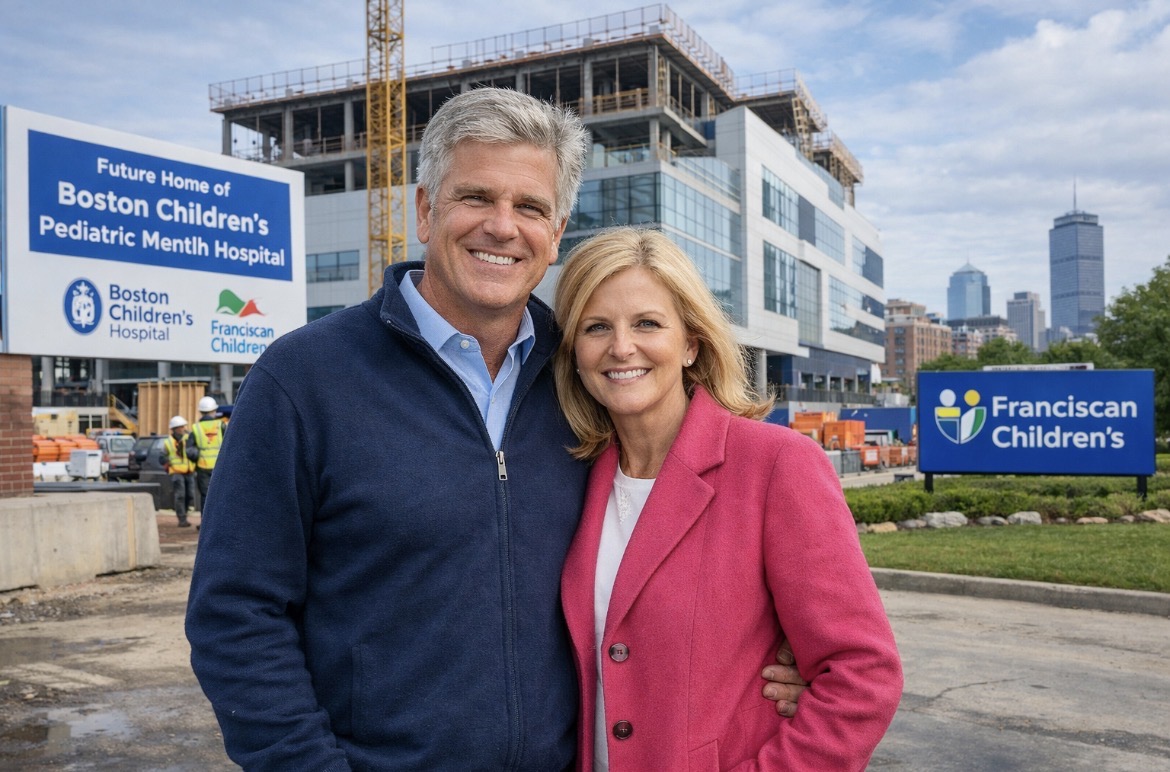
Rob and Karen Hale are the donors behind the $100 million gift powering Boston Children’s Hospital’s $640 million plan to build a new pediatric psychiatric hospital on the Franciscan Children’s campus in Brighton and to embed mental health across every corner of pediatric care.
Boston — In a move that reshapes both the skyline of pediatric care in Boston and the national conversation around children’s mental health, billionaire philanthropists Rob and Karen Hale have committed $100 million to Boston Children’s Hospital, the largest gift in the institution’s history and the cornerstone of a $640 million pediatric psychiatric campus now taking shape on the grounds of Franciscan Children’s in Brighton.
The record-setting donation, which will secure naming rights for a signature building on the new mental health campus, marks the couple’s biggest single philanthropic gift to date and is intended to help “turn the tide” on a crisis that has left young patients boarding in emergency rooms and families scrambling for fragmented, hard‑to‑navigate services.
For Boston Children’s, the Hale gift is nothing less than a mandate to center child and adolescent mental health as foundational to overall health, rather than an afterthought or “dark corner” of the hospital. Kevin B. Churchwell, MD, the hospital’s president and CEO, has called the donation “nothing short of transformational,” noting that it will accelerate a long‑planned shift toward integrated behavioral health—where psychiatrists, psychologists, social workers, neurologists, oncologists, surgeons, and therapists collaborate in the same physical and clinical space.
Psychiatrist‑in‑chief Stacy Drury, MD, PhD, who will lead a new national collaborative across 23 children’s hospitals as part of the initiative, has framed the project in deeply personal terms, saying that as a child psychiatrist of nearly 30 years, she never imagined seeing a children’s hospital elevate mental health as the true cornerstone of pediatric medicine.
At the center of the plan is a 116‑bed pediatric psychiatric hospital to be constructed on Franciscan Children’s 10‑acre Brighton campus, which joined the Boston Children’s system in 2023 and will now become the epicenter of a reimagined continuum of care.
The new facility will nearly double Boston Children’s inpatient psychiatric capacity, replacing and consolidating older units while preserving specialized medical‑psychiatric beds in Longwood to maintain access for medically complex children.
Beyond its inpatient units, the building is designed as a dense ecosystem of services: a day hospital offering 24 slots for partial hospitalization and intensive outpatient programs, a 14‑bed community‑based acute treatment unit, a full dental suite, a four‑room surgical suite with 10 pre‑ and post‑operative bays, an on‑site pharmacy, and expansive outpatient rehabilitation space with a gym and therapy pool.
For families, that means a child can receive psychiatric care, dental procedures, surgery, and rehabilitation within a single, coordinated campus—without having to choose between mental health and essential medical care.
Programmatically, the campus is being built around three core patient populations that Boston Children’s clinicians see as the most urgent and poorly served in the current system: children with general mental health conditions and significant medical comorbidities; children with neurodevelopmental disorders and autism; and services focused on early prevention and mental wellness before a crisis takes hold.
Drury and her colleagues describe a model in which a neurologist performing an EEG on a child recovering from brain cancer could walk down the hall to evaluate a patient with seizures on an inpatient psychiatric unit, embodying the goal of “seamless management of medical comorbidity.”
Across the broader Boston Children’s network, more than 120 mental health providers are already embedded in nearly every pediatric subspecialty, and the new campus will be backed by an expanded consultation‑liaison service dedicated to the 64 rehabilitation beds and cross‑training specialists to work comfortably on both medical and psychiatric floors.
For families who have experienced what Drury calls a “laundry list” approach to mental health referrals—where parents are handed phone numbers and websites and left to navigate waitlists and eligibility rules on their own—the promise of the Hale‑funded campus lies in continuity.
Patients will be able to step up and down levels of care, moving from crisis stabilization to partial hospitalization to intensive outpatient and then back to community‑based services, all within one system and often within one physical footprint.
The project is explicitly designed to offer alternatives to the emergency department and crisis centers, where children often spend days or weeks awaiting psychiatric beds; Boston‑area data show regular surges of youth boarding in ERs because demand for inpatient mental health care far outstrips supply.
By concentrating capacity, Boston Children’s leaders hope to shorten those waits, reduce readmissions, and give families a single point of entry into a network of therapy, medication management, rehabilitation, and community supports.
The Hales’ philanthropy has positioned them as leading figures in this effort, but it builds on years of quiet and public giving to Boston Children’s and other institutions in Greater Boston.
Rob Hale, founder and CEO of Quincy‑based Granite Telecommunications, and his wife Karen have already directed hundreds of millions of dollars toward health care, education, and community causes, including major gifts that helped establish the Hale Family Center for Families at Boston Children’s and other initiatives recognized across the hospital’s main campus.
With this $100 million commitment to pediatric behavioral health, their total philanthropic giving has reached roughly $500 million, much of it derived from wealth generated by Granite’s telecommunications services for large enterprises and governmental clients.
In interviews about the new mental health campus, the couple have spoken candidly about why they choose to make their donations visible and why they were drawn to child and adolescent behavioral health at this moment.
During and after the COVID‑19 pandemic, they said, friends repeatedly reached out seeking help to connect their children to hospital‑based mental health resources, exposing just how thin and confusing the safety net had become for families even in a well‑resourced city like Boston.
Rob Hale has called the crisis “immediate” and argued that the timing of their largest gift reflects a belief that “America requires assistance now more than ever,” particularly for kids battling depression, anxiety, suicidal ideation, and trauma.
Karen Hale has emphasized that publicly attaching their names to the project is intentional: they want to normalize philanthropy for mental health and encourage other wealthy individuals and family foundations to see child behavioral health as a worthy, urgent investment.
Their visibility at Boston Children’s is already woven into the institution’s physical environment: the Hale name anchors the main entrance, appears prominently throughout the lobby, and is associated with family‑support spaces that provide respite and resources between clinical appointments.
Friends sometimes send them photos upon encountering their name inside the hospital, along with notes of gratitude, reinforcing their sense that giving is not just an abstract financial transaction but something parents and patients experience in profoundly personal moments.
As this new project advances, those relationships are likely to deepen, with Boston Children’s planning to recognize the Hales’ role through naming rights on the flagship building at the Brighton mental health campus.
From an architectural and experiential standpoint, the design brief for the new hospital is pointedly aspirational: Boston Children’s and Franciscan leaders want the campus to look “as beautiful as every other area of pediatric medicine,” as Drury has put it, in deliberate contrast to the traditional image of psychiatric units as locked, dimly lit wards tucked away from public view.
Plans call for multiple light‑filled communal areas, play spaces, and five outdoor recreation zones, with programming that ranges from quiet rooms where overwhelmed children can decompress to dedicated areas where they can shout, stomp, and work through frustration safely under supervision.
The idea is to do for mental health what modern pediatric oncology units have done for cancer care: create spaces where treatment is intensive but childhood is still visible, where toys, art, and family presence coexist with IV poles and medical monitors.
Inside the building, the integration of dental, surgical, and rehabilitation services is also meant to send a message about parity between mental and physical health. Families whose children have autism or complex developmental disabilities, who often struggle to find providers equipped to handle both behavioral and medical needs, will be able to schedule procedures and treatments in an environment tailored for sensory sensitivities and behavioral support. The campus will also serve as a training site for the next generation of pediatric psychiatrists, psychologists, nurses, social workers, occupational and physical therapists, and medical specialists who want to practice at the intersection of mental and physical health.
Drury’s national collaborative, supported in part by the Hale gift, will link Boston with 22 other children’s hospitals to share best practices, develop standardized metrics for kids’ mental health outcomes, and scale promising interventions beyond Massachusetts.
The project is unfolding against a sobering backdrop: national pediatric associations and federal agencies have warned that the United States is in the midst of a youth mental health emergency, with rising rates of depression, anxiety, and suicide among adolescents and even younger children.
Boston Children’s, long regarded as one of the top pediatric hospitals in the world, has seen that crisis firsthand in its emergency departments, primary care clinics, and specialty practices, where mental health concerns now surface in nearly every setting.
The hospital’s strategy—underwritten in large part by the Hales—is to embed mental health screening, consultation, and treatment wherever children receive care, from cardiology and oncology to orthopedics and neurology, instead of isolating those services in standalone psychiatric units.
Looking ahead, Boston Children’s expects to begin major construction at the Brighton campus in the coming years, with an opening target later this decade; early timelines referenced a goal of starting work in the near term and welcoming patients by roughly 2029, though schedules may evolve as design, regulatory review, and fundraising proceed.
The $100 million Hale gift is designed as a catalytic anchor for a broader campaign that will include additional philanthropy, institutional investment, and potentially public funding to reach the full $640 million project cost. Hospital leaders stress that the gift is “the beginning, not the end” of the story: they see the new campus as a 10‑ to 20‑year platform for research, clinical innovation, and workforce development in pediatric mental health.
For the Hales, the project also represents an evolution in their philanthropic trajectory, from funding facilities and family programs to reimagining how a major academic children’s hospital thinks about and delivers mental health care.
In Boston’s highly visible culture of philanthropy, where named buildings and endowed chairs dot the landscapes of hospitals and universities, their decision to tie their largest gift to child behavioral health sends a strong signal that parity between mental and physical health is not just a clinical slogan but a philanthropic priority.
As the Brighton campus rises and Boston Children’s rolls out its integrated model across specialties, the Hale name is likely to become synonymous not just with generosity, but with a new kind of pediatric medicine in which a child’s mind and body are finally treated as inseparable.