$10 million latest gift to university from Robert Kraft elevates his giving to date over $1 billion

New England Patriots owner Robert Kraft has given Brandeis University $10 million to establish the Robert K. Kraft Family Center for Jewish Life and Leadership, a 28,000-square-foot home for Hillel that the university expects to open in spring 2028.
The gift is the cornerstone of a $25 million Brandeis Hillel campaign to convert the vacant Kutz Hall into a hub for Jewish learning, student life, leadership development, and campus-wide dialogue—a project that places Kraft’s name on another significant institution of Jewish communal life while extending a philanthropic record that has long moved well beyond sports.
The new center will include contemporary meeting rooms, flexible event and convening spaces, and a beit midrash, or house of study, designed for collaborative Jewish learning.
While it will be Hillel’s permanent campus home, Brandeis has emphasized that the facility will be open to students of all backgrounds.
The campaign has already attracted more than $21 million in commitments, including a combined $9.5 million from nine other donors and family foundations. That fundraising progress suggests the Kraft gift is functioning not simply as a naming grant but as the kind of catalytic commitment universities seek when transforming an underused building into a long-term institutional anchor.
For Kraft, the donation also has a personal dimension. His late wife, Myra Kraft, was a Brandeis graduate, and the family’s relationship with the Waltham University has included support for faculty and students.
But the new center aligns closely with the philanthropic priorities that have become increasingly central to Kraft’s public identity: Jewish continuity, safety, and leadership development, paired with an insistence that Jewish institutions remain active, welcoming presences within wider academic and civic life.
The name chosen for the Brandeis project—“Jewish Life and Leadership”—captures that broader ambition.
It is intended not only as a gathering place but also as a venue where students, scholars, practitioners, and communal leaders can engage in questions about the future of Jewish life.
Kraft’s philanthropy has often followed this institutional model: establish an enduring physical or programmatic platform, support it at a scale large enough to shape its future, and connect it to a larger community need.
At Columbia University, his alma mater, he helped create the Robert K. Kraft Center for Jewish Student Life, the Columbia/Barnard Hillel facility that opened in 2000 and has since served as a center for religious, cultural, social, and educational programming.
The Kraft Group says the family has given more than $18 million to Columbia for capital and endowed projects, including support for the Jewish student center, athletics, and the Kraft Family Fund for Interfaith and Intercultural Awareness.
The Columbia connection took on sharper public meaning in 2024, when Kraft said he would withhold further support from the university amid concerns about the treatment and safety of Jewish students and faculty during campus protests.
Even then, he said he intended to continue supporting the Kraft Center, describing it as a place of security and safety for Jews seeking to gather and practice their religion.
The Brandeis gift arrives in an environment in which Jewish campus life, donor engagement and university responses to antisemitism have all become more closely scrutinized. In that context, a major investment in a permanent, visibly Jewish campus institution carries both practical and symbolic weight.
Kraft has also translated his concerns about antisemitism into a national advocacy effort. After receiving the Genesis Prize in 2019, he founded the Foundation to Combat Antisemitism, which later introduced the Blue Square symbol and the “Stand Up to Jewish Hate” campaign.
The organization—now operating as the Blue Square Alliance Against Hate—seeks to motivate non-Jewish Americans to recognize and oppose antisemitism, using public-awareness campaigns and partnerships that have included prominent figures in sports.
The Kraft Group says the initiative has been funded at approximately $50 million, including $20 million from Kraft and about $30 million in additional commitments from other donors.
That national work reflects an evolution in Kraft’s giving. For years, the Kraft Family Foundation and related family philanthropic platforms have supported a wide range of causes, including higher education, public health, youth development, arts and culture, social services, and Jewish organizations.
The Kraft Group puts the family’s total giving at more than $400 million, though that figure encompasses the family, its foundations, and charitable efforts affiliated with the Patriots and New England Revolution.
More than three dozen permanent endowments have been established at education, health care, and social-service organizations, according to the organization.
Health care has been one of the family’s most substantial areas of investment. Kraft family gifts totaling $20 million helped establish the Kraft Family National Center for Leadership and Training in Community Health, a permanent endowment designed to recruit, train, and retain leaders in community health-center systems. The family has also supported the Kraft Center for Community Health, an academic-community partnership focused on physicians and nurses committed to improving access to care, and the Kraft Family Blood Lab at Dana-Farber Cancer Institute.
These efforts underscore a recurring theme in Kraft’s philanthropy: backing organizations that serve broad populations while strengthening the professional infrastructure—clinicians, community-health leaders, educators, and student leaders—needed to sustain that work.
In New England, Kraft has also used his sports organizations as philanthropic vehicles.
The family’s charitable initiatives have included grants to grassroots nonprofits, youth and community programs, and efforts tied to educational opportunity, workforce development, health care access and violence prevention.
The Kraft Group says a grant program begun in 2014 has delivered surprise $100,000 gifts to New England nonprofits, while the Myra H. Kraft Giving Back Assistance Fund helps local community organizations meet individuals’ urgent needs in areas such as housing, transportation, education, and health care.
The Brandeis Center, then, represents both a continuation and a refinement of Kraft’s giving. It is a major capital gift, a memorial-adjacent family connection to Myra Kraft’s alma mater, an investment in the next generation, and a response to an issue that has become a defining focus of his recent philanthropy.
By locating the project within Hillel but opening it to the entire student body, Brandeis and the Kraft family are positioning the center as a place for Jewish belonging without retreating from the wider university community.
If the project proceeds on schedule, students arriving in Waltham in 2028 will inherit more than a renovated building.
They will find a permanent institution built to support religious practice, leadership formation, scholarship, programming, and difficult public conversations—an approach that has increasingly defined Robert Kraft’s philanthropic legacy.
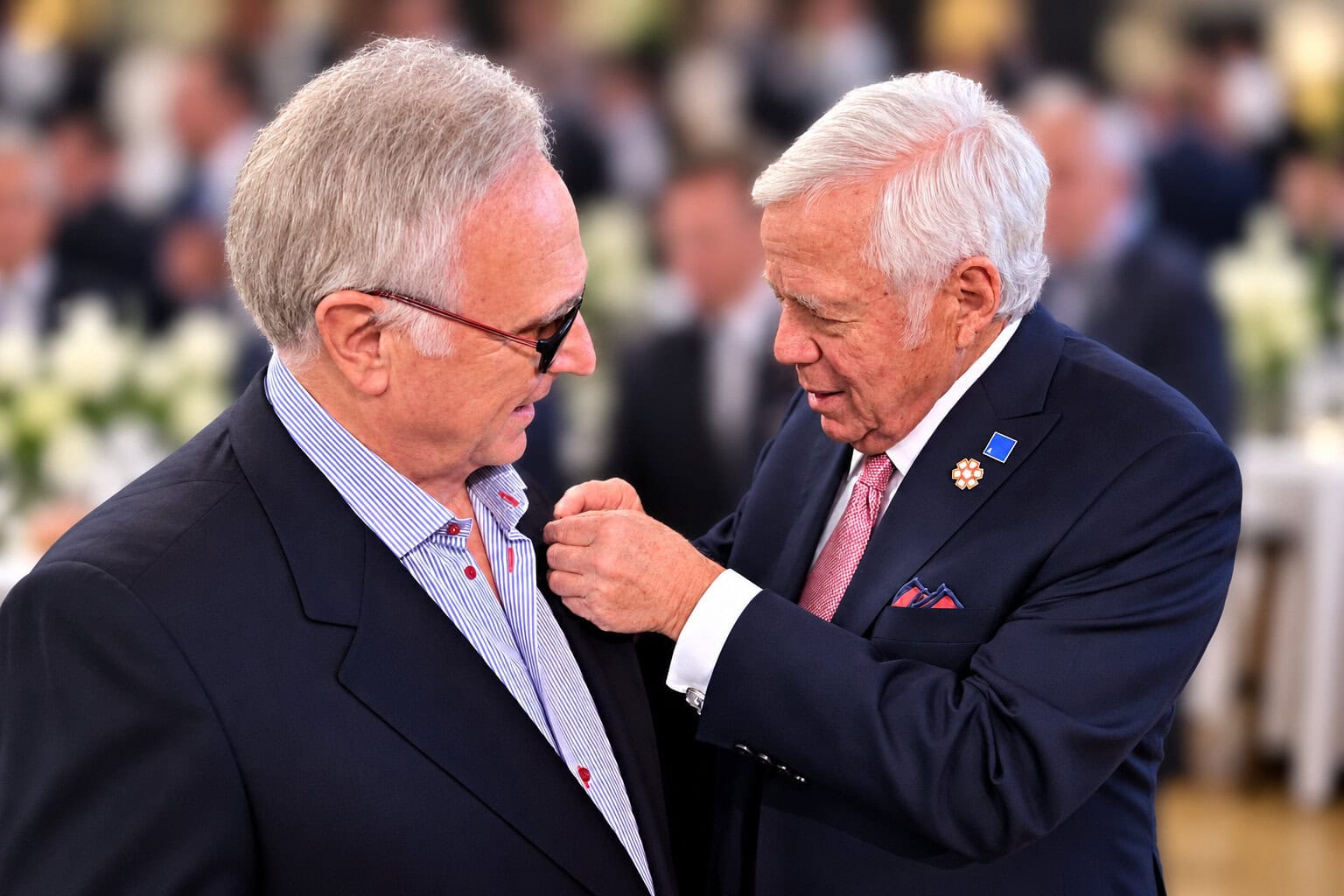
Photo: Billion-dollar philanthropist Robert Kraft with Lifestyles Magazine/Meaningful Influence founder Gabriel Erem