
$10 million gift from Sheldon and Marianne Lubar and family creates a permanent home for Milwaukee’s drawings and prints
Some of Joan Lubar’s earliest memories of the Milwaukee Art Museum are not of its grand paintings or its soaring lakefront architecture, but of standing in front of drawings beside her mother, Marianne, and being told to look closer.
That small instruction, repeated across a childhood of museum visits, has now grown into a gift that will shape how the institution cares for its collection for generations.
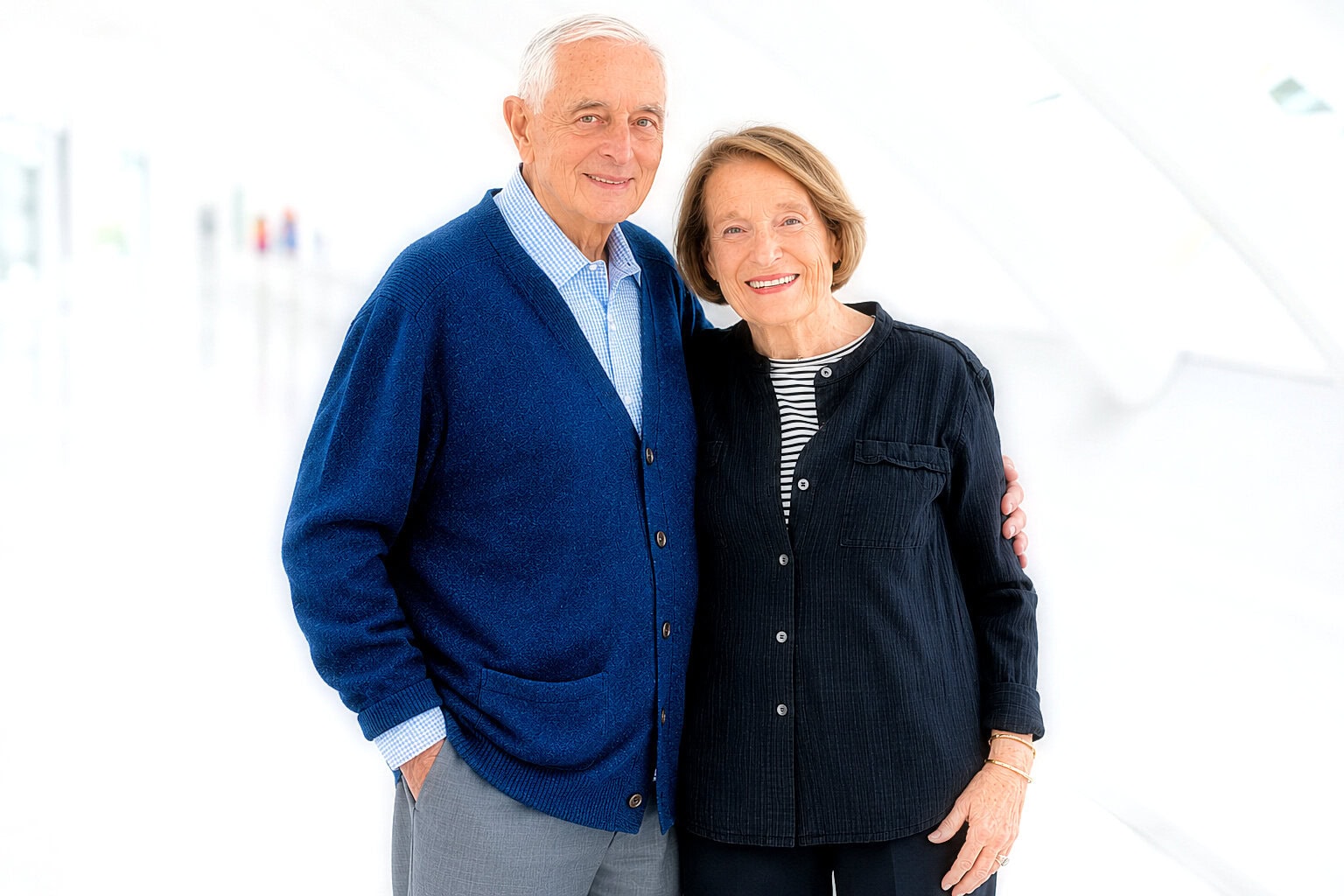
Sheldon and Marianne Lubar, together with Joan Lubar and John Crouch, David and Madeleine Lubar, and Susan Lubar, have committed $10 million to establish the Lubar Family Center for Drawings and Prints.
The gift permanently endows the people and programs that care for the museum’s works on paper, a collection that spans more than five centuries and accounts for more than half of the museum’s holdings of over 35,000 objects.
It funds four lasting pillars: the Lubar Family Curator of Drawings and Prints, the Lubar Family Paper Conservator, the Lubar Family Fellow in Drawings and Prints, and the Lubar Family Drawings and Prints Exhibition Program.
For Marianne Lubar, a Life Trustee of the museum, the gift is personal in the most literal sense.
“I am really excited to know there will be a dedicated space in the Museum to exhibit works on paper,” she said.
“Most great artists start by making drawings. It’s where you see their ideas take shape before anything else. Our family has spent so many hours with these works over the years, and we believe they deserve to be seen and celebrated.”
That sentiment captures the quiet paradox at the heart of the gift.
Drawings and prints form the largest part of the museum’s collection, yet they are among the least visible.
Paper is fragile and sensitive to light, so a sheet can hang in a gallery only for a limited time before it must return to storage to rest.
The work of keeping these pieces alive, studying them, conserving them and rotating them thoughtfully before the public requires a specialized team that most museums struggle to fund year after year.
By endowing those roles rather than a single exhibition or acquisition, the Lubars have chosen to underwrite the patient, often invisible labor that allows a collection to breathe.
Leading the new center is Nikki Otten, who has been named the inaugural Lubar Family Curator of Drawings and Prints.
Otten joined the museum in 2018 and has since organized exhibitions including Always New: The Posters of Jules Chéret, LaToya M. Hobbs: Carving Out Time, and, this year, Seeking Revelation: German Romantic Prints and Drawings. She earned both her master’s degree and her doctorate at the University of Minnesota–Twin Cities.
“Because works on paper are sensitive to light, they can only be on view for limited periods before returning to storage to rest,” she said.
“Each exhibition offers an opportunity to share different selections and explore new connections across the collection. This gift supports the research and specialized care that make those experiences possible.”
The Lubars’ story with the museum stretches back more than half a century, and it begins, like so much of their life together, in Madison.
Marianne arrived at the University of Wisconsin from Kenosha as a 17-year-old freshman and found herself living in the same residence hall where a young man from Whitefish Bay named Shel was working in the dining facilities.
They began dating, married in 1952 while she continued her studies and he finished law school, and returned to southeastern Wisconsin to raise four children and plant deep roots in Milwaukee.
Sheldon went on to build a national reputation in finance and public policy.
He served in federal housing and finance roles under Presidents Nixon, Ford and Carter, including as assistant secretary for housing production and mortgage credit and commissioner of the Federal Housing Administration, and he founded Lubar & Co., the Milwaukee private investment firm he still chairs and that his son David now leads as president and CEO.
Marianne, meanwhile, became one of the city’s most devoted cultural stewards, a driving force at the Milwaukee Public Library, the Milwaukee Art Museum, Jewish Museum Milwaukee, the Florentine Opera and the Golda Meir Library at the University of Wisconsin–Milwaukee, where she has long championed the idea that libraries are among the most democratic institutions a city can have.
She is president of the Lubar Family Foundation, and UW–Milwaukee awarded her an honorary doctorate in leadership in the arts in recognition of that work.
At the art museum, the couple’s leadership has been tested in the most demanding of circumstances.
Sheldon first served as president of the board in the late 1970s. A quarter century later, the Santiago Calatrava-designed Quadracci Pavilion had opened to global acclaim but left the museum carrying a heavy construction debt, and he agreed to lead the campaign to retire it.
His approach was characteristically disciplined: pledges would come due only once the campaign reached a $25 million milestone, giving donors confidence that their gifts would truly finish the job.
The strategy worked. Some $30 million was raised, and the building debt was cleared months ahead of schedule, with the Lubars themselves among the campaign’s leading donors. That the family’s newest gift arrives as the museum celebrates the pavilion’s 25th anniversary gives it a certain symmetry.
The first chapter secured the building; this one secures what is inside it.
Sheldon’s own explanation for decades of civic commitment is characteristically brief. “Great cities need great institutions,” he said.
“We’re proud to support the Milwaukee Art Museum as Milwaukee’s great institution.”
The gift also marks the moment the Lubars’ philanthropy fully becomes a two-generation enterprise. Joan Lubar now sits on the museum’s Board of Trustees, continuing the stewardship her parents began.
“That’s what works on paper ask of you,” she said of those early lessons in looking.
“They reward patience and curiosity.” David Lubar sees in the collection an echo of his parents’ convictions about access and opportunity.
“Prints have always been one of the most democratic forms of art,” he said.
“Through printmaking, artists like Albrecht Dürer and Käthe Kollwitz could reach far more people than a single painting ever could. That’s what moves me about this collection, and it’s what this gift is about, too: making sure these works keep reaching people in Milwaukee for generations.”
Susan Lubar spoke for the people behind the work.
“Behind every exhibition are people who study the art, care for it, and help us see it in new ways,” she said.
“It’s exciting to support that work and to know this collection will continue to be a source of discovery for Milwaukee.”
The Milwaukee Art Museum’s director, Kim Sajet, framed the gift in terms of intimacy and craft.
“A drawing can bring us close to an artist’s thinking, while a print reveals how an idea takes shape through extraordinary skill and experimentation,” she said.
“The Lubar family understands the value of these works and the expertise needed to care for and share them. Their generosity gives us a strong foundation to study this remarkable collection, develop exhibitions, and invite more people to experience it.”
The center joins a remarkable map of Lubar philanthropy across Wisconsin.
At UW–Milwaukee, the couple’s two landmark $10 million gifts created what is now the Lubar College of Business and the Lubar Entrepreneurship Center, and their support there, which began in 1979, has funded more than 1,000 student scholarships.
At UW–Madison, their alma mater, they helped found the Lubar Institute for the Study of the Abrahamic Religions to foster dialogue among Jews, Christians and Muslims, strengthened computer sciences with a $7 million gift, and supported the business and law schools.
At Marquette University Law School, the Lubar Center for Public Policy Research and Civic Education bears their name, and at Alverno College, a $1 million scholarship helps future teachers finish their degrees.
This year, the Wisconsin Alumni Association honored the couple with its Distinguished Service Award, a recognition of seven decades spent investing in the state that shaped them.
Yet this gift may be the one closest to Marianne’s heart, and to the family’s shared memory.
Throughout all those years, the Lubars kept returning to the same rooms, the same sheets of paper, the same quiet act of leaning in. Now, long after Marianne first told her daughter to look closer, the family has made sure that every Milwaukeean who walks through the museum’s doors will have the chance to do the same, and that the people who make that possible will always be there.