
$2 trillion morning and a “Hi, Mom! ”: Dario and Daniela Amodei behind the biggest IPO ever and their impact on philanthropy ahead
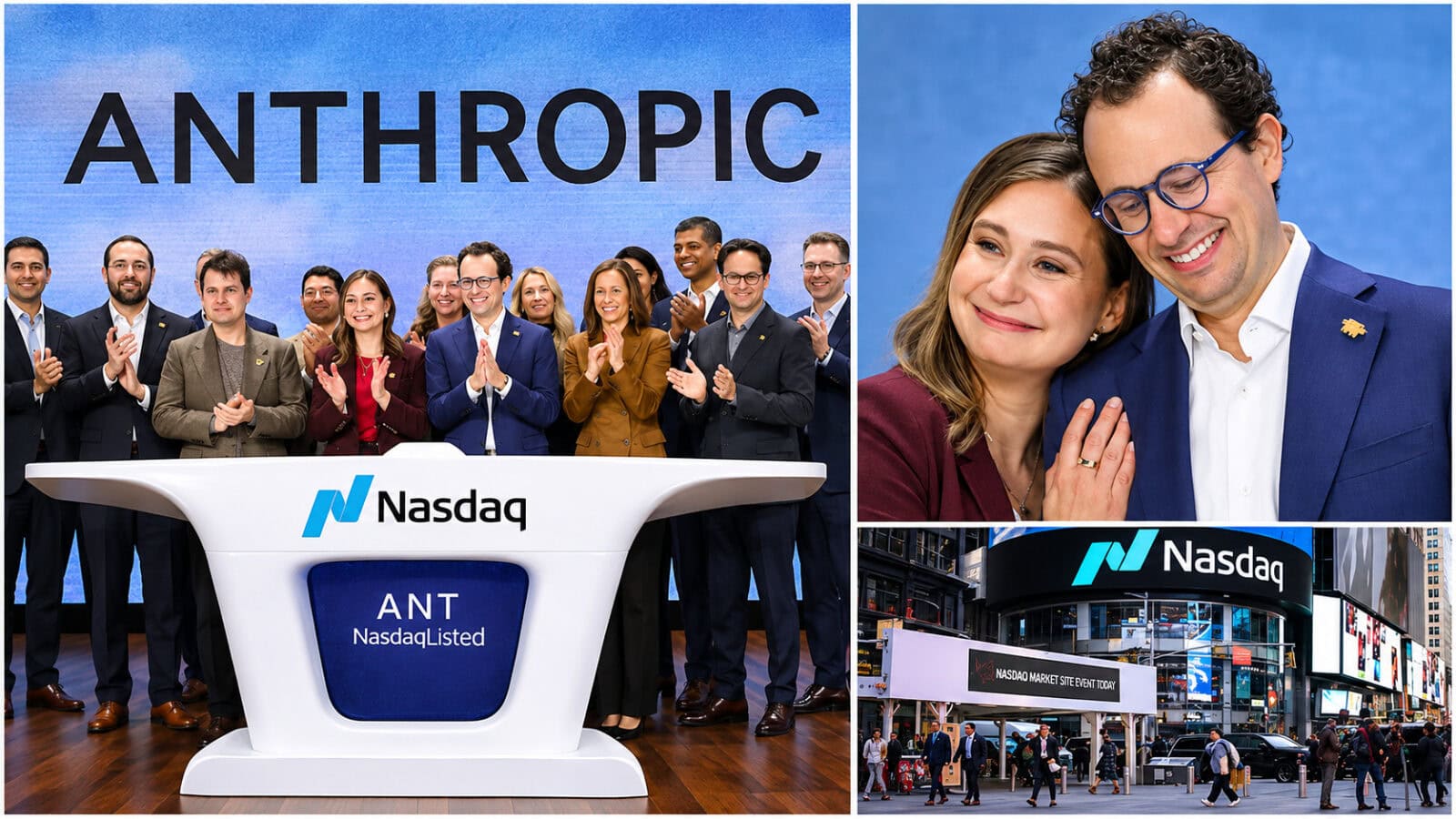
Dario and Daniela Amodei grew up in San Francisco’s Mission District, built a company side by side, and promised to give away most of what they made.
On the morning Anthropic went public, here is the story behind the promise and the lives it might one day reach.
At eight o’clock in the morning, the scene outside the Nasdaq in Times Square was quiet.
A small police presence, and nothing to suggest that, within a few hours, a five-year-old company would be worth about two trillion dollars on paper.
Then the day began.
Dario Amodei, Anthropic’s chief executive, arrived with his wife, Camilla Clark.
His younger sister, Daniela, the company’s president, arrived too.
The night before, Anthropic had sold about $81 billion of its stock, the largest public offering ever.
When the opening bell rang, the executives wore small pins of Clawd, the pixelated crab that is the mascot of their coding tool, and the shares opened at $111.50.
Somewhere in that morning, Daniela said something no one would have predicted.
She spoke about how proud she and Dario were of the team and what an incredible milestone this was.
Then she added a line for her family.
“I hope you’re watching,” she said.
“If you are, hi, Mom!”
She said one thing more.
She hoped that after all this was over, she and her brother might spend a little more time together, “just the two of us as siblings.”
It is a funny thing to hear on the day a company becomes one of the most valuable in the world.
It is also the truest way into this story, which is not really about a stock.
It is about a brother and sister who grew up in San Francisco and the promise they made along the way.
Dario was born in 1983 and Daniela four years later, in a city that never stopped changing around them.
Both went to Lowell High School, a public school.
Daniela has talked about lugging her backpack onto the 9-San Bruno bus.
Dario said what stayed with him about San Francisco was its spirit of “nonconformism” and “individualism”, the sense that “it’s okay to be crazy.”
Their Italian father, Riccardo, was a leather craftsman who came from Tuscany.
Their Jewish mother, Elena Engel, worked for the city’s public libraries, where she helped furnish dozens of branches as they were renovated.
“She had this quiet but powerful way about her,” recalled Michelle Jeffers of the city’s library system.
Dario has said that his parents wanted to improve the world.
“They gave me a sense of right and wrong and what was important in the world,” he has said, “imbuing a strong sense of responsibility.”
Richard Shapiro, his physics teacher at Lowell, says that when he hears Dario’s voice now, “it’s the same,” with the same sincere interest and “worrying concern” for the work in front of him.
Dario was a science kid, drawn to physics, and he went on to study it at Stanford.
In 2006, Riccardo, who had been ill for a long time, died.
Dario was in his early twenties and had just begun a doctorate at Princeton.
He turned toward biology, hoping to help with human illness.
Within a few years, the disease that had taken his father became largely curable.
“There was someone who worked on the cure for this disease, who managed to cure it and save a bunch of people’s lives,” Dario has said, “but could have saved even more.”
On the morning of the IPO, when he spoke at Nasdaq, he began by talking about what this technology could do for medicine and curing disease.
Daniela took a different road.
She studied English literature, politics, and music at UC Santa Cruz, worked as a congressional staffer, and joined the early team at the payments company Stripe.
After a postdoctoral fellowship at Stanford’s medical school, Dario moved into artificial intelligence, first at Baidu and then at Google, before joining OpenAI in 2016.
Daniela followed him there two years later.
She has joked that watching her brothers, John and Patrick Collison, work together at Stripe gave her “great training wheels” for working with a sibling.
At the end of 2020, they and five colleagues left OpenAI to build something new.
Anthropic incorporated the next January as a public benefit corporation, a company that must weigh the public good alongside its profits.
Daniela once told a room of aspiring entrepreneurs that having five other co-founders made things “even more complicated” than working with her brother.
She said what made it work was “a ton of clarity” about who owned what.
Somewhere in those early years came the promise.
When Anthropic was founded, the company says, all seven co-founders pledged to give away 80% of what they own in it. Besides Dario and Daniela, they are Tom Brown, Jack Clark, Jared Kaplan, Sam McCandlish, and Chris Olah.
In other words, it means most of their stake in the company they built.
Dario wrote about the reasons in a January essay.
“Wealthy individuals have an obligation to help solve this problem,” he wrote, speaking of the strain that artificial intelligence could put on workers and their families.
It saddened him, he said, that many wealthy people in tech had come to hold “a cynical and nihilistic attitude that philanthropy is inevitably fraudulent or useless.”
Daniela has said that growing up in a city where creative promise and wealth inequality lived side by side shaped how she thinks about the company.
“It’s why I can’t think about what we’re building at Anthropic without thinking about who it’s being built for,” she has said.
The siblings have tried to build that thinking into the company itself.
Anthropic matches its employees’ gifts to charity, adding three shares for every one given by people who joined early and one for every one given by later hires, and the company says about half its employees take part.
Dario has said that every employee goes through a culture interview, and that the company says no to talented people who do not fit.
“We don’t want people who aren’t oriented towards the public benefit,” he said.
The company has also set aside about five percent of its shares for a new public benefit fund, which it says could make large gifts to charities or support people directly, and it has committed $200 million to studying and addressing how AI may affect jobs.
“We want it to be baked into essentially our structure,” Daniela said this morning.
Giving on this scale takes time.
Anthropic’s roughly 5,300 employees are newly wealthy on paper, but most cannot give away their shares for several more months.
Jack Lewars, an adviser who works with donors, expects most of that money to reach charities “from next spring onwards.”
Adam Nash, who runs the giving platform Daffy, which works with several AI companies, says he sees a generation asking real questions: “I’m seeing a lot of 20-somethings and 30-somethings who are thinking about ‘What is this wealth for?’
“What is the impact of what we’re creating?”
Nicole Taylor, who leads the Silicon Valley Community Foundation, hopes they will think about the impact they can make at scale and not go it alone.
Nobody has said yet where the money will go.
But the company’s culture of generous giving shows what is possible.
Earlier this year, Coefficient Giving, the foundation that grew out of Dustin Moskovitz and Lifestyles Magazine/Meaningful Influence cover subject Cari Tuna’s philanthropy, announced a $276 million grant to buy about 90 million insecticide-treated bed nets for the Democratic Republic of Congo, which the charity evaluator GiveWell estimates could prevent about 67,000 deaths, most of them children under five.
That grant is not Anthropic’s. But Anthropic’s founders and early backers are close to that world, and it offers a glimpse of what a gift can do.
Closer to home, small nonprofits already use the company’s tools.
Scott Burns, who runs the Montgomery County Food Bank north of Houston, uses Claude to plan food pickups and deliveries and to stay in touch with donors.
“Costs have gone up for fuel,” he said, and he still wants to do more without adding a bunch of additional resources.
People who work in philanthropy have ideas for the larger gifts to come.
Phil Buchanan of the Center for Effective Philanthropy suggests sending money to the country’s community foundations, which know their own neighborhoods.
Steven Dean, a Boston University law professor, would like to see large gifts go to historically Black colleges and universities.
And Nick Allardice of GiveDirectly, which sends cash to families in poverty, puts the possibility in the biggest terms he can: “This could be a moment where hundreds of millions of lives can be improved, and there may not be many moments like that in history.”
That, in the end, is what the IPO morning was about.
At the Nasdaq, Daniela spoke to everyone watching.
“Intelligence is now something humans can build,” she said.
“What we choose to build with it is up to all of us.”
She said she wants people to feel “like this technology is not happening to them.”
Dario said the day “only strengthens our resolve to do the right thing.”
Daniela called the debut “one stop on the journey” and said that tomorrow, they would wake up as “the same company.”
It is a remarkable thing for two children of the Mission to have done, and a long road lies ahead.
The grants and gifts will come slowly, over many years, and each one will reach a real person.
But on a day full of numbers, the moment worth remembering may be the small one: Daniela Amodei, on the biggest day of her company’s life, saying hi to her mom.