
$29.2 million from Rob Walton to protect six of Southern Africa’s great wild places
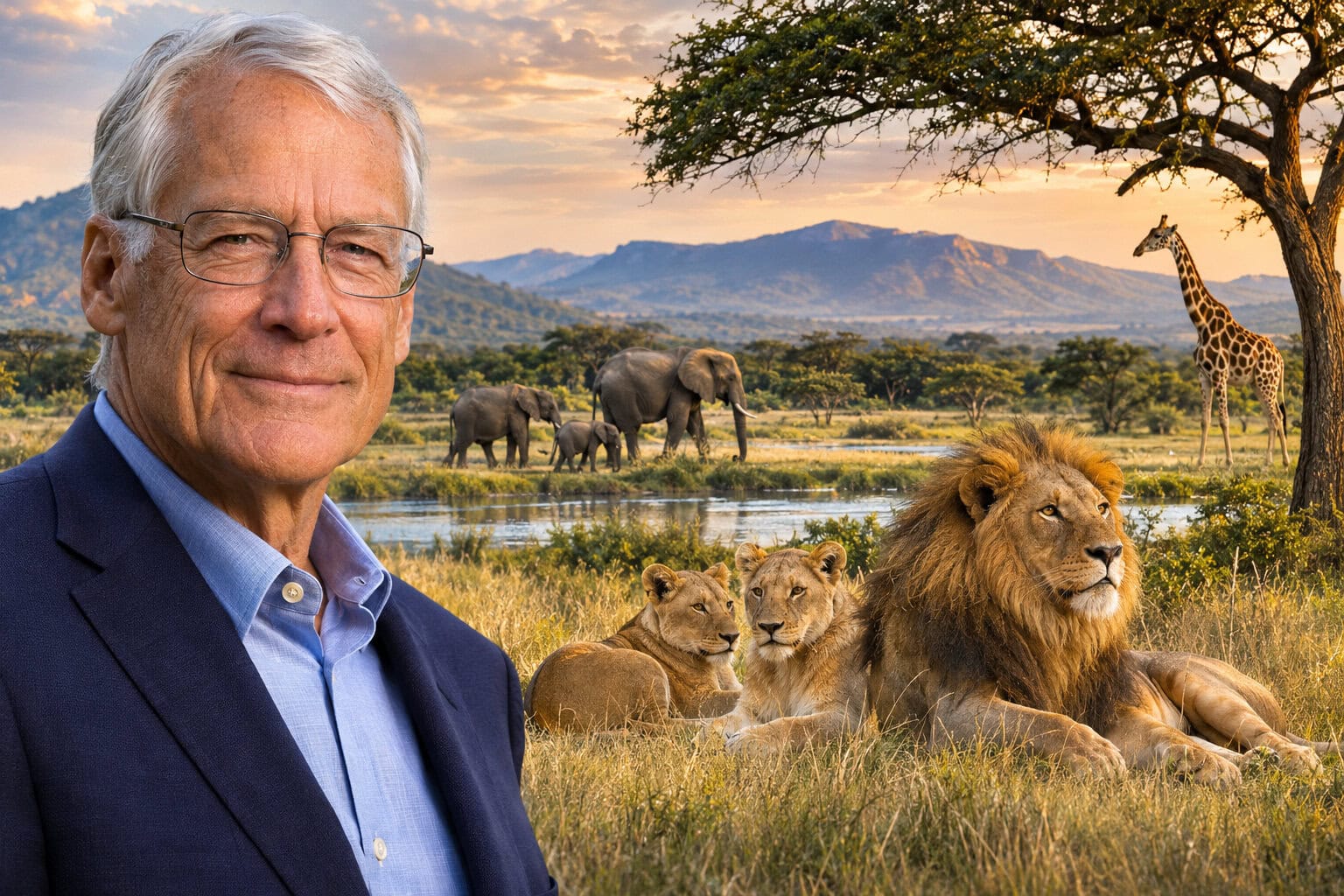
About 25 years ago, Rob Walton went to South Africa to visit a friend and tour a nature preserve.
His friend told him that this kind of work was what Nelson Mandela said “good guys” do. The comment stayed with him.
It took him back to childhood camping trips with his family in America’s national parks. On Thursday, the line came full circle.
The Rob Walton Foundation committed $29.2 million to the Peace Parks Foundation, the conservation group Mandela co-founded in 1997 with Anton Rupert and Prince Bernhard of the Netherlands.
The grant covers six protected areas in four countries.
They are Limpopo, Zinave, and Banhine National Parks in Mozambique; the Greater Mana Pools Ecosystem in Zimbabwe; the Nyika-Vwaza Complex in Malawi; and Luengue-Luiana National Park in Angola.
Together they cover 82,000 square kilometers, more than nine times the size of Yellowstone.
The money will fund park governance, ranger and operational capacity, wildlife protection, ways for people and wildlife to live alongside each other, and the long-term financing that keeps a park running after the ribbon-cutting.
The timing matters. Conservation groups across the continent are turning to private philanthropists as aid from wealthy nations dries up.
Peace Parks chief executive Werner Myburgh said protecting Africa’s natural heritage “requires more than individual projects or short-term funding commitments.” He said the foundation’s support will help his team “secure their long-term future.”
Duko Hopman, the Walton foundation’s executive director, presented the gift as an invitation as well as a grant: “We see an opportunity to build on that experience across six important landscapes and encourage other funders to join this effort.”
Peace Parks has a record worth building on. In Mozambique, Zinave was a heavily depleted park and is now the country’s first Big Five national park.
The six sites are among 162 “Keystone Protected Areas” in 33 African countries.
Those areas hold 71 percent of Africa’s threatened vertebrate species and supply water to nearly 250 million people.
Keeping that network well run has become the main mission of Walton’s philanthropy.
Walton is 82.
He is the eldest son of Sam and Helen Walton and chaired Walmart’s board from 1992 to 2015.
He now owns the Denver Broncos with his family, and the family’s fortune is estimated near $150 billion. For much of the past decade his giving went through the Rob and Melani Walton Foundation, now the Rob Walton Foundation.
Its board includes his children Ben Walton and Rachel Penner and Conservation International co-founder Peter Seligmann.
The foundation has grown fast.
Its grants rose from about $8.8 million in 2019 to $108.5 million in 2024, roughly $327 million in six years, with about $441 million still in assets.
Some of the largest gifts on that list show what he cares about.
In 2021, he pledged $100 million to African Parks, with $75 million going to the largest endowment gift in that group’s history.
African Parks has counted him as a partner since 2003. Conservation International, where Walton has long served on the board, has received about $79.8 million from the foundation. In 2024 alone, the foundation gave $33.9 million to the Theodore Roosevelt Presidential Library Foundation in Medora, North Dakota; $24.6 million to Conservation International; and $9.3 million to the Wildlife Conservation Society for African protected areas.
Arizona is where his giving is easiest to see.
In 2012, the Waltons gave $27.5 million to Arizona State University’s sustainability institute, a commitment that grew to $31.8 million by 2019. Last year he gave ASU $115 million, the largest gift in the university’s history.
It created the Rob Walton School of Conservation Futures, an endowed chair, three professorships, and the Rob Walton Scholars Fund.
The school will start offering a bachelor’s degree and three master’s programs in spring 2027, and its professional academy has already logged more than 1,500 enrollments.
“One of the biggest gaps is leadership,” Walton said when he announced the gift.
“Without enough skilled leaders to manage and scale these efforts, we won’t make the progress we need.”
This fall brought more.
In October, African Parks announced a $4.6 million grant from the foundation that pays for verified results, measuring one square kilometer of intact nature at a time.
The foundation has also offered up to $50 million in matching funds to African governments that put Global Environment Facility money toward Keystone Protected Areas. It has said it will give more if nations show greater interest.
All told, Walton’s documented giving and pledges come to roughly half a billion dollars.
The approach behind the numbers is consistent: pay for the managers, rangers, and institutions that keep wild places alive for decades.
“Nature doesn’t recognize borders,” Walton has said. This week, he backed that belief in four countries. Mandela’s own foundation has spent nearly 30 years trying to connect.