
$334 million from Eric Schmidt powers a new era of scientific computing as he takes the helm at Caltech
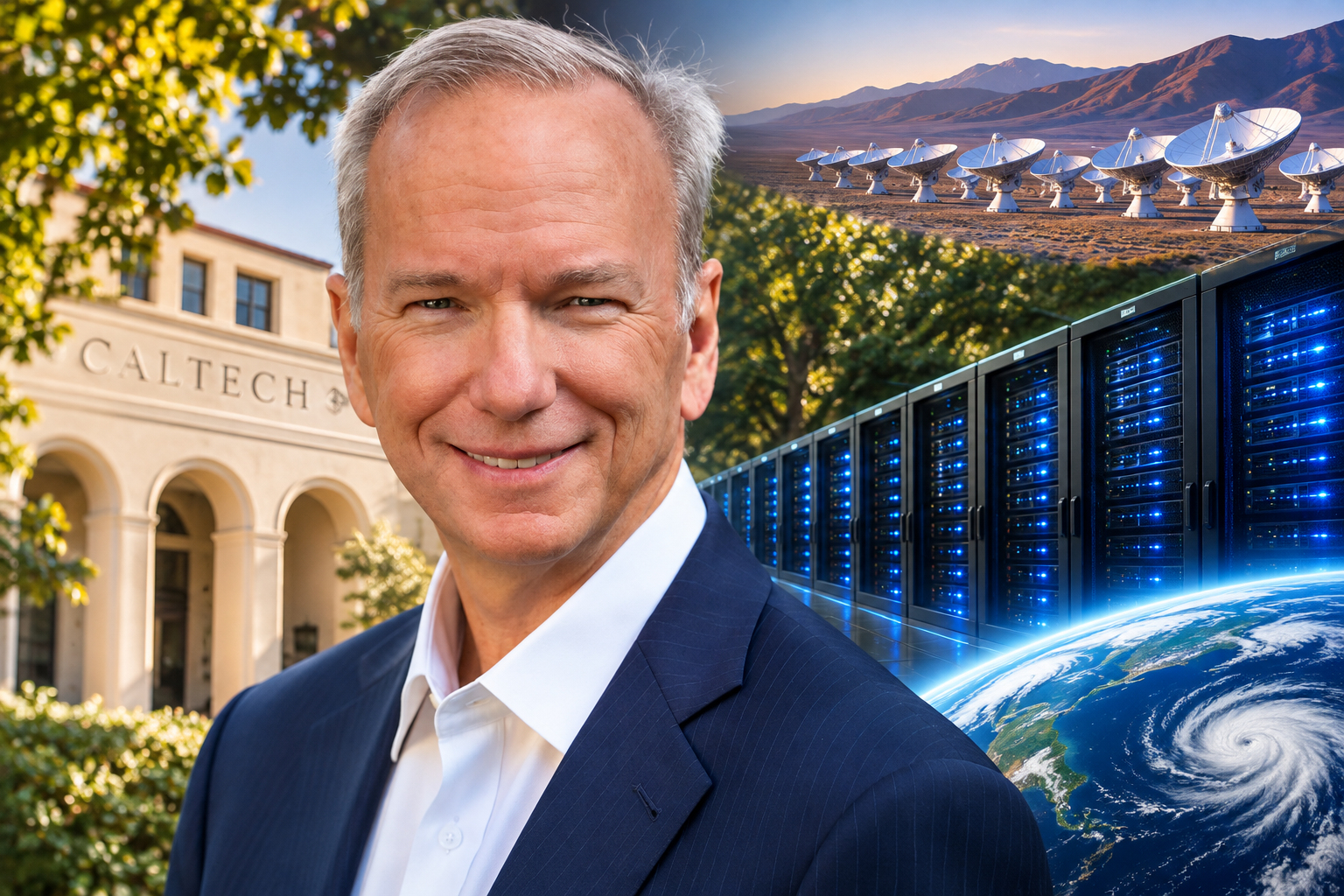
Eric Schmidt has spent much of his life building the machines and systems that make knowledge move faster.
Most recently, the former Google chief executive took on two roles that show where that work has led him.
He became chair of Caltech’s Board of Trustees, and a week later the philanthropy he and his wife, Wendy, founded announced a $334 million grant to bring one of the most powerful academic supercomputers in the country to the University of Illinois.
The grant from Schmidt Sciences will fund Garnet, a research computing system at the National Center for Supercomputing Applications in Urbana-Champaign.
It is the largest grant in the center’s 40-year history. Garnet is expected to be at least four to five times more powerful than the center’s current leading machine, and it is designed to keep absorbing new generations of GPU technology rather than aging in place.
It will run in the same facility that once housed the Blue Waters supercomputer and is expected to come online in mid-2027.
Scientists will use it to screen potential new drugs, sharpen climate and weather forecasts, design new materials, and work through the flood of data coming from the world’s telescopes.
Garnet is the largest of five sites in the new Schmidt Science Computing Network.
The network links institution-owned computing systems at Illinois, Johns Hopkins, the University of Chicago, and UC Berkeley with Lawrence Berkeley National Laboratory.
The idea is simple and ambitious.
Many of the most important questions in science now need computing power that individual university labs can’t afford.
Schmidt Sciences pays for the hardware, the universities own and run it, and researchers around the world share the capacity along with the software and expert support that turn raw computing into results.
“Scientific ambition should not be limited by whether a research team can secure the computing power needed to pursue its most important questions,” said Schmidt Sciences President Stuart Feldman.
“The Schmidt Science Computing Network is a bet on the ingenuity of scientists and the strength of research institutions.”
The network had a fitting debut. It was first announced at the UChicago–Caltech Conference on AI+Science, at the place where Schmidt’s philanthropy and his new trusteeship meet.
Schmidt’s ties to Caltech go back years.
Eric and Wendy Schmidt have given the Institute more than $250 million across several initiatives.
The best known is the Deep Synoptic Array, a Caltech-led radio telescope of 1,650 dishes planned for a remote Nevada valley.
It is expected to survey the sky 100 times faster than any radio telescope in the world and to find about a billion new radio sources, with all of its data released publicly in real time.
The array is part of the Eric and Wendy Schmidt Observatory System, a set of four privately funded observatories, including a space telescope, that recalls the era when philanthropists built Palomar and Lick.
His commitment is also personal.
Since 2023, Schmidt has co-taught a Caltech undergraduate course with Richard M. Murray, the Thomas E. and Doris Everhart Professor of Control and Dynamical Systems and Bioengineering, on how fast-moving technologies become useful products and services.
“Over the years, through teaching at Caltech and supporting research programs across the Institute, I have seen firsthand how fundamental science, engineering rigor and intellectual freedom drive discovery and innovation,” Schmidt said.
He calls the Institute, fondly, “the crown jewel of nerddom.”
Caltech President Ray Jayawardhana called Schmidt “an inspired choice to lead the Board,” citing “his tremendous expertise at the intersection of science, technology, and innovation, together with his consequential support for research.”
Kent Kresa, chairman emeritus of Northrop Grumman and a past board chair, joins him as vice chair.
Kresa and his wife, trustee Lynn Booth, recently endowed Caltech’s aerospace department with a $50 million commitment.
Schmidt brings a long record to the role.
He held research posts at Xerox PARC and Bell Labs, served as chief technology officer at Sun Microsystems and chief executive of Novell, and led Google from startup to global institution.
He now chairs and leads Relativity Space, which builds reusable rockets. In public service, he was the founding chair of the Pentagon’s Defense Innovation Board and chaired the National Security Commission on Artificial Intelligence.
With Wendy, he also founded the Schmidt Family Foundation and the Schmidt Ocean Institute.
All of these roles point the same way. Schmidt believes the next era of discovery will pair a professor and graduate students with a team of AI agents.
Caltech students, he says, will graduate as “a scientist who can use AI in a transformative way,” and they will be in demand everywhere.
With Garnet and its sister systems, the Schmidts are building the computing infrastructure that scientists will need.
At Caltech, Schmidt now helps guide one of the institutions best placed to use it.