
$400 million, given quietly: low-profile donors’ latest gift to university
Edith and Peter O’Donnell Jr. never wanted their names in the paper.
For decades they gave large sums to science and medicine in Dallas and then stepped aside, so the attention went to the researchers doing the work.
Friends teased them about it, calling them “Mr. and Mrs. O’nonymous.”
The couple took it as a compliment.
So the news that their foundation has now given nearly $400 million to UT Southwestern Medical Center, more than any other donor in its history, would probably have made them a little uncomfortable.
The final installment is a capstone gift of everything the O’Donnell Foundation has left. With it, the Foundation completes more than half a century of work.
The final gift isn’t a farewell, though.
It was set up to keep giving.
Shortly before the capstone gift, the Foundation gave oil-producing land in West Texas to the Southwestern Medical Foundation, and the earnings from that land will go to UT Southwestern every year.
The Foundation will close, but its money will keep paying for discovery, teaching, and patient care for years after its last board meeting.
That was always the O’Donnells’ approach: find good people, back them, and stay with them long enough for something important to come of it.
The man who carried that approach to the finish is Bill Solomon.
He was a longtime friend of the couple and a trustee of their foundation for years, and he has led it since 2016. The O’Donnells asked him to carry on their giving after they were gone.
Few charitable requests take more trust, and he has honored it with obvious care.
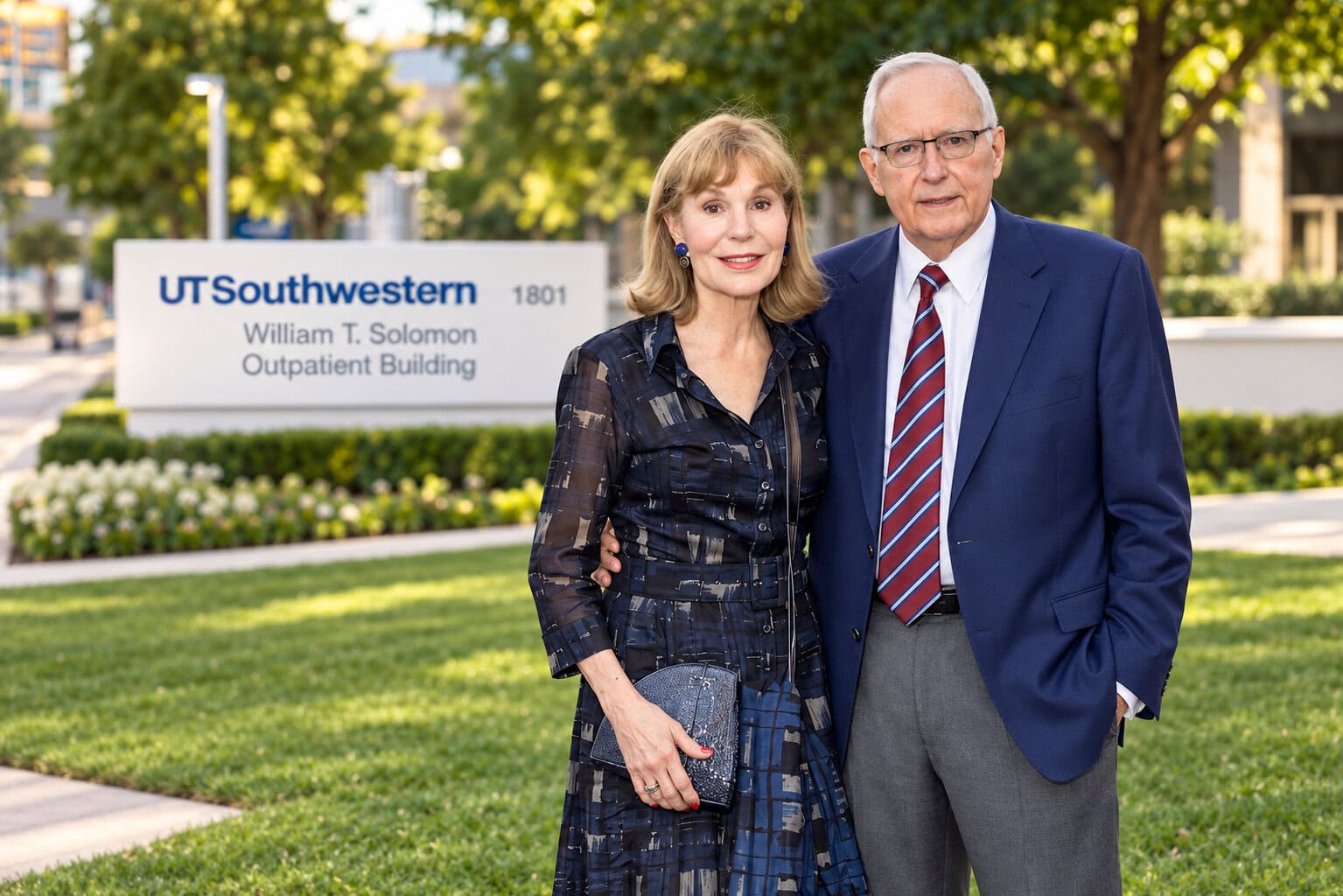
UT Southwestern has now thanked him in a way that will outlast everyone involved. With the University of Texas System’s approval, the Outpatient Building on West Campus is now the William T. Solomon Outpatient Building. Solomon was at the naming ceremony with his wife, Gay.
Even while being honored, Solomon kept steering the credit back to his friends. “Edith and Peter were consistent and sincere in their desire to keep their names out of the headlines as much as they could,” he said.
“Their legacy of giving wasn’t always obvious, but it was always substantial and impactful.”
The building’s name also reflects the Solomons’ own giving.
Bill and Gay endowed the Division of General Internal Medicine that bears their names, and they helped build William P. Clements Jr. University Hospital.
Bill also once chaired the board of the Southwestern Medical Foundation, the organization that will now manage the West Texas land for the medical center.
“He has advanced the O’Donnells’ philanthropic legacy with remarkable care and conviction,” said Michael McMahan, the foundation’s president.
“It is especially meaningful to see him honored.”
To understand why the O’Donnells’ money mattered so much, look at what it made possible.
They founded their foundation and treated giving as an investment in people, a long-term one.
An early gift created the Center for Human Nutrition, which still studies how food can prevent and treat chronic disease.
They also backed two young researchers, Michael Brown and Joseph Goldstein, whose work on how the body handles cholesterol won the Nobel Prize in 1985.
Goldstein still talks about them with real affection. “Peter and Edith O’Donnell were maestros of philanthropy,” he said, “and their support was as enduring as it was widespread.”
He believes their insistence on excellence explains why their money accomplished so much.
The couple also thought about the scientists who were just starting out.
They helped create a program that gives promising young investigators a way to get their careers going.
They paid for an integrated electronic medical record system so patient care could be coordinated, which made UT Southwestern one of the first places in the country to use one. Not all of their gifts were glamorous.
Most of them were useful.
Late in life, their ambitions grew larger.
Their lead gift created the Peter O’Donnell Jr. Brain Institute, which studies the brain and searches for better treatments for neurological disease. Later gifts helped patients and families get through the long, confusing process of treating a brain illness.
Then they reached beyond individual patients to whole communities, endowing the Peter O’Donnell Jr. School of Public Health.
Its dean, Dr. Saad Omer, says the gift let the school hire top scientists and recruit students who will shape the field “for the next 50 years—and beyond.”
Dr. Daniel Podolsky, UT Southwestern’s president, summed up what the couple understood: the hardest problems in medicine need the best minds, and those minds need someone willing to back them for the long haul.
“Their devotion to excellence and passion for our community,” he said, “inspired bold investments that led to paradigm-shifting discoveries.”
Now the foundation that carried their names is finishing its work much the way they lived, quietly and thoroughly.
The land in West Texas will keep producing income, and the medical center will keep putting it to use.
The O’Donnells’ legacy will keep showing up in the researchers they recruited, the doctors they helped train, and the patients who get better care because of them.