$27.5 million and counting: as dedicated philanthropists Lisa and Charles Simonyi lead the way at the University of Washington, their friends Jodi Green and Mike Halperin are celebrated for a lifetime of saying yes

Some people give to a university.
Others give themselves to it.
Jodi Green and Mike Halperin have done both for more than three decades, and this year the University of Washington Foundation is giving them the 2026 Gates Volunteer Service Award.
It is one of the university’s most respected honors.
It recognizes people whose time, service, and philanthropy have shaped the UW and who inspire others to do the same.
The award fits them well, and so does the moment.
The UW Foundation Board, which Green once chaired, is now led by Lisa Simonyi.
She and her husband, Charles Simonyi, have become two of the university’s most generous and forward-looking supporters.
The two couples share something uncommon: the belief that a great public university is one of the best tools a community has for improving the world, and that the people who love it should give their curiosity as freely as their money.
Halperin’s connection to the UW started when he was 7.
His father, Walt Halperin, joined what was then the botany department and taught plant physiology for 35 years.
The family lived in faculty housing. Young Mike visited his father’s lab in Johnson Hall, where Walt sometimes slept on an old green Army cot to watch over his experiments.
He took the bus to the student union for peanut butter cups and bowling, and went on weekend trips with the UW kayak club.
“The UW was more than just his job,” Halperin remembers.
“It was our whole identity.”
Later he sat in his father’s introductory biology class as a student. He went on to a career in emergency medicine and earned two UW degrees.
Green came to the university differently.
She met Halperin on the East Coast.
When she moved to Seattle, a campus tour took her past Johnson Hall and the old greenhouse.
She was a software engineer, and nobody in her family had gone to college.
Her parents deeply valued education, and college changed her life.
“When I look around here,” she says, “I’m looking at thousands of Jodis that are getting this incredible opportunity.”
Her volunteer life began in the early 1990s, when she joined the board of the Henry Art Gallery, the UW’s contemporary art museum.
The couple has supported Henry ever since.
They are listed among the donors to its $10 million Henry Now campaign, and their names appear in its patron circles year after year.
When Green agreed to represent Henry on the UW Foundation Board, she decided to learn the whole university, not just one corner of it.
What followed has become part of UW lore.
She went to all three campuses, Seattle, Bothell, and Tacoma, on official visits and on what her husband calls “Jodi jaunts.”
She watched a UW philosopher teach ethics to elementary school students.
She brought Halperin to cancer immunologist Nora Disis’s lab and to the Institute for Protein Design.
She filled black notebooks, each a couple of hundred pages long, with notes from every meeting with professors, students, deans, provosts, and presidents.
“I went everywhere and asked too many questions,” she says. In time she was asked to chair the board.
Halperin says those notebooks gave them their “50,000-foot view of the university.”
That view paid off when the two became general co-chairs of Be Boundless, the UW’s historic fundraising campaign.
More than half a million donors gave a combined $6.3 billion. Halperin notes that more than half of those dollars came from people who never attended the UW.
That made it essential to meet newcomers where their interests already were.
“The more we know, the better we serve,” Green likes to say. At UW Tacoma, they sat on a bench along the old railroad line through campus and admired the diversity of the students.
They built a friendship with business leader Jim Milgard Sr. over visits in Tacoma and California, where Halperin asked him for a significant new gift to the Milgard School of Business.
It built on the family’s $15 million naming endowment, which remains the largest philanthropic gift ever made to UW Tacoma.
Their own giving during the campaign was personal.
They wanted to make a gift larger than any they had made before and to honor the man who started it all.
Over lunch at the Faculty Club with Mike’s parents, they shared the plan.
When biology chair Toby Bradshaw announced the Walt Halperin Endowed Professorship in Biology, Walt, a famously quick wit, was speechless for the first time in his life.
The professorship has since supported a remarkable body of hummingbird research by UW biologist Alejandro Rico-Guevara.
It includes studies of how hummingbirds drink nectar, why males evolved bills built for fighting, and why some females evolved male plumage to avoid harassment.
University reporting also credits the couple’s gifts with helping the biology department recruit a new generation of young faculty.
Their generosity reached the frontlines of medicine, too.
When the Institute for Protein Design raced to build computer-designed COVID-19 vaccines, UW Medicine listed gifts from Jodi Green and Mike Halperin among the supporters of that work.
The nanoparticle vaccine program later received international funding for a Phase 3 trial.
The couple is also a founding donor to the UW Sisterhood Initiative, which helps women of color thrive on campus and after graduation.
As founding donors, they each committed $50,000.
Their giving extends beyond campus: the Seattle Public Library’s Northeast Branch has a children’s area named for them.
Lately they have answered another call: helping shape the UW’s Civic Health Initiative, which works with communities to strengthen civic participation and public institutions.
“When the UW calls, we almost always say yes,” Green says.
Halperin adds that answers to civic problems often already exist in the scholarship of UW faculty and graduate students.
Ed Taylor, vice provost and dean of Undergraduate Academic Affairs, says they “engage the intellectual, civic, and moral life of this place with care, humility, and a deep sense of responsibility to something larger than themselves.”
That same spirit runs through the work of leading philanthropists Lisa and Charles Simonyi, who are leading the next chapter of the community Green and Halperin helped build.
Charles Simonyi is a pioneer of personal computing software, best known as the architect of Microsoft’s early applications, and he remains a technical fellow at the company.
Lisa Simonyi is a Swedish-born entrepreneur and civic leader with degrees in corporate communication and international management.
She has served Seattle’s cultural and health institutions and now chairs the UW Foundation Board, the seat Green once held.
Including their most recent gift, the Simonyis have given more than $27.5 million to the UW.
Their generosity stands out for its foresight.
Through the Charles and Lisa Simonyi Fund for Arts and Sciences, they launched the DiRAC Institute in the Department of Astronomy.
They saw early that telescopes like the Simonyi Survey Telescope at the Vera C. Rubin Observatory would soon gather more data than scientists could manage. DiRAC was built to help them handle it.
Their $5 million gift helped build the Bill & Melinda Gates Center for Computer Science & Engineering and created the Charles & Lisa Simonyi Undergraduate Commons.
They also helped lead the group of friends who named that building for the Gates family, the same family whose name is on this year’s award.
“It’s a very natural thing to do,” Charles Simonyi has said of giving where the need is clear, “we are really extending the excellence that already exists.”
Their most recent commitment may be their most far-reaching.
A $10 million gift from Charles and Lisa Simonyi created AI@UW, a university-wide initiative for the responsible and creative use of artificial intelligence.
It established the Charles and Lisa Simonyi Endowed Chair for Artificial Intelligence and Emerging Technologies, held by Noah A. Smith, the university’s first vice provost for AI.
It also funds SEED-AI grants for faculty, student scholarships, community engagement, computing resources, and an AI governance committee.
Lisa Simonyi has also been a key volunteer for the Ana Mari Cauce Welcome Center.
The center is being built as a front door to the university, a place where anyone can begin their UW story.
“Charles and I are so privileged to know Ana Mari, count her as a friend, and participate in this fitting tribute,” she said when the center was named.
Taken together, the stories of these two couples show philanthropy at its warmest.
Green and Halperin spent decades learning the university so they could welcome others into it.
The Simonyis are now generously funding the tools, spaces, and ideas that will help that welcome reach the next generation.
Asked what she would tell a newcomer who wants to help, Green says there is probably a center of excellence at the UW that matches their passions.
Halperin agrees: “The UW wants to know you as much as you want to know the UW.”
Few people have proven that more fully than the four of them.
Illustration: Charles and Lisa Simonyi and Jodi Green and Mike Halperin
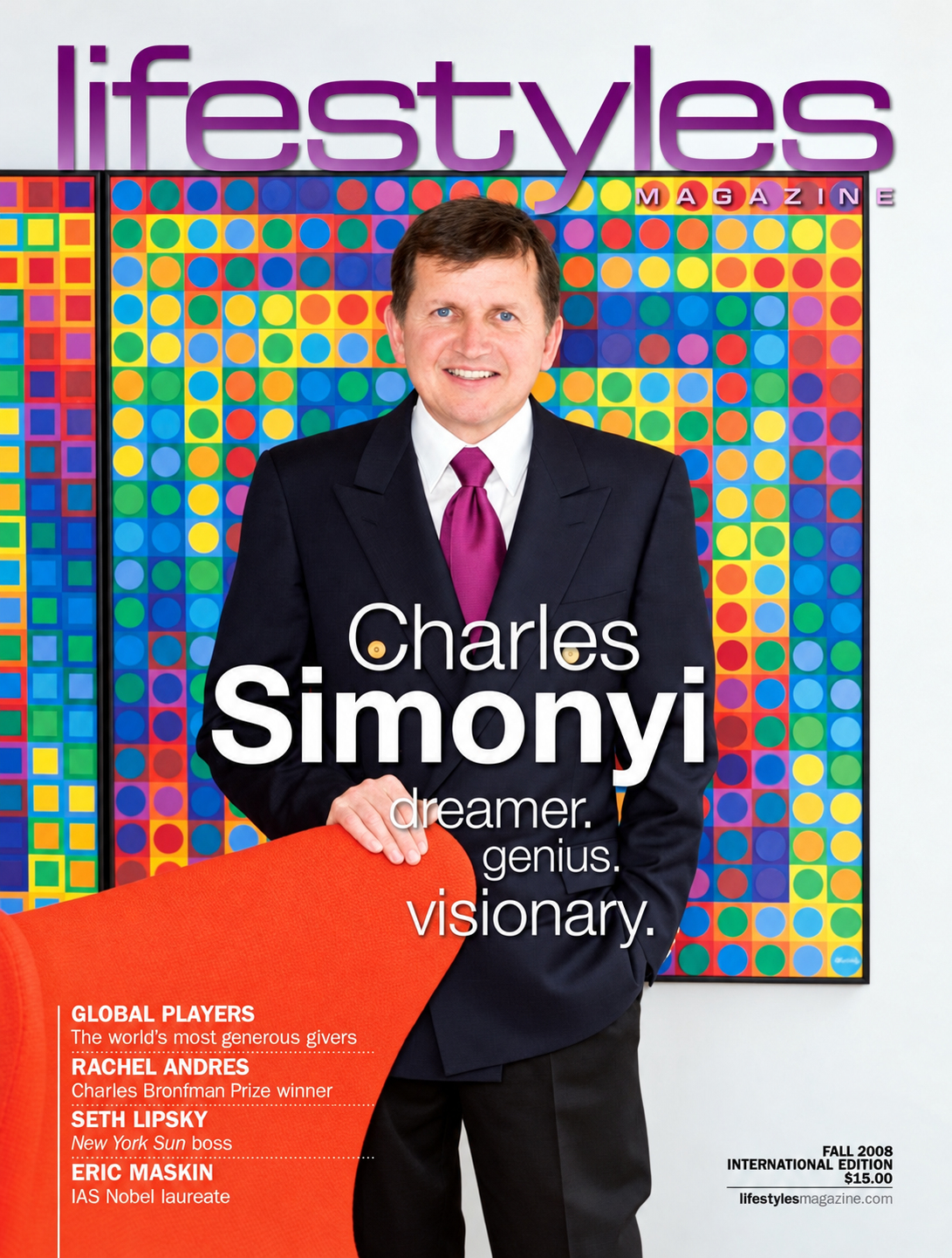
The world’s only two-time space tourist, Microsoft pioneer, philanthropist, and long-time supporter of Lifestyles Magazine/Meaningful Influence was featured on the publication’s cover