
$1.5 billion plus in philanthropy reaches a new milestone: generous givers Len and Emily Blavatnik mark 20 years of betting early on brilliance
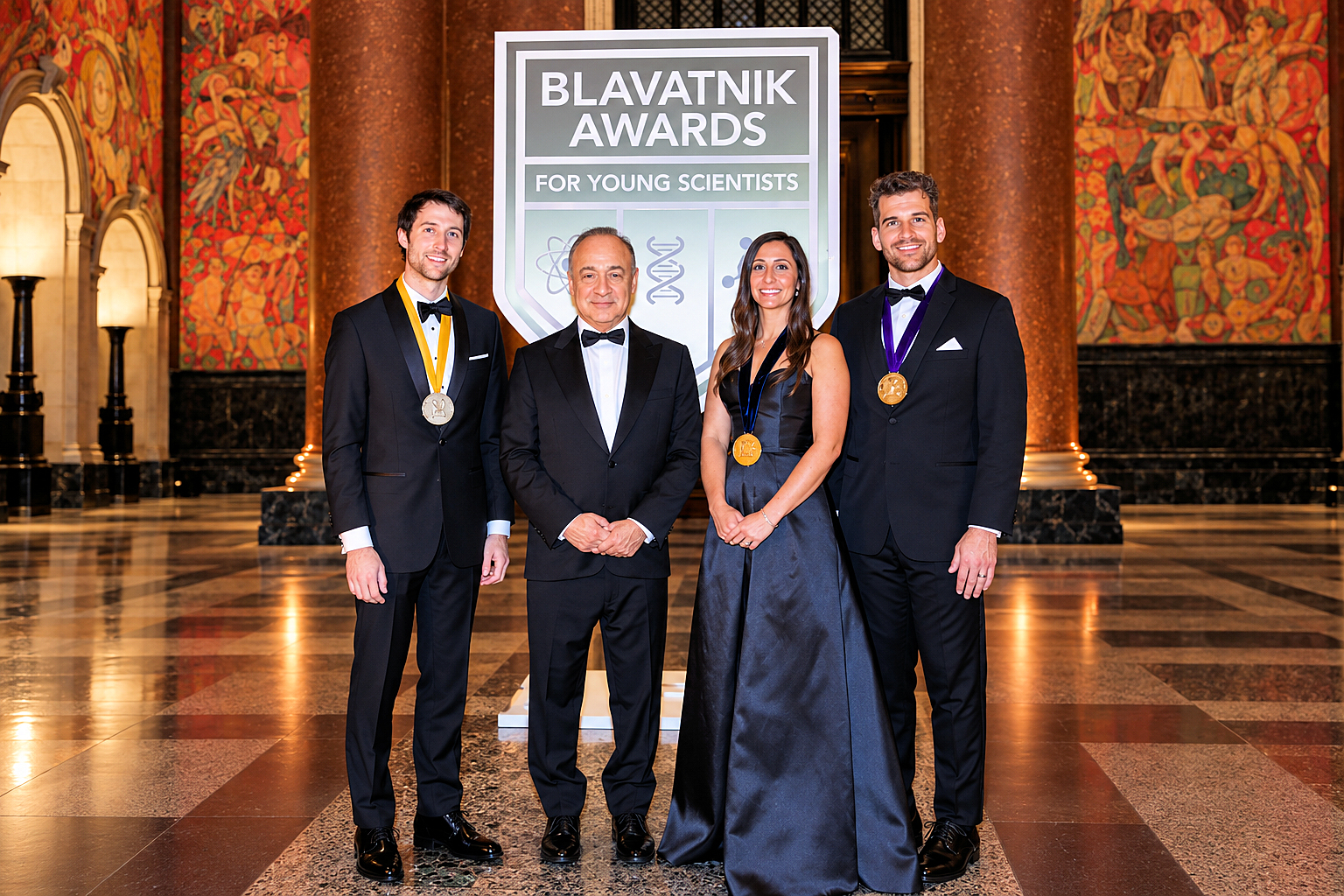
Under the great, vaulted halls of the American Museum of Natural History, where the long history of life is on display, Len and Emily Blavatnik hosted a black-tie evening about what comes next.
The 2026 Blavatnik National Awards for Young Scientists, presented on October 6 at the program’s 20th-anniversary gala, named three laureates.
Each received $250,000 in unrestricted funding, the largest unrestricted science prize for early-career researchers in the United States.
Richard P. Lifton, president of The Rockefeller University, presided over the evening as presenter of ceremonies, before an audience drawn from philanthropy, research, academia, business, and the arts.
The prize began with a question.
At the 2007 Nobel Prize ceremony, Len Blavatnik, founder of Access Industries and head of the Blavatnik Family Foundation, watched the world honor scientists for discoveries made decades earlier.
He wondered what might happen if exceptional scientists were recognized much sooner, just as they were building their own labs, chasing ambitious questions, and taking creative risks.
That same year, the Blavatnik Family Foundation created the awards, which The New York Academy of Sciences has administered independently ever since.
Nicholas B. Dirks, the Academy’s president and CEO, retold that origin story from the stage. “We are extremely proud to recognize this year’s National Laureates and to welcome them into the Blavatnik Awards community,” Blavatnik said.
The competition was steep.
This year’s laureates, all faculty scientists aged 42 or younger, were selected from 372 nominees at 187 academic and research institutions in 43 states and the District of Columbia. An independent jury of eminent scientists also named 15 finalists, each awarded $15,000 in unrestricted funds.
Two institutions celebrated firsts: Ohio State University and the Arc Institute each produced their first Blavatnik National laureate.
David Nagib, the chemical sciences laureate and a professor of chemistry and biochemistry at Ohio State, is known as a champion of “radical” medicinal chemistry. Making complex molecules is one of the slowest steps in drug discovery, and new medicines typically take 10 to 15 years to reach patients.
Nagib’s lab tames radicals and carbenes, two of chemistry’s most energetic and unruly species, and uses them to turn normally unreactive carbon-hydrogen bonds into useful building blocks. That helps chemists make more potent, more selective medicines faster and at lower cost. His paper classifying radical polarity was among the most read in the Journal of the American Chemical Society in 2024, the same year he was named a Blavatnik finalist.
His team has since built AI tools and an open-source database that let any researcher with a smartphone simulate reactions, cutting predictions that once took more than a day to seconds.
“Our goal is to democratize radical chemistry so it can be used by all,” he said. He describes his career as “playing in sandboxes or empty areas where nobody else is looking.” He plans to spend the prize on equipment and bold new ideas. “To be recognized in this way,” he said, “it really motivates us to keep chasing the stars.”
Patrick Hsu, the life sciences laureate, is a co-founder and core investigator of the Arc Institute in Palo Alto and an assistant professor of pathology at Stanford. As a graduate student at Harvard and the Broad Institute, he was an early pioneer of CRISPR-Cas9.
He later expanded the toolkit with RNA-targeting enzymes. In 2024, he and his colleagues announced bridge recombinases, a new class of RNA-guided enzymes. Their bridge RNA was the first known guide that recognizes both the DNA to be changed and the DNA to be installed, so whole regions of the genome can be inserted, removed, or flipped.
In 2026, his team showed the system working in human cells, targeting sequences linked to sickle cell disease and Friedreich’s ataxia. Hsu and his collaborators also built Evo 2, a genome foundation model that can flag likely disease-causing mutations and write new functional DNA.
“With AI, it’s now possible to design a DNA sequence and predict what it will do before writing it into living cells,” he said, adding generously that “this recognition belongs to a lot of people in my lab and across the field.”
Jonathan Rivnay, the physical sciences and engineering laureate and Jerome B. Cohen Professor of Engineering at Northwestern, works on an elegant problem. The body runs on chemical and ionic signals that conventional electronics can barely read, let alone answer. Rivnay designs soft, flexible materials that speak biology’s language.
He is best known for helping pioneer implantable “living pharmacies,” tiny devices that house engineered cells and prompt them to make medicine inside the body. In March, his multi-institutional team unveiled HOBIT, an implant about the size of a folded stick of gum.
It generates oxygen on site to keep its cell “factories” alive. In animal studies, it produced three biologics at once for 30 days: an anti-HIV antibody, a GLP-1-like peptide, and the hormone leptin.
Such devices, he said, “could eventually act as programmable drug factories inside the body,” pointing toward personalized care for cancer, diabetes, and circadian rhythm disorders.
The evening also honored the Blavatnik Regional Awards, the program’s original postdoctoral prize for New York, New Jersey, and Connecticut. Each laureate received $30,000 and each finalist $10,000.
The winners were chosen from 176 nominations at 35 institutions. Trevor van Eeuwen of Rockefeller won in chemical sciences for revealing how hidden DNA elements copy themselves and trigger immune responses, with clues to autoimmune disease and cancer. Barbara Bosch, a physician-scientist nominated by Rockefeller, won in life sciences for drug discovery against priority pathogens such as tuberculosis.
Natalie Fardian-Melamed of Columbia won in physical sciences and engineering for light-based nano sensors that remotely detect tiny mechanical forces, with uses ranging from biomedicine to quantum technology. Six regional finalists were also recognized.
The program’s international branch had its own celebration earlier this year.
On May 5, the Blavatnik Awards in Israel named three laureates, each awarded $100,000, the largest unrestricted prizes for scientists in Israel aged 42 or younger. Sergey N. Semenov of the Weizmann Institute designs simple chemicals that oscillate, form patterns, and move in lifelike ways.
Uri Ben-David of Tel Aviv University studies the “chromosomal chaos” of cancer and identified a vulnerability, the protein KIF18A, that is now a drug target in clinical trials.
Paz Beniamini of the Open University of Israel became that institution’s first laureate and the Israel program’s first astrophysicist, honored for work on stellar explosions and fast radio bursts. On June 2, they were celebrated against a sea-and-sunset backdrop on the terrace of the Peres Center for Peace and Innovation in Tel Aviv, in the program’s ninth year in Israel.
Twenty years in, the founding idea has proved itself many times over.
The awards started as a tri-state postdoctoral prize, went national in 2014, and in 2017 added parallel programs in the United Kingdom and Israel.
Together they now award more than $2 million a year.
To date they have honored 539 scientists with $21.5 million in unrestricted funding. Honorees have founded 52 companies, six of them publicly traded, with a combined value of more than $40 billion.
Lifton offered the clearest proof by tracing the first class of 14 honorees.
Eight now hold named or endowed chairs at Yale, Rockefeller, Cornell, Columbia, and Cambridge.
Five have been elected to the National Academy of Sciences, and one to the Royal Society, and their later honors include the Shaw Prize, the Benjamin Franklin Medal, and the Fields Medal.
Two decades after a question asked at a Nobel ceremony, the Blavatniks’ early bet on brilliance keeps paying off.