
$200 million-plus new gift: Victor and Victoria Atkins and the record donation that crowns school’s 125th year
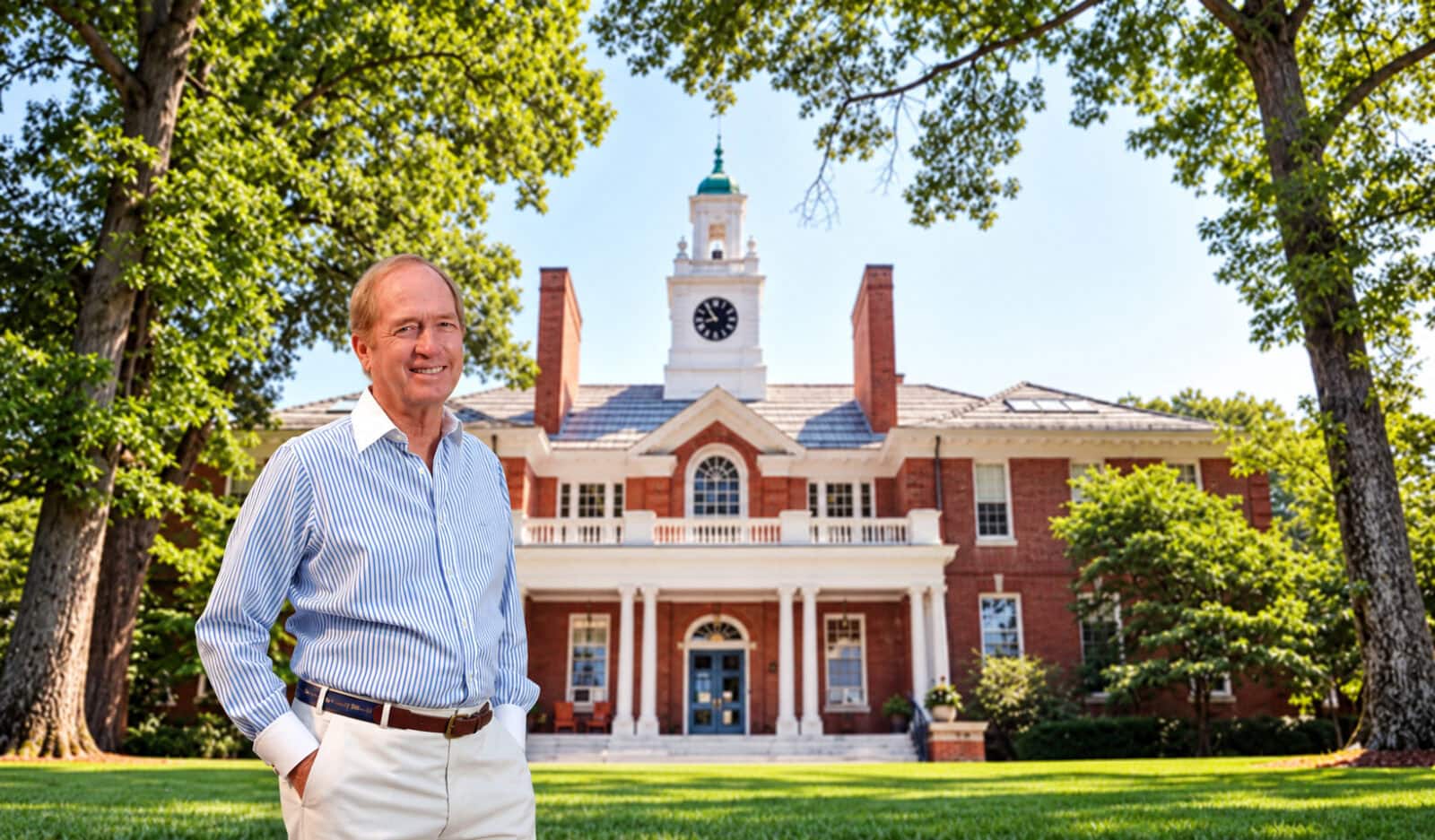
At Middlesex School’s 125th anniversary celebration, much of the room’s attention was on Victoria Ramsay Atkins.
Head of School Bessie Speers and Board of Trustees Chair Jason Robart, class of 1983, told a full room of faculty, staff, families, and alumni that her husband, Victor Kennicott Atkins Jr., class of 1963, had given the Concord, Massachusetts, school a gift with a projected long-term value of more than $200 million.
It is by far the largest gift in the school’s history and one of the largest ever made to an independent school in the United States.
For Victoria Atkins, the gift comes after years of listening to her husband talk about the school that shaped him. “Victor cared so deeply about Middlesex,” she said. “It was inspiring to hear his ideas and witness all the ways Middlesex impacted his life and, in turn, how his life has now impacted Middlesex.”
She was part of that relationship from the start. Speers said it had been an honor to spend time with Victor and Victoria over the past several years.
She credited the couple and many people at the school well before her tenure with building the connection that deepened his commitment to Middlesex.
As Speers described it, the Atkinses were a familiar and welcome presence at the school, not distant benefactors.
The gift reflects the priorities the couple talked about. Victor Atkins set out exactly how the money should be divided. Half is unrestricted, to be directed by the head of school and the trustees, and the school has added it to the endowment.
A quarter goes to the faculty endowment, to recruit and keep the teachers Middlesex is known for, and to protect its low student-to-teacher ratio. Fifteen percent goes to financial aid so that talented students can attend whatever their families can afford.
The last 10 percent goes to residential life, which supports the boarding experience at the heart of the school.
“Victor understood that the backbone of a great school is first and foremost its people,” Speers said. “By investing in our exceptional faculty, staff, and students, he has ensured that Middlesex can continue to attract, support, and inspire talented and dedicated human beings.”
The gift will arrive in stages. Middlesex has already received about 40 percent, and the rest will be paid to the school over the next several decades, according to Allegra Zamore, the school’s director of communications.
For a school of 429 students in grades 9 through 12, on a 350-acre campus off Lowell Road, the numbers are striking.
Middlesex’s endowment was $217 million in its most recent tax filing, so over time the Atkins gift could roughly double it. Before the gift, Middlesex ranked 19th in endowment among boarding schools with more than 400 students, according to Boarding School Review, and each of the top nine reported $400 million or more.
The school already has a 4-to-1 student-to-faculty ratio, and the gift is meant to maintain it.
Victoria Atkins’s own giving has long run alongside her husband’s. Donor lists at the Nevada Museum of Art in Reno show Victoria and Victor K. Atkins year after year among its most generous supporters, including as major sponsors of museum exhibitions.
In Santa Barbara, where the couple also spent much of their life, their names appear together on the donor rolls of the Cancer Foundation of Santa Barbara. Her husband’s giving reached Harvard, the University of Oxford’s 1610 Society, the Santa Barbara Museum of Art, the Santa Barbara Maritime Museum, and renowned cottage hospitals. Together, their giving has touched classrooms, galleries, and hospital wards in three states.
Another relative helped carry the story on Saturday: Victor’s younger brother, William T. Atkins, who followed him to Middlesex and graduated in 1967. He speaks as someone who knew the school with his brother. Victor “never forgot the impact Middlesex had on his life,” William said, and he believed in the school’s ability “to cultivate thoughtful, principled leaders to help to make meaningful difference in the world.”
William said Victor hoped the gift would inspire others in the school community “to carry that commitment forward, both on campus and in their personal and professional lives.”
The man his wife and brother describe came to Concord from San Francisco. He was born in Seattle, attended the Town School in San Francisco, and graduated from Middlesex with high honors.
He earned a cum laude degree in English from Harvard in 1967, then served as a U.S. Navy officer in the Vietnam War, earning the Bronze Star Medal with Combat “V,” the Vietnamese Cross of Gallantry and several unit commendations.
His family says he rarely spoke about those honors and preferred to talk about his pride in the men he served with. He graduated from Harvard Business School in 1972 with high distinction as a George F. Baker Scholar.
He started his career at Blyth & Company in New York, became a senior vice president at E.F. Hutton, and later served as chairman of Polaris Industries, helping guide it to a listing on the New York Stock Exchange. In his later years, he focused on private investing and on philanthropy.
At Middlesex, the family name was already familiar. Victor Atkins endowed the Atkins Athletic Center in 1993, the Atkins House dormitory in 2000, and the Elizabeth Atkins Field House in 2002.
The Concord Bridge put his earlier giving to the school at about $50 million.
The school inducted him into its Athletics Hall of Fame in 2010 and gave him its Henry Cabot Lodge Distinguished Alumni Award in 2018. A plaque on campus carries one of his favorite sayings, “Illegitimi non carborundum,” or “Don’t let the bastards get you down.” The family says the phrase sums up the determination behind everything he did.
At home, his family knew him as a lover of tradition, a big reader, an art enthusiast, and a great storyteller who knew his wine and his history as well as anyone. He was also famously blunt. The family liked to joke, “Victor, tell us what you really think.”
The line always got a laugh, because anyone who knew him knew he already had. Victoria Atkins has seen up close what the school watched from a distance: his generosity was quiet, and he gave to things he believed in, not for applause.
“This incredible act of generosity is, quite simply, a gift that will inspire and influence generations to come,” Robart said.
He called Victor Atkins “a visionary leader, philanthropist, and deeply loyal alumnus” who believed a Middlesex education should prepare students “not only for college, but for lives of purpose and leadership.”
George Noble, the school’s assistant head for institutional advancement, said the school’s task now is to build on that foundation “for generations to come.”
Few people understand that foundation better than the wife who heard the ideas behind it and the brother who walked the same campus four years after him.