$150 million gift, the largest in university’s history, launches Kevin Hallock’s $600 million Accelerate Richmond campaign
In 1969, when the University of Richmond was so strapped that closing it or handing it to the Commonwealth of Virginia was on the table, a soft-spoken pharmaceutical executive named E. Claiborne Robins stood behind a $50 million pledge.
Robins had arrived at Richmond as a poor scholarship student and paid his way as a working commuter. His gift was then the largest ever made to an American university by a living donor, and for more than half a century it has been the defining fact of the school’s modern identity.
Now that story got a new chapter.
At the kickoff of its most ambitious fundraising campaign ever, Richmond announced a $150 million gift commitment, the largest in the nearly 200-year history of the institution, from a donor.
Richmond has a quiet tradition of donors who prefer to stay out of view.
In 2023, a Robins School of Business alumnus who had worked part time at a grocery store to pay for his education made a $10 million planned gift for endowed business scholarships and asked that his name be withheld.
Late last year, another anonymous donor provided the lead gift for the Oliver Hill Faculty Fellowship at Richmond Law, the first endowed position at the university named for an African American.
The new donor has not been identified, and the university has disclosed nothing beyond the amount and the priorities the money will serve.
What is clear is the scale.
The commitment is three times the size of the Robins pledge in nominal dollars, six times the $25 million that alumni Carole and Marcus Weinstein gave in 2023 for a learning center, and on its own equal to a quarter of the new campaign’s goal.
That campaign, Accelerate Richmond, aims to raise $600 million for four priorities: access and affordability, academic excellence, what the university calls lives of purpose, and athletics. It has been running quietly for some time and has already brought in more than $425 million, so Thursday’s event marked the start of its public phase rather than its beginning.
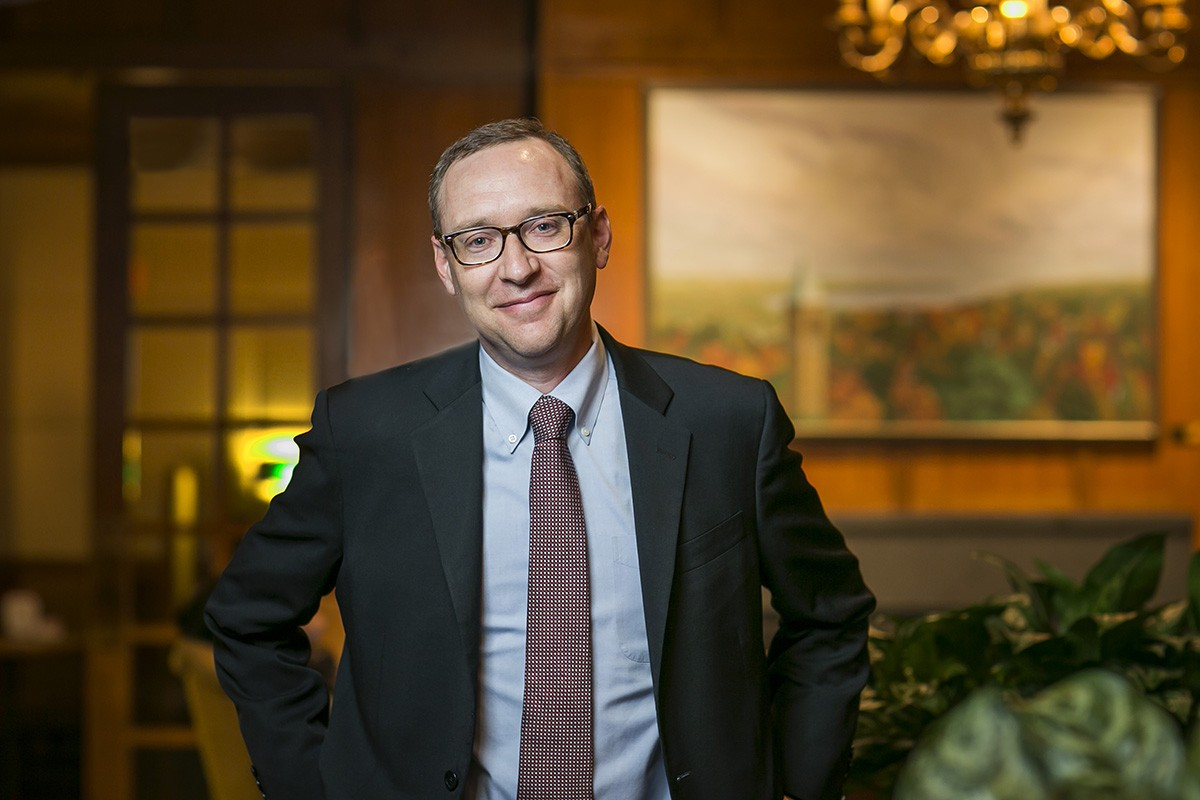
The person out front is Kevin F. Hallock, Richmond’s 11th president, who came to the university in 2021 after 16 years at Cornell, where he led both the SC Johnson College of Business and the School of Industrial and Labor Relations.
Hallock is a labor economist whose scholarship is about why people earn what they earn, and he still teaches a course on the economics of the university itself. It is hard to imagine a president better suited to explain where this gift is going.
“We are profoundly grateful for this generosity and the confidence of our supporters in the trajectory of the University of Richmond,” Hallock said. “This extraordinary gift builds on generations of generosity among the alumni and friends of this amazing university. I could not be more excited about our positive momentum and our future.”
The most carefully designed piece of the gift is a $50 million matching fund for endowed scholarships, called the Richmond Affordability Initiative. Rather than simply funding aid, the anonymous donor will match other donors’ gifts to endowed scholarships, a structure meant to pull in new money. If the match is fully used, it could put $100 million into permanent scholarship support.
The initiative is aimed squarely at a group elite private colleges often struggle to reach: middle-income families who earn too much to qualify for significant need-based aid but not enough to pay full tuition without strain.
Richmond already admits undergraduates need-blind and meets 100 percent of demonstrated need, but anyone who has sat at a kitchen table with a financial aid letter knows that “demonstrated need” and what a family can actually afford are not always the same number. The match is designed to close that gap.
There is a nice echo of Richmond’s own history in that structure. After Robins made his pledge, the university’s new president, E. Bruce Heilman, announced within months that Richmond would try to match it with another $50 million, at a time when the school’s largest campaign had raised about $2 million. Richmond raised more than $75 million in less than five years.
Robins, by the university’s own account, wanted his gift to encourage other alumni to give, and he believed education was “the greatest investment that any individual or corporation or foundation could possibly make.” Whether or not the new donor had that precedent in mind, the matching fund works the same way. It is a gift built to multiply itself.
The remaining $100 million will support the campaign’s other priorities. Richmond plans a series of endowments to recruit, recognize, and keep outstanding faculty and to support teaching in emerging fields, reinforcing the teacher-scholar model that goes with its small, discussion-based classes.
The campaign also promises every undergraduate personalized advising, career preparation, and hands-on experience, building on the Richmond Guarantee, which already gives each student up to $5,500 for a paid summer internship or faculty-mentored research. Athletics is the fourth pillar, with money for facilities, coaches, and scholarships across the university’s 17 Division I programs.
Athletics is also where one of the campaign’s most visible named donors has already stepped in. In June, alumni Paul and Anne-Marie Queally, both members of the Class of 1986, gave $10 million as the lead gift for a new lacrosse facility at the north end of Robins Stadium, expected to open in 2029.
Paul Queally, a former co-president of the private equity firm Welsh, Carson, Anderson & Stowe, served as the university’s rector from 2018 to 2022 and chairs the board of Spider Management, which invests Richmond’s endowment.
The couple’s name is already on Queally Hall at the business school, the Queally Center for Admission and Career Services, and the Queally Athletics Center.
The Weinsteins, meanwhile, remain among the university’s most generous benefactors, following their 2023 learning center gift with $3 million more to support Jewish life on campus.
The people who have given the most to Richmond over the decades—the Robins family, whose giving has passed $200 million; the Jepsons, whose support made possible the nation’s first school of leadership studies; the Weinsteins; and the Queallys—have mostly done it publicly, with their names on buildings. That makes the choice of anonymity for the largest gift of all stand out.
Anonymity keeps the attention on students, and it spares the donor the attention that comes with a nine-figure number.
It also lets the gift speak for itself, as a vote of confidence in an institution with an endowment of about $3.49 billion, a record of more than $54 million raised last year from over 16,800 donors, and an alumni base that has broken its own giving-day records two years running.
“Every donation, no matter the size, will serve to build upon the amazing student experience that defines a Richmond education,” said Martha Callaghan, vice president for advancement.
It is the same idea Claiborne Robins expressed more than 50 years ago: a single large gift can change a university, but it matters most when it encourages many others to give too.
Richmond now has $175 million left to raise, a $50 million match waiting to be claimed, and a benefactor whose name, for now, belongs only to those who need to know it.