
$100 million gift as a vote of confidence: Stephen M. Ross brings Pine Crest to West Palm Beach
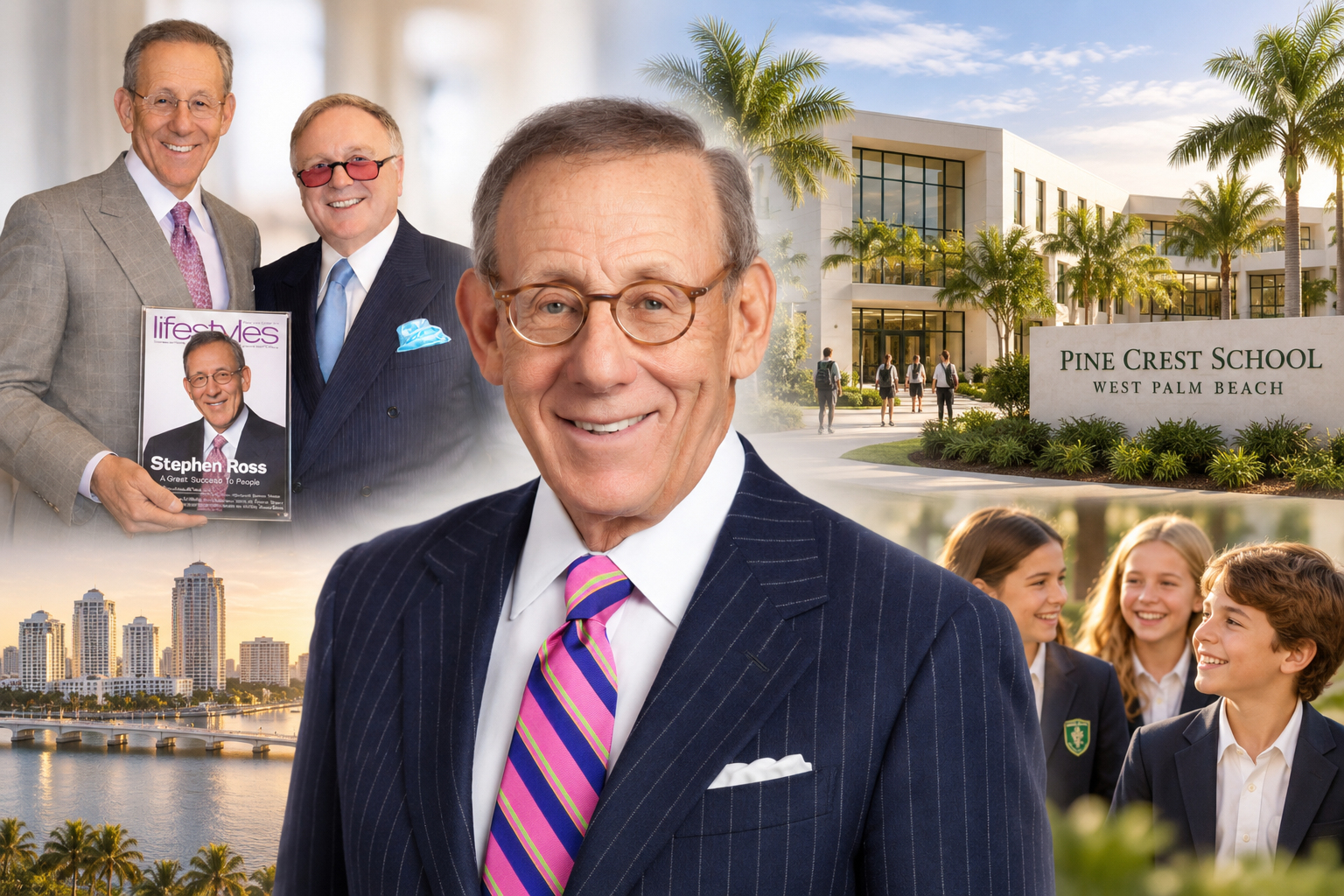
The Related Companies founder—and longtime Lifestyles Magazine/Meaningful Influence supporter—has quietly committed one of the largest philanthropic gifts ever made to an American independent school, giving a rising city something money alone rarely buys: a great school.
One kind of philanthropist gives to what already exists; another, rarer kind gives to what does not yet exist and insists it should. Stephen M. Ross has spent six decades in the second category. On Thursday afternoon, Bloomberg reported that the figure behind his latest act of civic imagination is $100 million—a commitment from the Stephen M. Ross Foundation that is helping Pine Crest School, one of the most respected independent day schools in the American South, open a third campus in West Palm Beach
By any measure, it is an extraordinary number.
And it is entirely characteristic of the man who made it.
Pine Crest, founded in Fort Lauderdale in 1934 by Dr. Mae McMillan in rented rooms above the old Elks Club, first revealed its West Palm Beach ambitions on June 2, describing a “landmark philanthropic commitment” from the Stephen M. Ross Foundation that would “accelerate and strengthen” a plan the school had been studying since 2023.
At the time, the amount was left undisclosed—a discretion that says as much about the donor as the sum itself. Reporting, attributed to people familiar with the matter, now puts the commitment at $100 million.
What makes the gift’s structure so thoughtful is that it does not simply build a building. In the school’s own description, the commitment underwrites faculty recruitment and retention, financial assistance, academic and extracurricular programming, and new spaces for research, technology, entrepreneurship, engineering, artificial intelligence, and experiential learning—across all three campuses, not merely the new one.
Fort Lauderdale and Boca Raton, which together enroll roughly 2,700 students, are strengthened, not diluted, by the expansion. That is philanthropy written by someone who has read a balance sheet.
The physical scale matches the financial one. On July 20, West Palm Beach city commissioners approved terms to sell Pine Crest 57 acres of undeveloped city-owned land along Roebuck Road near Florida’s Turnpike for $6.6 million — about $116,000 an acre, with 55 acres deed-restricted for educational use and two acres reserved for an access road.
The pre-K through grade twelve campus will be the largest in Pine Crest’s history, eclipsing Fort Lauderdale’s 48 acres and Boca Raton’s 28.
When a commissioner asked whether the school truly needed all 57 acres, Pine Crest said yes. Board of trustees chairperson Todd Rosenberg described the ambition plainly: not a “traditional school that’s multi-level and indoors,” but “an incredible campus, a place that everyone could be really proud of” (
The city’s own case for the discounted price was unsentimental and persuasive: the parcel requires extensive de-mucking before anything can be built, and Deputy City Administrator Armando Fana told commissioners the city faces a deficit of nearly 600 school seats, with demand certain to grow as new institutions bring “high-paying jobs and high-net-worth households.”
Pine Crest, for its part, framed the decision around a market transformed by shifting demographics, a surge in corporate relocations, and the arrival of Vanderbilt University and Cleveland Clinic.
Under president Dr. Dana Markham, who has led the school since 2011 after more than two decades in its classrooms and offices, Pine Crest is expanding from strength rather than necessity.
To understand why a $100 million gift to a K-12 school is so distinctive, it helps to remember where his philanthropy began.
In September 2004, Ross—a Detroit native, BBA ’62, and a tax attorney before he founded Related Companies in 1972—gave $100 million to the University of Michigan’s business school. The Regents convened in special session to rename it the Stephen M. Ross School of Business.
In September 2013, he gave $200 million more, split between the business school and athletics—then the largest single gift in the university’s history—bringing his total to $313 million.
He remains Michigan’s largest individual donor, with lifetime giving to the university now approaching $500 million.
Beyond Ann Arbor, he established the WRI Ross Center for Sustainable Cities, founded the Ross Initiative in Sports for Equality (RISE), and in 2013 signed the Giving Pledge, committing more than half his estate to charity.
Forbes and Bloomberg both place his fortune in the double-digit billions, built on a company that has developed or acquired well over $60 billion of property from Time Warner Center to Hudson Yards.
What is happening in Palm Beach County is not a retirement.
It is a second act pursued with the intensity of a first.
Through Related Ross, Ross has directed roughly $10 billion into West Palm Beach and the surrounding county, and Bloomberg has described him as leading the effort to make the city a “model city.”
The civic architecture has followed the cranes.
The Related Ross Foundation launched with a lead gift of $8.35 million to Palm Beach State College, guaranteeing tuition-free education for students in targeted neighborhoods.
In April, the college and the foundation surprised nearly 300 seniors at Palm Beach Lakes Community High School with full-ride scholarships.
In June, the Stephen M. Ross Emerging Scholars program expanded on a $12.66 million commitment, opening a college pathway to any interested graduating senior.
Perhaps the most quietly brilliant mechanism is Build Together, under which Related Ross office tenants contribute a dollar per square foot annually to the foundation’s grantmaking. More than 40 businesses had committed over $400,000 in ongoing annual support at launch, with participation reported at 100 percent and projections surpassing $2 million a year over the next decade.
It makes generosity a term of the lease—philanthropy engineered into the city’s operating model.
Seen against that backdrop, the Pine Crest commitment is the keystone.
Related to Ross is also backing Wingrove Academy, a pre-K through 12 school planned on 45 acres in Wellington, set to open in 2028.
Towers attract capital; schools attract families. Ross, who has spent a career reading cities before they become obvious, appears to have understood that a place only truly matures when its children have somewhere excellent to go in the morning.
The $100 million buys teachers who stay. It buys tuition assistance for families who would otherwise never see a campus like this. It buys laboratories where a fourteen-year-old encounters artificial intelligence as a tool, not a rumor. It buys 57 acres of Florida scrubland the chance to become the most consequential piece of educational real estate in Palm Beach County.
And it buys something less quantifiable. Pine Crest was founded ninety-two years ago by a woman tutoring winter visitors’ children in borrowed rooms. That it now enters its next century propelled by one of the largest independent-school gifts in American history is a fitting symmetry — one benefactor’s belief in the durable, compounding, entirely unglamorous value of a good education.
Lifestyles Magazine has followed Stephen M. Ross’s philanthropy for many years and has rarely seen it more precisely aimed.
He has named a business school, an athletic campus, a research center, and a movement.
This time he has done something arguably even more generous: he has built a school and, characteristically, tried not to mention the price.