
$200 million on a handshake with Wes Sechrest grew into the largest philanthropic fund in history devoted solely to pulling critically endangered species back from extinction’s edge
When Leonardo DiCaprio and Wes Sechrest sat down with Jeff Bezos and Lauren Sánchez in 2021, the meeting wasn’t pitched as the birth of anything historic.
It was, by most accounts, a conversation between people who cared about the same disappearing things—a chance for the actor and the biologist to talk with the Amazon founder and his wife about what it would actually take to keep certain species from vanishing for good.
Five years and a great many follow-up calls later, that conversation has become the Phoenix Species Project, a $200 million commitment that is now the largest single philanthropic fund in history dedicated exclusively to pulling critically endangered plants and animals back from the edge.
DiCaprio’s name will draw the headlines. Bezos’s fortune will draw the skepticism and the awe. But the person who has spent his entire adult life building toward this exact moment is a conservation biologist most Americans have never heard of, a man who has been quietly counting frogs, mapping extinction risk, and refusing to let obscure species die unnoticed for more than two decades.
Wes Sechrest is not a household name, and he seems entirely comfortable with that. He is the co-founder, chief executive, chief scientist, and board chair of Re:wild, the nonprofit that DiCaprio helped launch in 2021 and that Sechrest has actually run, in one form or another, since 2008. Before it was Re:wild, it was Global Wildlife Conservation, a scrappy Austin, Texas, outfit that Sechrest started with his childhood friend Brian Sheth, the two of them having grown up together exploring the forests of New England long before either had the money or the credentials to do anything about what they were seeing disappear.
Sechrest earned a biology degree at Wake Forest and a Ph.D. at the University of Virginia, then spent years doing the unglamorous work that conservation actually runs on: co-authoring the Global Amphibian Assessment, a sweeping evaluation of extinction risk across more than 8,000 amphibian species, and helping build the Zoological Society of London’s EDGE of Existence program, which ranks creatures by how evolutionarily irreplaceable and how endangered they are.
It is dense, unglamorous science—the kind that rarely makes anyone famous but that quietly decides which species get a fighting chance and which get forgotten.
That is the sensibility Sechrest has now poured into the Phoenix Species Project.
The fund, split evenly between $100 million from the Bezos Earth Fund and $100 million from Re: wild, with additional support from DiCaprio himself, the nonprofit Age of Union, and the Todd Graves Family Foundation, will back recovery efforts for what the project calls the Phoenix 100: a list of critically endangered animals and plants spanning 30 countries, chosen specifically because they already have local people fighting for them and simply lack the sustained money to finish the job.
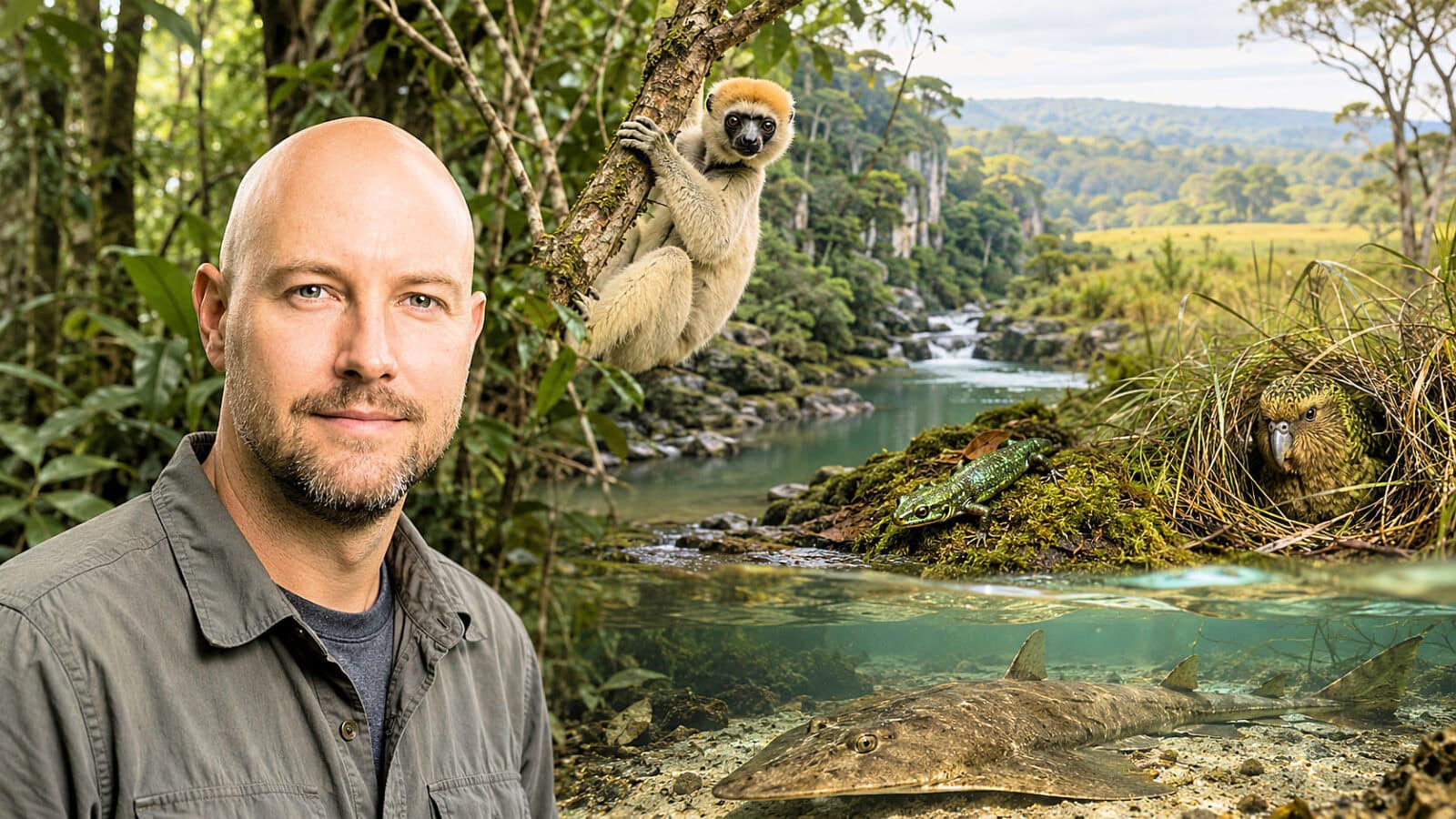
The list reads like an inventory of species that only a biologist could love into the spotlight: the golden-crowned sifaka, a lemur clinging to Madagascar’s northern forests; the Hickory Nut Gorge green salamander, a tree-dwelling amphibian discovered in a single North Carolina canyon in 2019 and then nearly wiped out by mudslides from Hurricane Helene; the Charco Azul pupfish, already extinct in the wild after its Mexican desert spring dried up from drought and agricultural water extraction; the bowmouth guitarfish, hunted across the Indo-Pacific for its fins; and Australia’s night parrot, a nocturnal ground-dweller that vanished from human sight for nearly 150 years before being rediscovered.
What sets the fund apart from the usual conservation grant is patience, and that patience carries Sechrest’s fingerprints all over it.
Rather than the one-year or two-year grants that force conservationists to spend as much energy chasing renewals as saving animals, the Phoenix Species Project is structured to give each species five years of guaranteed support, according to Barney Long, Re:wild’s senior director of conservation strategies, who has worked alongside Sechrest for years.
“This fund is focused squarely on species recovery, not merely stopping decline,” Long said, “freeing conservationists from disruptive short-term funding cycles and equipping them to do what’s actually required to bring species back.”
It is a philosophy. Sechrest has argued for it since long before Bezos or DiCaprio entered the picture, rooted in a belief he expressed plainly when the project launched: “Although we have pushed many species and ecosystems to the brink, we know that with the right people and resources, we can recover them.”
The timing matters, too, and Sechrest knows it.
It has been noted that this rare bit of good news for imperiled wildlife arrives even as the current administration in Washington rolls back endangered species protections, as governments worldwide fall short of their biodiversity commitments, and as corporations quietly walk back their own environmental pledges.
Against that backdrop, a private-sector fund willing to commit to species most people will never see in person feels almost defiant.
Speaking with Here & Now’s Scott Tong days after the launch, Sechrest made the case that saving obscure creatures is never really just about the creatures—it is about the ecosystems that quietly keep humans alive, the forests that filter drinking water, the wetlands that buffer storms, and the webs of life that climate change is fraying from every direction at once.
It is the same argument he has been making in scientific journals and county-fair-sized nonprofit offices for twenty years, just delivered, for once, to a national radio audience instead of a peer-reviewed panel.
There is something fitting about a project this large being anchored by someone who built his career studying the smallest, least celebrated creatures on Earth—salamanders in a single canyon, a fish that lived in one spring, and a succulent the size of a fingertip.
Sechrest has spent his life arguing that these lives matter on their own terms, evolutionary distinctiveness and all, independent of whether anyone finds them charismatic.
Now, with $200 million behind him and a coalition that includes one of the world’s richest men and one of its most recognizable actors, he finally has the resources to prove it.
The test, as Sechrest would likely be the first to admit, is not the announcement. It is what the Phoenix 100 looks like in five years, when the funding cycle he fought so hard to build finally comes due.