$10 million to help earthquake recovery announced by Carlos Jordá
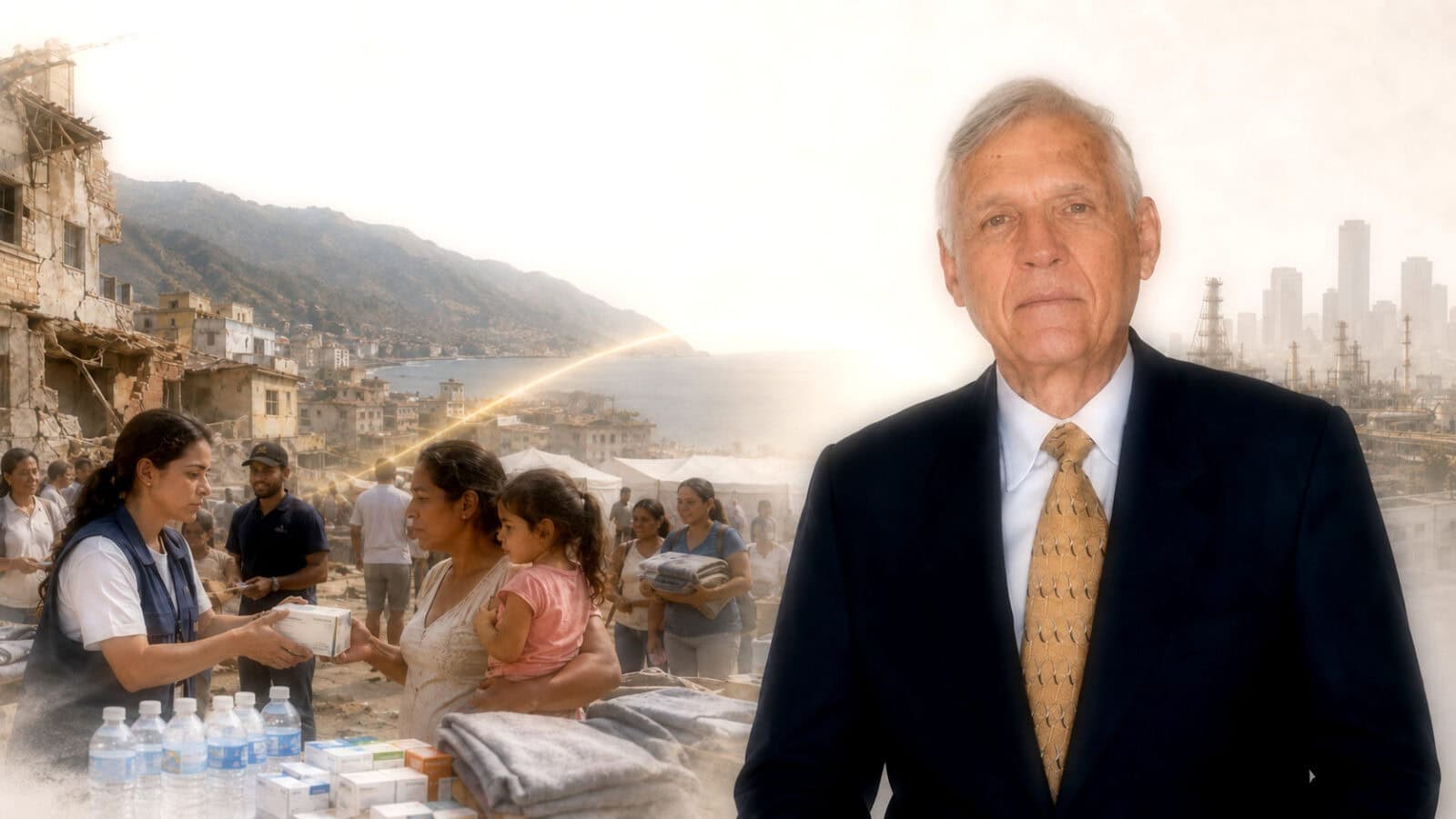
Carlos Jordá was 22 years old when he first walked into a Venezuelan oil refinery, fresh out of engineering school, with no way of knowing that more than five decades later he would still be tied to that same industry, still carrying that same country with him, even after building his career and his family thousands of miles away in Texas.
Recently the President and CEO of CITGO stood before investors to discuss the company’s quarterly results, and then did something that had little to do with earnings at all.
“Our thoughts are with the people of Venezuela affected by the recent earthquakes,” he said.
“The company launched an employee matching program and approved a $10 million donation to the Simón Bolívar Foundation to support relief efforts for people affected by the earthquakes that struck Venezuela on June 24. The donation will be allocated to reputable international organizations that will provide emergency supplies and immediate assistance, maximizing the impact of aid in the affected areas”.
It was a brief passage in a long financial statement, but for Jordá, it was not routine.
He was born in Venezuela, trained as a chemical engineer at Michigan Technological University and the Universidad Central de Venezuela, and started his professional life in 1971 at the Amuay refinery before spending the next 27 years climbing through Petróleos de Venezuela, S.A., the country’s national oil company.
He eventually became president of PDV America and, between 1999 and 2002, chairman of the very company he now runs — CITGO itself grew out of Venezuela’s state oil apparatus, which means Jordá’s entire career and the company’s history have been quietly intertwined with the country for decades.
He moved to Houston with his wife, Dalia, in 2007, and the couple has raised three children and welcomed three grandchildren there, building an American life while never fully stepping away from his roots.
That is the man who, on June 24, watched the news alongside everyone else as two massive earthquakes tore through the country of his birth — a magnitude 7.2 foreshock followed less than a minute later by an even more powerful magnitude 7.5 mainshock, the strongest to strike Venezuela in more than a century.
In La Guaira, the coastal state closest to the epicenter, roughly 80 percent of buildings are estimated to have collapsed.
What began as a tally of 32 confirmed deaths in the first chaotic hours grew, week after week, into a far larger tragedy: by early August, more than 6,300 people had died, over 73,000 had been hospitalized, and tens of thousands remained unaccounted for.
For most CEOs, a disaster in a country where their company happens to do business might warrant a statement and a check.
For Jordá, colleagues and biographers describe something closer to an obligation shaped by identity — a man who spent nearly three decades inside Venezuela’s oil industry before ever crossing into the American corporate world, and who has spoken previously about how his engineering training and his roots shaped the way he leads.
Under his direction, CITGO’s response didn’t stop at a corporate press release.
The company activated its Simón Bolívar Foundation, a charitable arm it has quietly funded for years with a specific and unglamorous mission: getting medicine, vitamins, and basic health care to Venezuela’s most vulnerable people, particularly mothers and children, both inside the country and among the diaspora who have fled it.
In a typical year, that mission runs on a few million dollars — $7.5 million in 2024, for instance, enough to reach a few hundred thousand people with essentials.
Jordá’s $10 million pledge, delivered personally in his own words rather than buried in a press release, is one of the largest single commitments the Foundation has made, and it is being funneled through vetted partners already working inside Venezuela’s disaster zones to deliver emergency medical care, essential medicines, and temporary shelter.
He didn’t stop there. Jordá also greenlit an employee matching program, meaning that when a refinery worker in Lake Charles or a terminal employee in Corpus Christi decides to give whatever they can spare, the company doubles it — turning individual acts of generosity from a workforce that includes many with their own family ties to Venezuela into something larger.
It is a tool CITGO has reached for before in moments of crisis, including during the 2010 Haiti earthquake, when the Foundation matched employee gifts dollar for dollar.
Other companies have made their own gestures — ExxonMobil gave $500,000 to the American Red Cross in early July, and by that point the broader private sector had mobilized nearly $33 million for earthquake relief — but none of those announcements carried quite the same weight of personal history.
For Jordá, this was never simply a line item.
It was a 76-year-old engineer who left a Venezuelan refinery as a young man, built an entire career and family on the other side of that departure, and then, watching his home country buckle under the earth’s shifting plates, decided that the company he leads would answer not just as a business, but as something closer to family.