
$20 million gift from alumnus Bob Hinton presents naming opportunity at university
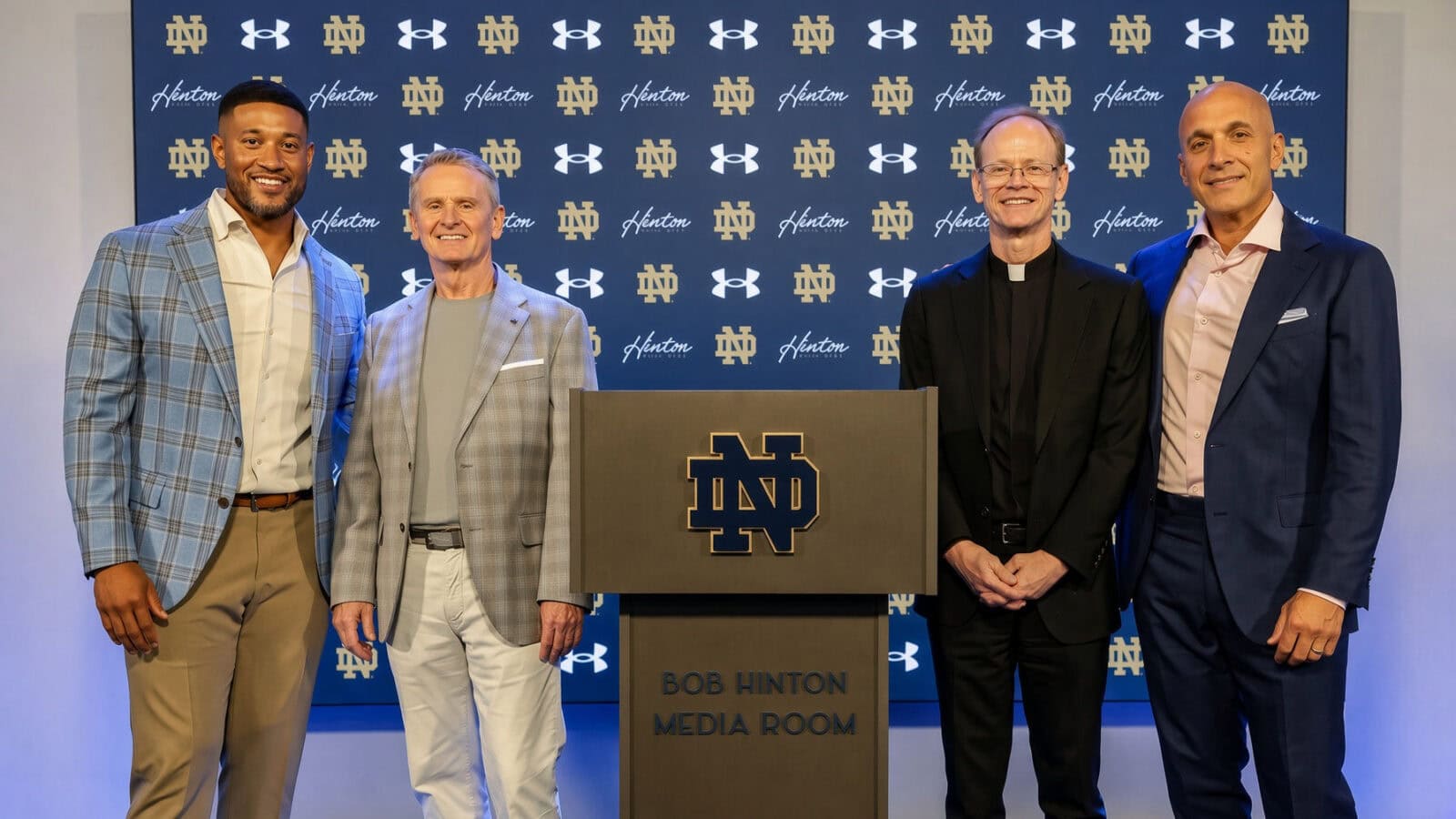
The University of Notre Dame has announced a $20 million gift from alumnus Bob Hinton to name the stadium’s north tunnel and media room.
Starting this season, the Fighting Irish will take the field through the Bob Hinton Tunnel.
Coaches and players will address the media inside the Bob Hinton Media Room.
Hinton, a 1976 Notre Dame graduate and founder of Hinton Transportation Investments, said his gift is aimed at keeping Notre Dame competitive in college football — on the field and in the classroom.
The gift, announced by the university on August 12, was celebrated with a gathering held inside the newly christened media room, where Hinton was honored with a blessing from University President Rev. Robert A. Dowd, C.S.C., and remarks from James E. Rohr, Director of Athletics, Pete Bevacqua, and Dick Corbett, Head Football Coach, and Marcus Freeman.
For nearly a century, the north tunnel has served as one of the most recognizable pieces of real estate in college athletics, the passage through which generations of Notre Dame players—from Knute Rockne’s era through Joe Montana, Tim Brown, and Jerome Bettis—have emerged onto the field beneath the “Play Like a Champion Today” sign. Beyond gamedays, the tunnel doubles as a landmark for campus tours and a processional route for graduates during commencement, giving it a symbolic weight that extends well past football.
“Bob is a loyal son of Notre Dame, and his generous gift will make a considerable impact on our student-athletes’ experiences now and in the future,” Bevacqua said in the university’s release.
“We are honored to celebrate him by adding his name to our iconic stadium tunnel and to our media venue, a location that allows our student-athletes and coaches to speak to a global audience.”
The media room itself, tucked inside the stadium’s north end, functions as the university’s most visible public-facing platform in athletics—the site of postgame press conferences, coaching announcements, and campus briefings that reach fans and journalists well beyond South Bend.
With his name now attached to it, Hinton’s gift effectively wires his identity into the university’s ongoing broadcast of itself to the world, a role he embraced when he said, “In today’s college football landscape, being the best off the field with facilities, coaches, and administration is as important as being the best on the field. Both are necessary for consistent success.
Notre Dame’s commitment to both is clear. I am humbled and honored to be part of continuing to make Notre Dame the icon of college football on the field and, as importantly, in the classroom. Nobody values the student-athlete experience better than Notre Dame.”
The $20 million commitment is not Hinton’s first large investment in Notre Dame football.
In 2019, he made a $5 million gift to endow the program’s defensive coordinator position,
, becoming just the fourth endowed coaching role in Fighting Irish football history at the time, alongside the positions held by head coach Brian Kelly, offensive coordinator Chip Long, and defensive backs coach Todd Lyght. Clark Lea, then in his first year running Notre Dame’s defense, became the inaugural Bob Hinton Defensive Coordinator.
At the time, athletic director Jack Swarbrick praised Hinton’s embodiment of “excellence, integrity, faith, and family,” while head coach Brian Kelly noted that Hinton had “used that experience to develop an incredibly successful business, primarily built upon the idea of family,” and that his giving reflected a habit of “always thought of others — and in this instance, Notre Dame — before himself.”
Taken together, the two gifts put Hinton’s known cumulative giving to Notre Dame athletics at roughly $25 million over seven years, a pace of philanthropy that has quietly built him into one of the program’s most significant modern benefactors even as he has kept a relatively low public profile outside of South Bend.
That profile traces back to a business built far from the spotlight, in the trucking and heavy-duty transportation industry of West Michigan.
Hinton graduated from Notre Dame in 1976 with a degree in accounting and began his career at Arthur Andersen & Co., then one of the country’s most prestigious accounting firms. In 1983, he left that path to purchase a small company, New Life Transport Parts Center, in a leveraged buyout from American Natural Resources, Inc., a New York Stock Exchange-listed conglomerate that had operated it as part of its transportation division since 1974.
At the time of the purchase, the business had $9 million in sales and 19 employees—a modest starting point for what would become a decades-long build.
Hinton made the company family-owned and family-run, a structure and philosophy he has credited repeatedly as the foundation of his success. Over the following four decades, through a combination of organic growth and acquisitions, Hinton expanded that single business into Hinton Transportation Investments, now the largest trailer aftermarket parts business in its industry, with operations spanning North and South America and more than 1,000 employees.
Its portfolio today includes New Life Transport Parts, Road Equipment, Martec International, Pace Transportation, and U.S. Trailer Parts & Supply, operating out of a home base in Byron Center, Michigan, near Grand Rapids. In 2017, Hinton stepped back from day-to-day leadership, passing the president and CEO title to Robert Lindley, while remaining active as chairman of the company’s board.
The “family business” ethos that Hinton built his company around extends directly into his philanthropy and into his own household. His two children, Caitlin Hinton, a 2008 Notre Dame graduate, and Joseph Hinton, a 2011 Notre Dame graduate, both work alongside him at Hinton Transportation Investments, and both were on hand, by virtue of their own Notre Dame ties, to watch their father’s name permanently etched into the university’s most storied piece of gameday architecture.
It is a detail that has run through both of Hinton’s major Notre Dame gifts: the sense, echoed by coaches, administrators and Hinton himself, that his devotion to family and his devotion to his alma mater are, in his mind, largely the same instinct — a belief that lasting institutions, whether a trucking company or a football program, are built the same way, one generation investing in the next.
Notre Dame’s athletic department has increasingly leaned on major donors to fund the infrastructure behind its on-field ambitions, from the $100 million-plus football operations facility the university unveiled this summer to a string of other named spaces across its stadium and campus.
Hinton’s gift fits within that broader pattern of philanthropy reshaping the physical and competitive landscape of college football, where facilities, coaching salaries, and staff resources have become as central to recruiting and retention as tradition itself.
For Notre Dame, whose independence from a conference media contract has long required it to rely more heavily on private giving than many of its rivals, gifts like Hinton’s have become not just symbolic gestures but structural necessities.
Fittingly, for a program that trades heavily on symbolism and continuity, the university chose to mark this particular gift on the ground where its identity has always been most visibly performed: the tunnel players run through the golden helmets by, and the room where, week after week, the story of the Fighting Irish is retold to the world.