$50 million new gift to university from Lifestyles Magazine/Meaningful Influence cover subject David M. Rubenstein elevates his philanthropy past the billion-dollar mark

The University of Chicago’s historic quads are poised for a new century of student life and intellectual exchange, thanks to a transformative $50 million gift from David M. Rubenstein, chair of the University’s Board of Trustees and one of America’s most imaginative philanthropists.
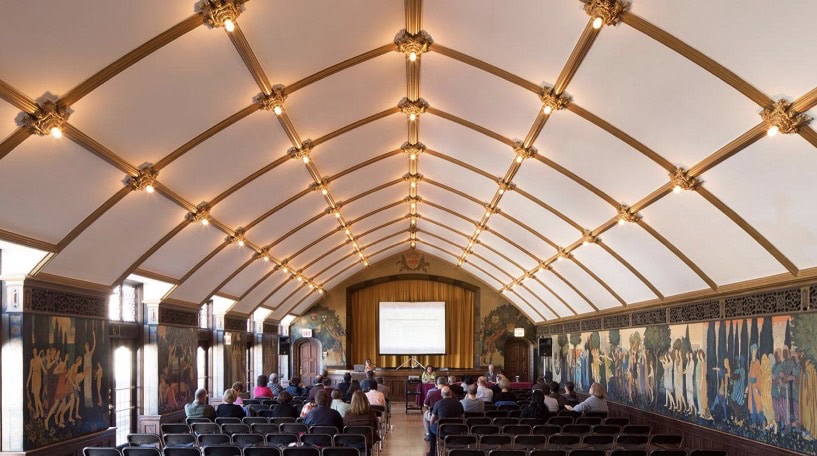
His latest commitment will modernize Ida Noyes Hall—an iconic 1916 neo-Gothic landmark—recasting it as the David M. Rubenstein Commons, a vibrant hub where students, faculty, alumni, and visitors can gather, study, and connect while preserving the building’s beloved architectural character and name.
For a campus that treasures its history as much as its future, the gift is both a bold investment in student experience and a characteristically forward-looking expression of Rubenstein’s belief that great institutions and great spaces must be renewed for generations yet to come.
The university describes the project as the first step in an ambitious, long-range effort to revitalize its historic quads, preserving their architectural legacy while updating key buildings to meet contemporary needs for accessibility, sustainability, and collaborative spaces.
Rubenstein Commons will be designed as an inviting living room for the campus, with spaces that encourage informal conversation, quiet study, and community building, echoing Ida Noyes Hall’s century-long role as a social and intellectual crossroads while also equipping it with modern infrastructure and environmental performance.
President Paul Alivisatos has framed the initiative as proof that UChicago can safeguard the “beauty and meaning” of its historic environment while ensuring it actively serves the university’s mission for the next hundred years.
For Rubenstein, who has chaired the board since 2022 and works closely with university leadership on vision and governance, the project is deeply personal.
A 1973 graduate of the Law School and former editor of the Law Review, he has long spoken of UChicago as a place that shaped his thinking and opened his horizons, and his philanthropy to the institution has steadily reflected that gratitude.
“UChicago’s historic buildings and its quads are architectural treasures,” he has said, emphasizing that breathing new life into Ida Noyes Hall is about creating a “center of gravity” for the campus that welcomes the world to Hyde Park while honoring the legacy of those who built it.
The Ida Noyes project joins a series of landmark gifts that have already reshaped the university’s landscape and expanded access for its students. In 2010, Rubenstein created the Rubenstein Scholars Program at the Law School, one of the nation’s most selective full-tuition scholarship initiatives, which has already supported more than 200 outstanding students and, through subsequent renewals, continues to underwrite three years of tuition for dozens of scholars in successive classes.
His philanthropy also made possible the David Rubenstein Forum, a striking conference center and intellectual destination that opened in 2021 and now hosts major conferences, lectures, symposia, and arts events, strengthening UChicago’s connection to the city and to global conversations across disciplines. Seen together, the Forum, the Scholars Program, and the new Commons form a powerful triangle of investment in ideas, people, and place.
Beyond Chicago, Rubenstein’s name has become synonymous with a modern, civic-minded approach to giving that he himself has framed as “patriotic philanthropy.”
As co‑founder and co‑chairman of The Carlyle Group, he built one of the world’s leading investment firms and then used that success to support the institutions, documents, and cultural treasures that define the American story.
An original signer of The Giving Pledge, he has committed the majority of his wealth to philanthropy and has translated that pledge into tangible projects that the public can see and touch—from restored buildings to accessible archives.
In Washington, D.C. and across the country, his gifts have helped restore and sustain some of the nation’s most important historic sites. He has provided major support to the National Park Service, the National Archives, George Washington’s Mount Vernon, Thomas Jefferson’s Monticello, and the Kennedy Center, where he served as chairman of the board.
At the Library of Congress and the Smithsonian Institution—where he is a former chair of the Board of Regents—Rubenstein has backed both capital projects and programming that broaden public access to history and culture, including a $10 million gift to the Smithsonian’s National Museum of African American History and Culture and the loan of rare Abraham Lincoln documents such as the Emancipation Proclamation and the 13th Amendment.
These efforts have allowed millions of visitors to encounter artifacts that might otherwise remain out of sight, reinforcing his conviction that history belongs to everyone.
Higher education has been another central pillar of Rubenstein’s philanthropy, marked by both scale and thoughtful attention to institutional needs. At Duke University, his undergraduate alma mater, his contributions—now exceeding $100 million—have supported the Rubenstein Arts Center, the Rubenstein Rare Book and Manuscript Library, public policy, athletics, and the David M. Rubenstein Scholars Program for first-generation and low-income students, while his leadership as board chair helped guide Duke through a critical period of its own growth. He has made similarly significant commitments to Harvard, including $60 million to the Harvard Kennedy School for fellowships and campus expansion, and he serves as a Fellow of the Harvard Corporation, reflecting a pattern of service that matches his philanthropy.
Rubenstein has also invested in the frontiers of knowledge beyond universities, backing institutions dedicated to pure research and global problem-solving. At the Institute for Advanced Study in Princeton, he provided $20 million for a new building—also called Rubenstein Commons—that gives leading scholars a dedicated space to collaborate across disciplines, reinforcing the Institute’s unique role as a haven for curiosity-driven inquiry.
He sits on the boards of organizations such as the National Gallery of Art, Memorial Sloan Kettering Cancer Center, Johns Hopkins Medicine, the Brookings Institution, and the World Economic Forum, bringing an investor’s discipline and a historian’s perspective to some of the world’s most consequential institutions.
Even as his name is attached to buildings and programs, Rubenstein has also become a widely recognized public educator in his own right. As the host of television programs and podcasts and the author of several books on leadership and American history, he uses conversation as a philanthropic tool, amplifying the insights of thinkers, public servants, and cultural leaders for broad audiences.
That commitment to public understanding is of a piece with his giving: whether restoring a monument or endowing a scholarship, the through line is a belief that informed citizens and vibrant institutions are essential to a healthy democracy.
His contributions have not gone unnoticed. Rubenstein is a recipient of the Presidential Medal of Freedom, the nation’s highest civilian honor, in recognition of his impact as a financier, philanthropist, and civic leader. Yet those who work alongside him often emphasize his hands-on engagement—the hours spent in boardrooms, committee meetings, and strategy sessions—and his readiness to leverage networks and ideas —not just funding —to advance causes he believes in.
At UChicago, that combination of generosity, governance, and genuine affection for the institution has made him a crucial partner in shaping the university’s trajectory amid rapid change in higher education.
With the announcement of the Ida Noyes Hall gift, the University of Chicago community sees not only the future of a beloved building secured but also a clear signal of confidence in the institution’s long-term vision.
As designs are developed and timelines set, students and alumni alike can look forward to a revitalized Commons that weaves together the past and the future: a neo-Gothic landmark filled with light, conversation, and possibility.
It is an approach that mirrors Rubenstein’s broader philanthropy—deeply rooted in history, unmistakably modern in its aspirations, and always oriented toward creating spaces, in every sense, where people can gather to learn, reflect, and imagine what comes next.