
$188 million gift to university’s Humanities Hub marks the pinnacle of Stephen A. Schwarzman’s billion-dollar lifetime of transformative philanthropy
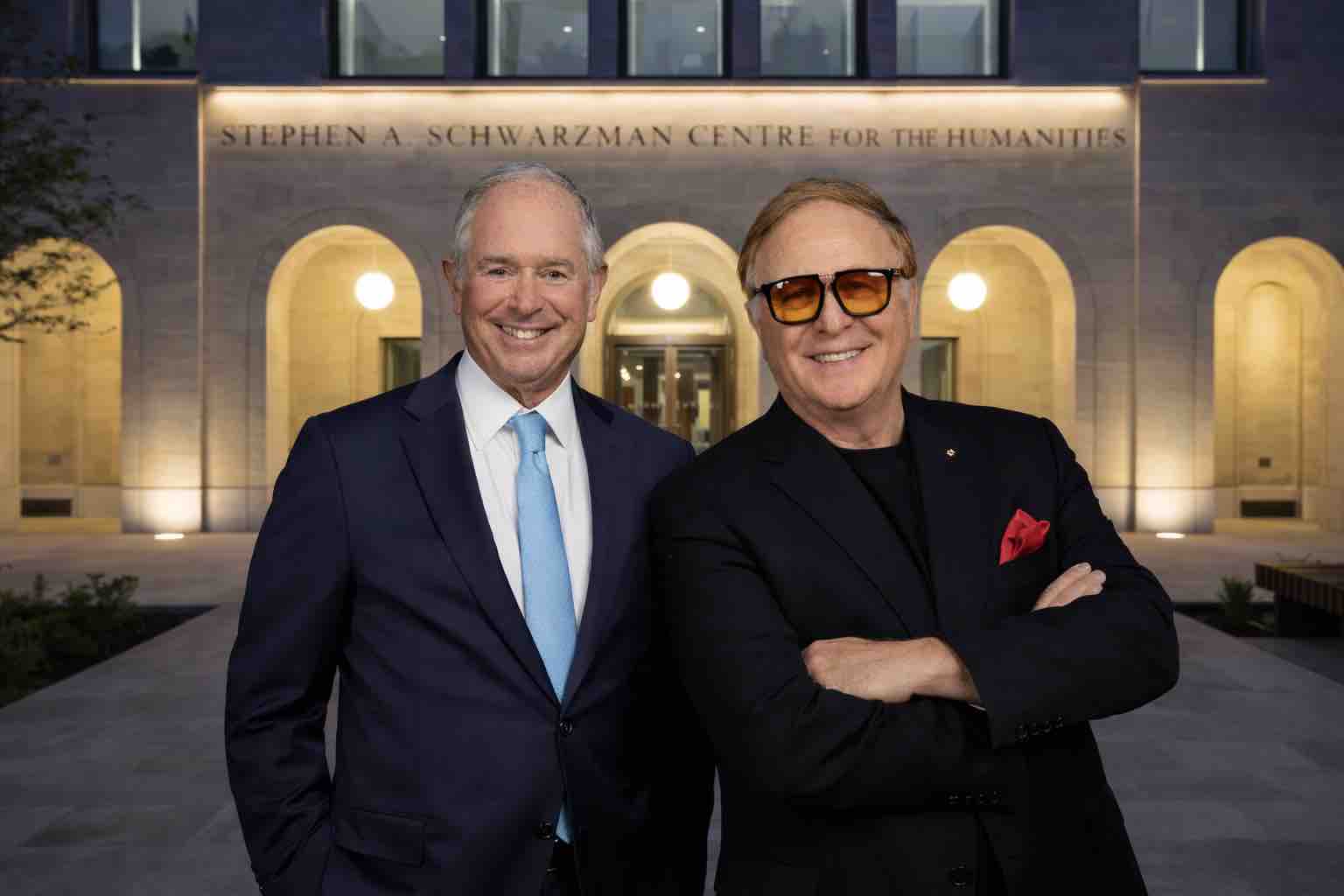
On April 25, 2026, Oxford University will open the doors of one of the most ambitious and symbolically resonant academic buildings in its eight-century history: the Stephen A. Schwarzman Centre for the Humanities. Poised between modern experimentation and ancient tradition, the new center is more than just an architectural addition to the storied university—it is the physical manifestation of an evolving vision of how scholarship, creativity, and human meaning can intersect in the digital age.
Designed by Hopkins Architects and situated in the Radcliffe Observatory Quarter, the building unites seven humanities faculties under one roof for the first time while bridging the boundaries between research, performance, and public life. Its creation was made possible by a landmark £150 million donation from Stephen A. Schwarzman, whose name now sits beside some of the most venerable institutions in the world—an act both philanthropic and philosophical in its implications.
The opening celebration—free and open to the public—is designed as a day-long unfolding of what the center intends to be: inclusive, intellectual, and inspiring. Among the inaugural performances, artist Es Devlin and composer Nico Muhly will transform the Great Hall into a landscape of clay vessels and choral harmonies with 360 Vessels, a newly commissioned work performed by Oxford’s Schola Cantorum.
The piece, inspired by Oxford’s Dominican foundations and the writings of 17th-century poet-theologian Thomas Traherne, embodies the center’s aim: a shared inquiry into what it means to be human through sound, structure, and spirit.
The day continues with the Scottish Ensemble performing Shostakovich and Tchaikovsky from memory, each note synchronized with choreographed movement to visually express music’s patterns, while ZooNation Dance Company brings The Mad Hatter’s Tea Party to the center’s new theatre, reimagining Wonderland as a vibrant hip-hop spectacle of rhythm and identity.
Art and technology converge in works by Refik Anadol and Anna Ridler, both of whom redefine what cultural imagination looks like in the age of artificial intelligence.
Anadol’s Archive Dreaming turns immense datasets into living, breathing visual landscapes that pulse with motion and meaning, a reminder that archives—like memory itself—are dynamic and ever-evolving.
Ridler’s newly commissioned A Perfect Language of Images continues her decade-long exploration into AI, knowledge, and natural history, drawing upon scientific research underway at Oxford. These installations, immersive and introspective, embody the Centre’s guiding ethos: that the humanities are not a relic of the past but a continually renewing conversation between art, science, and society.
For Cultural Program Director John Fulljames, the Centre’s mission is about connection as much as creation. His programming, built around collaboration and co-creation, brings an exceptional roster of artists into sustained exchange with Oxford’s academic community through the Schwarzman Centre Cultural Fellows program.
Among them are Refik Anadol, Es Devlin, Lil Buck, Bryce Dessner, Rhiannon Giddens, Kae Tempest, Nitin Sawhney, Sir Wayne McGregor, Hans Ulrich Obrist, and creative studio Marshmallow Laser Feast.
The result is a constellation of voices that challenge the ivory tower stereotype, transforming Oxford’s humanities into a space for fluid dialogue between intellect and imagination. Fulljames describes the opening as “a place where we can all come together to make sense of what it means to be human in today’s world,” encapsulating the spirit that defines this new era at the university.
Beyond its architecture and programming, however, the Schwarzman Centre represents the most significant British philanthropic gift in the humanities in modern memory—one that places its benefactor, Stephen A. Schwarzman, among the rare figures reshaping educational landscapes through scale and strategy.
Best known as the co-founder, chairman, and CEO of Blackstone, one of the world’s largest alternative investment firms, Schwarzman’s philanthropy has evolved into an international campaign to strengthen institutions of learning and culture.
His approach blends American-style magnitude with global reach, echoing the 20th-century patrons who sought to couple financial achievement with intellectual legacy.
The Oxford gift follows a $350 million donation to MIT in 2019 to establish the Schwarzman College of Computing, a $100 million gift to the New York Public Library in 2008 that led to the naming of its main building as the Stephen A. Schwarzman Building, and a $100 million gift in 2013 to launch Schwarzman Scholars at Tsinghua University in Beijing—a Rhodes-like graduate fellowship aimed at fostering cross-cultural leadership between China and the West.
Collectively, these gifts illuminate a coherent philosophy of giving rooted in the belief that knowledge, if paired with ethics and cultural depth, remains the best safeguard against the uncertainties of the modern world.
Schwarzman, who has often spoken about his desire to preserve and elevate humanistic inquiry in an AI-driven future, has placed the humanities in dialogue with technology rather than in opposition to it.
At Oxford, that impulse is evident in the building’s layout, where the Institute for Ethics in AI sits alongside performance and research spaces.
While his earlier gifts emphasized computation, data, and cross-border education, the Schwarzman Centre represents a return to human reflection—the interpretive lens through which innovation must pass to remain humane.
The scope of Schwarzman’s philanthropy also underscores the growing scale of private giving that now defines global higher education. His cumulative donations exceed $1.3 billion, placing him among the leading university benefactors of his generation.
Yet his gifts have always carried both civic and symbolic weight. In New York, the restored Schwarzman Building of the Public Library reimagined one of the city’s most historic cultural venues for the digital era, while in China, the Schwarzman Scholars program created a new educational model for international understanding. At Oxford, the emphasis shifts once more—from infrastructure and algorithms to empathy, performance, and public participation.
The Schwarzman Centre is therefore not only a British architectural event but an expression of a global conversation about how culture and capital can align to strengthen the social fabric.
As Oxford prepares for its public opening, anticipation extends beyond academia. The upcoming themed seasons—Unfinished Revolutions, exploring the legacy of the 1776 U.S. Declaration of Independence, and Utopia Now!, envisioning alternative futures with contributors such as Brian Eno and Kim Stanley Robinson—signal a programming ambition that speaks to politics, art, and the environment alike.
The Great Hall’s glass dome, the Sohmen Concert Hall’s Passivhaus design, and the seamless integration of digital installations mark the building as an exemplar of both sustainability and sensory experience. It stands as a structure of stone and glass, yes, but also as a vessel of ideas—one where the humanities no longer retreat behind ancient walls but project themselves forward into the public square.
For Stephen Schwarzman, now nearly half a century into a career shaped by both commerce and culture, Oxford’s Centre represents perhaps his most personal form of legacy-building: a commitment to the continuity of human understanding in an era defined by information overload.
It is a gift not merely of capital but of conviction—a belief that the humanities, when renewed through openness and a spirit of global collaboration, remain as vital to civilization’s progress as the technologies that daily reshape it.
When the doors open in April, the Schwarzman Centre will stand less as a monument to a donor than as a living forum for the questions and contradictions that define our time.