
$50 million latest gift to university from Larry Leinweber expands his philanthropy into the billion-dollar range
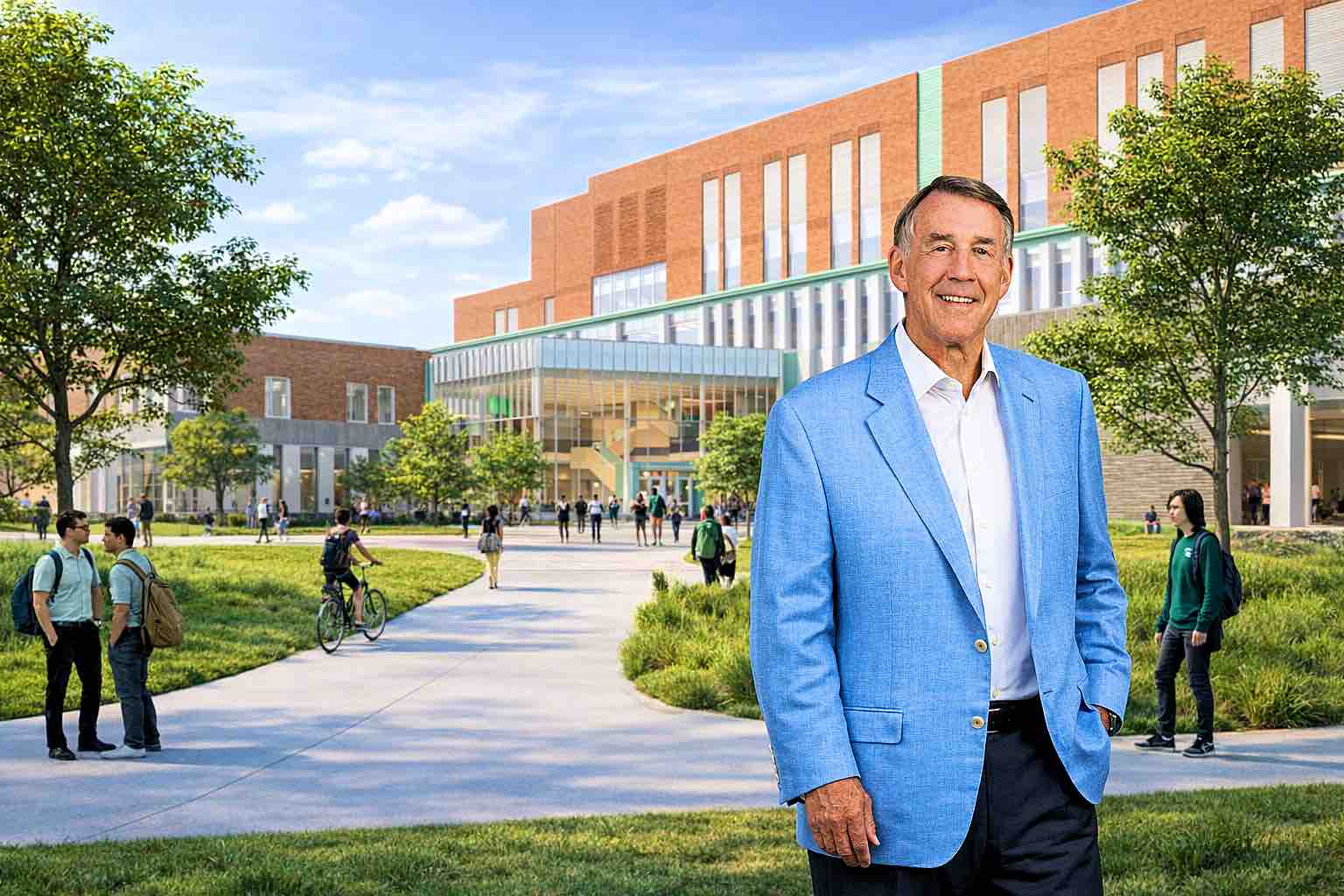
Michigan State University has secured a landmark $50 million commitment from the Michigan‑based Leinweber Foundation to establish the Leinweber Center for Engineering and Digital Innovation, the largest gift ever made toward a campus facility in the university’s history.
The 265,000‑square‑foot center, part of a more than $340 million project on the southwest corner of Red Cedar Road and West Shaw Lane, is slated for substantial completion by December 2028 and is designed to expand MSU’s capacity in fields reshaping Michigan’s economy, from artificial intelligence and data science to semiconductors and esports.
Pending final approval by the Board of Trustees, the new facility will carry the Leinweber name and stand as a visible expression of Larry Leinweber’s belief that education and research can change the trajectory of lives—as they did in his own case as a first‑generation Michigan State graduate who built one of the country’s leading public‑sector software companies.
MSU leaders describe the center as both an academic engine and a workforce hub, designed to bring together six colleges: Engineering, Natural Science, the Broad College of Business, Arts and Letters, Communication Arts and Sciences, and Social Science. Inside, the building will feature active‑learning classrooms, technology‑rich teaching laboratories, student project studios, dedicated digital‑learning spaces and a permanent home for esports, alongside experimental and computational research labs for more than 75 principal investigators. University officials say the expanded footprint will allow MSU to enroll about 1,000 additional engineering students and to scale programs in data science, AI, cybersecurity and advanced computing—areas closely aligned with the needs of Michigan’s automotive, mobility, manufacturing and technology employers. In partnership with the state of Michigan, the center is intended to anchor new pipelines of talent for industries that increasingly depend on software, chips and intelligent systems, while giving students hands‑on access to collaborative, multidisciplinary projects from their first year on campus.
For Larry Leinweber, the MSU gift extends a deep personal story of opportunity. Raised in rural Osceola County, he was the first in his family to graduate from college and went on to found New World Systems, a Troy‑based software firm that provided mission‑critical planning and public‑safety software to city and county governments across the United States.
He led the company as chief executive for roughly three decades before its 2015 acquisition by Tyler Technologies in a deal valued at about $670 million, turning a regional startup into a national platform and giving Leinweber the resources to pursue large‑scale philanthropy in science and education. In public statements, he has linked his philanthropy directly to that trajectory, emphasizing that a Michigan State education and a career in software convinced him that “the power of education” and “the power of research and innovation” can shape both individual lives and the future of his home state.
The Leinweber Foundation, established in 2015 and headquartered in Birmingham, Michigan, has quickly become one of the country’s most consequential funders of theoretical physics and computing. Its mission centers on long‑horizon scientific research, particularly in areas where sustained support for fundamental discovery can be hard to secure through traditional public funding.
According to the foundation and partner institutions, more than $150 million has been invested in scientific research, with a strong emphasis on endowments that support faculty, postdoctoral fellows, graduate students and cross‑institutional collaboration over decades.
In addition, the foundation runs scholarship programs for Michigan students in computer science, computer engineering and related STEM fields, ensuring that high‑ability students from the state have pathways into exactly the disciplines its capital projects are expanding.
One of the earliest and most visible expressions of Leinweber’s philanthropy in higher education came at the University of Michigan, where a $25 million gift in 2021 helped fund construction of the 163,000‑square‑foot Leinweber Computer Science and Information Building on North Campus.
In recognition of that gift, the U‑M Board of Regents voted to name the facility for the Leinweber Foundation, and the building is designed to bring together the Computer Science and Engineering Division of Michigan Engineering and the School of Information under one roof for the first time.
The project addresses a surge in demand: in the past decade, enrollment in both computer science and information programs at U‑M has roughly quadrupled, and the new building adds flexible classrooms, collaboration spaces and advanced labs meant to anchor Michigan’s role as a talent supplier to the global tech sector. It also fits into U‑M’s broader carbon‑neutrality strategy by serving as an early site for geothermal heating and cooling, aligning Leinweber’s gift with the university’s climate goals.
If the Michigan State engineering center and the University of Michigan computing hub represent the applied, workforce‑facing side of Leinweber’s philanthropy, his investments in theoretical physics reveal an equally ambitious bet on basic science.
In 2025, the Leinweber Foundation announced gifts totaling $90 million to establish Leinweber Institutes for Theoretical Physics at four of the nation’s premier research universities—the University of Michigan, the University of California, Berkeley, the University of Chicago and the Massachusetts Institute of Technology—along with a Leinweber Forum for Theoretical and Quantum Physics at the Institute for Advanced Study in Princeton. Described by the Science Philanthropy Alliance as the largest single private commitment ever made specifically to theoretical physics research, the initiative is structured as a network: each institute receives an endowment to support graduate students, postdoctoral researchers, visiting scholars, workshops and joint convenings across the member institutions. At UC Berkeley, for example, $14.4 million from the foundation, combined with $3.6 million in university funds, created an $18 million endowment for the Leinweber Institute for Theoretical Physics, underwriting fellowships, conferences and collaborative programs in areas such as quantum field theory, cosmology and condensed‑matter physics.
Caltech has also emerged as a significant beneficiary of the Leinweber Foundation’s interest in fundamental science. In 2020, the foundation provided a $12 million gift to establish the Leinweber Forum for Theoretical Physics, with Caltech adding $3 million of its own to bring total support there to $15 million. The forum is focused on strengthening Caltech’s already formidable position in foundational physics by supporting faculty, graduate students and postdoctoral scholars, and by creating programming that connects Caltech researchers with peers across the broader Leinweber network.
Taken together with the later $90 million multi‑institutional initiative and subsequent expansions that brought Stanford and other partners into the network, the foundation’s commitments in theoretical physics alone rose to “more than $100 million,” and later press coverage placed the cumulative physics‑related total at “over $130 million” by the mid‑2020s.
Beyond these flagship scientific investments, the foundation has underwritten a range of educational and research activities that complement its core themes. Public materials note sustained support for scholarships that enable Michigan students to study computer science and related STEM fields, often at institutions that are simultaneously benefiting from the foundation’s major capital projects.
At Michigan, that ecosystem now includes both scholarship support and the Leinweber Computer Science and Information Building; at Michigan State, the new center’s digital‑learning spaces, student studios and esports hub will sit atop a base of financial aid that makes such opportunities more broadly accessible.
Even in physics, where the beneficiaries include global elites such as MIT, Stanford, Harvard, Caltech, Chicago, UC Berkeley and the Institute for Advanced Study, the structure of the giving—endowed positions, fellowships and cross‑site convenings—signals an intent to seed long‑term communities of inquiry rather than one‑off projects.
Because the Leinweber Foundation operates with its own endowment and makes multi‑year commitments, IRS filings and grantmaker databases show annual charitable disbursements in the mid‑single‑digit millions, atop the headline‑grabbing capital gifts.
Those routine grants, coupled with the named mega‑gifts to universities and physics institutes, indicate that any “total giving to date” number is a moving target and almost certainly understates Leinweber’s full philanthropic impact if it relies only on announced major gifts.
What can be said with confidence is that, when one combines the clearly quantified pieces—over $130 million for theoretical physics (including Caltech), at least $25 million for the U‑M computer science and information building, and $50 million for the MSU engineering and digital innovation center—Larry Leinweber’s documented commitments already exceed roughly $205 million, with a strong likelihood that his actual lifetime philanthropy is significantly higher once all research, scholarships and non‑public grants are included.
The cumulative picture that emerges is of a donor using a software entrepreneur’s mindset to build a coherent portfolio around human capital and fundamental discovery.
His documented giving clearly runs into the high hundreds of millions of dollars and plausibly approaches or exceeds the low billion‑dollar range when major commitments and networked initiatives are aggregated, even if public sources do not yet offer a precise, official total.
Between the $25 million naming gift for the University of Michigan’s Leinweber Computer Science and Information Building, the $50 million MSU commitment for the Leinweber Center for Engineering and Digital Innovation, the at least $130 million devoted to theoretical‑physics institutes and forums at institutions such as Caltech, MIT, UC Berkeley, the University of Chicago, the University of Michigan and the Institute for Advanced Study, and related scholarship programs and scientific investments, his philanthropy in science and higher education can now be counted in the many hundreds of millions of dollars.
In each case, the through‑line is consistent: he is building durable, named platforms that expand educational access, deepen research capacity and tie Michigan’s future to both its homegrown students and the global scientific enterprise—with the new Michigan State engineering and digital innovation center as the latest, and perhaps most visible, chapter in that story.