
$125 million donation by Aileen K. and Brian L. Roberts and their family redefines the future of children’s health
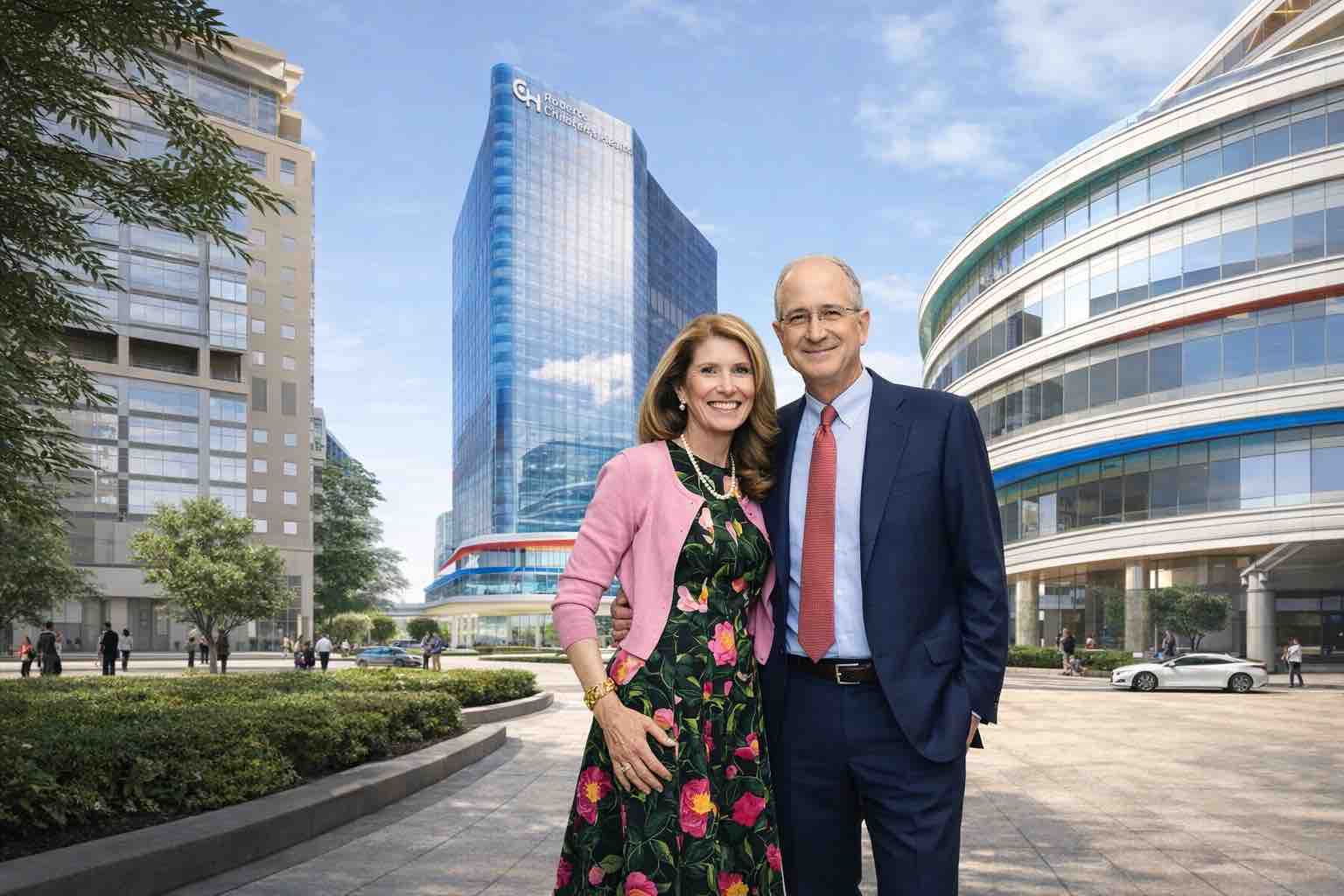
Children’s Hospital of Philadelphia is moving into a new era of pediatric care on the strength of a single family’s long-running commitment to the city’s children.
The latest chapter is the landmark 20‑plus‑story Roberts Children’s Health expansion, where the final beam was raised on Jan. 28 in a topping‑off ceremony that brought together hospital leaders and Philadelphia Mayor Cherelle Parker to mark a structure that will reshape the skyline and, more importantly, the region’s capacity to care for sick children.
When it opens in 2028, the tower is expected to add hundreds of private patient rooms and more than 30 procedure and imaging suites, along with advanced diagnostic and treatment areas designed to speed and streamline care for children with complex conditions.
At the heart of this expansion is a $125 million philanthropic gift from Aileen K. and Brian L. Roberts and their family, the largest single donation in CHOP’s 170‑year history and a defining act of generosity even by the standards of a city long steeped in institutional philanthropy.
The gift will help fund construction of the new inpatient tower and the revitalization of CHOP’s existing hospital, underwriting a continuum of care that stretches from cutting‑edge procedures to the day‑to‑day comforts that sustain families through months‑long treatment journeys.
For CHOP President and CEO Madeline Bell, Roberts Children’s Health is framed as a “hospital of the future,” where the institution’s strengths in research, clinical care, and family‑centered support are deliberately woven together. In public statements, she has described the project as an opportunity to enhance the hospital experience for patients and families while expanding capacity to meet growing demand for pediatric specialty care across the region and beyond. The tower’s design reflects that ambition: fully private rooms, integrated procedure and imaging platforms for specialties such as cardiology and neurology, automated medication delivery, and amenities ranging from fitness areas to meditation and entertainment spaces for families who may find themselves living at the hospital for weeks or months at a time.
For the Roberts family, the new tower is not a first foray into pediatric health but an escalation of a philanthropic narrative that spans decades and multiple institutions.
Brian Roberts, chair and CEO of Comcast and a central figure in Philadelphia’s corporate landscape, has long treated philanthropy as an extension of civic stewardship, an approach that has carried through from his parents, Comcast founder Ralph Roberts and noted philanthropist Suzanne Roberts.
The family has given “hundreds of millions of dollars” to anchor major projects in the city, championing causes in health care, education, the arts, and technology and using high‑profile naming gifts to signal both commitment and accountability.
Within CHOP, their imprint is now unmistakable. In 2016, Aileen and Brian Roberts committed $25 million to launch the Roberts Center for Pediatric Research, a striking glass tower on the Schuylkill riverfront that houses one of the country’s largest pediatric research enterprises.
That gift also seeded the Roberts Collaborative for Genetics and Individualized Medicine, a multidisciplinary initiative that brings together diagnostics, clinical management, consulting, therapeutics, and research to harness genetics in tailoring treatment to individual children.
Madeline Bell has credited those earlier donations with helping propel CHOP to the forefront of pediatric genetics research, a position the new inpatient tower is intended to translate into concrete gains at the bedside more rapidly.
The $125 million commitment to Roberts Children’s Health is explicitly cast by the family as a continuation of this work rather than an isolated act. In a statement, Aileen and Brian Roberts have said that their lives have been “touched” by CHOP in “countless ways” and that their goal with this latest gift is not only to realize Bell’s vision for the future of pediatrics but also to inspire other donors to support the “life‑changing work” happening “right here in our backyard.” Brian Roberts, in comments to The Daily Pennsylvanian, underscored the global reach of CHOP’s mission, describing the hospital as a destination for medical talent, a center of breakthrough innovation, and a “beacon of hope for generations to come.”
The family’s giving has expanded beyond CHOP to a broader philanthropic portfolio that reinforces Philadelphia’s position as a medical and cultural hub. They have helped advance cancer treatment by supporting the Roberts Proton Therapy Center at Penn Medicine, which has become a flagship facility in radiation oncology and a model for academic‑industry collaboration in high‑cost clinical infrastructure.
Their backing was also instrumental in the relocation and expansion of the Barnes Foundation, the museum that houses one of the world’s most significant collections of impressionist and modern art, underscoring the family’s belief that cultural institutions and health systems jointly underpin a city’s quality of life.
In education and technology, the Roberts name has appeared on initiatives to narrow digital divides and support public school students. During the early months of the COVID‑19 pandemic, the family helped provide laptops and connectivity to Philadelphia students, aligning Comcast’s technological capabilities with philanthropic dollars to address an urgent access gap as classes moved online.
For observers of contemporary philanthropy, that episode reinforced a pattern: the Roberts family tends to focus not only on buildings but also on the systems—technological, clinical, and educational—that determine whether those buildings can deliver on their promise.
The family’s philanthropic reach extends beyond a single branch of the Roberts tree.
In February 2025, Brian Roberts’ sister, Catherine Clifton, and her husband made a $120 million gift to Penn Medicine, leading to the naming of the Clifton Center for Medical Breakthroughs, a $1.6 billion patient tower in University City. Taken together, the Roberts and Clifton gifts are reshaping the city’s medical landscape on both the pediatric and adult sides, reinforcing an ecosystem in which children and their parents may receive cutting‑edge care within a few blocks of each other.
At CHOP, the scale of Roberts Children’s Health reflects demand as much as aspiration. Founded in 1855 as the nation’s first pediatric hospital, CHOP now records tens of thousands of inpatient admissions and more than 1.6 million outpatient visits each year, its network stretching across Pennsylvania, New Jersey, and into a growing regional footprint of specialty and primary care centers.
The hospital serves as a major teaching site for the Perelman School of Medicine at the University of Pennsylvania and runs one of the largest pediatric research programs in the country, with discoveries that affect children far beyond the city limits. Hospital leaders say that without significant expansion, CHOP would increasingly struggle to meet rising demand for advanced pediatric care—especially for complex, rare, and chronic conditions that require high‑acuity beds and multidisciplinary teams.
The Roberts gift is therefore both symbolic and intensely practical. It allows CHOP to move forward on a roughly $2 billion tower project while signaling confidence to bond markets and other donors that one of the city’s most influential families is prepared to stand behind the hospital’s long‑term strategy.
The new building’s emphasis on private rooms, integrated treatment floors, and family‑centered amenities reflects lessons learned from recent years, when infection control, privacy, and caregiver well‑being became central concerns in hospital design.
For families who will one day walk through the doors of Roberts Children’s Health, the philanthropy behind the building may remain largely invisible, overshadowed by the immediate urgency of a child’s illness.
Yet the Roberts family has consistently positioned their giving as an investment in precisely those families’ futures. Their donations have underwritten the labs where new therapies are discovered, the proton beams that treat otherwise untreatable tumors, the research collaboratives that decode genetic mysteries, and now the inpatient rooms where those advances are translated into care.
In that sense, the final beam raised above Civic Center Boulevard is more than a construction milestone. It is the physical manifestation of a philanthropic philosophy that binds personal experience to public responsibility, with a single family using its wealth and influence to push a leading children’s hospital toward a more expansive—and more inclusive—vision of what pediatric medicine can be.